Clear Sky Science · en
Bilevel multiobjective control enhances arterial performance via spatiotemporal optimization of presignalized intersections
Why city drivers should care
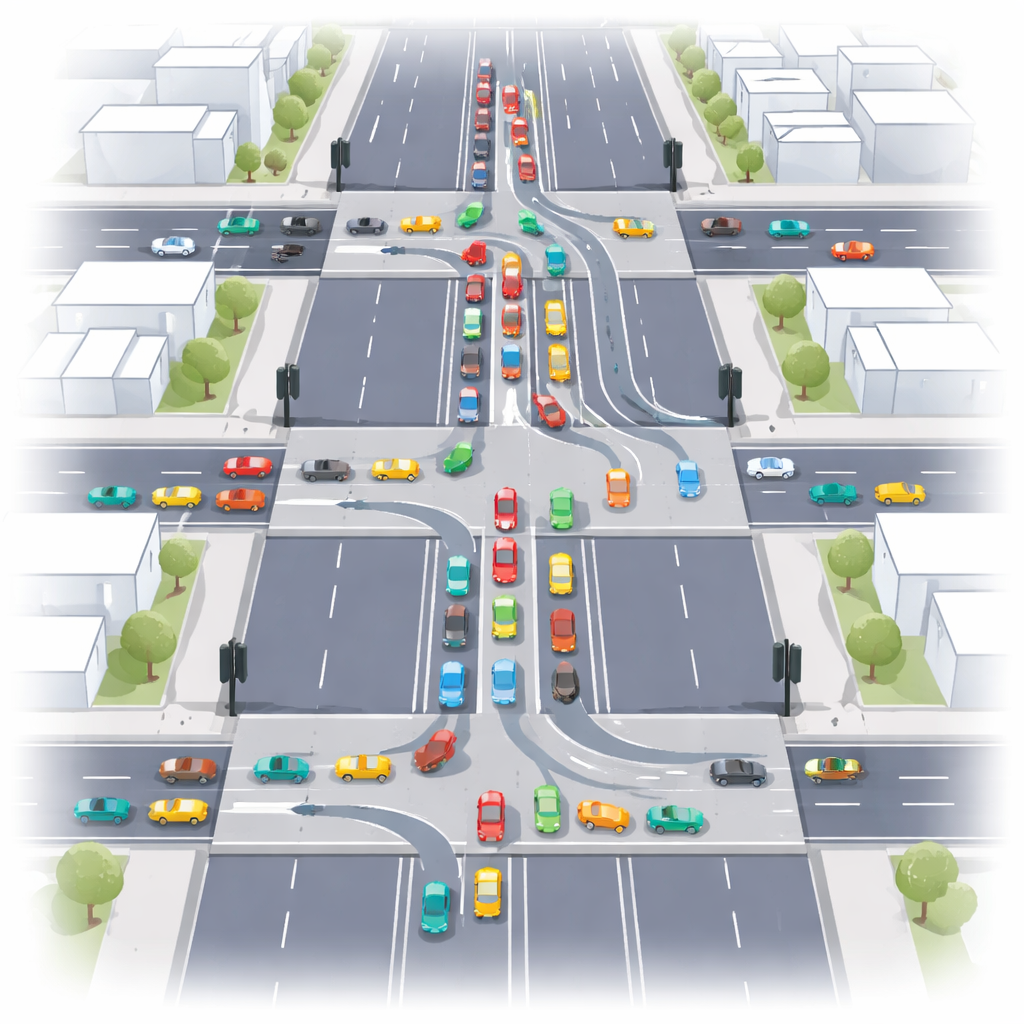
Anyone who has crawled through a city at rush hour knows that intersections often feel like bottlenecks where time and fuel are wasted. This study explores a way to squeeze more performance out of the streets we already have, without building new roads. By adding an extra set of traffic lights upstream of busy junctions and coordinating them in a smarter, layered way, the authors show that cities can move more cars with shorter delays and fewer gridlocked queues, helping traffic flow more smoothly and cleanly along major corridors.
A new twist on traffic lights
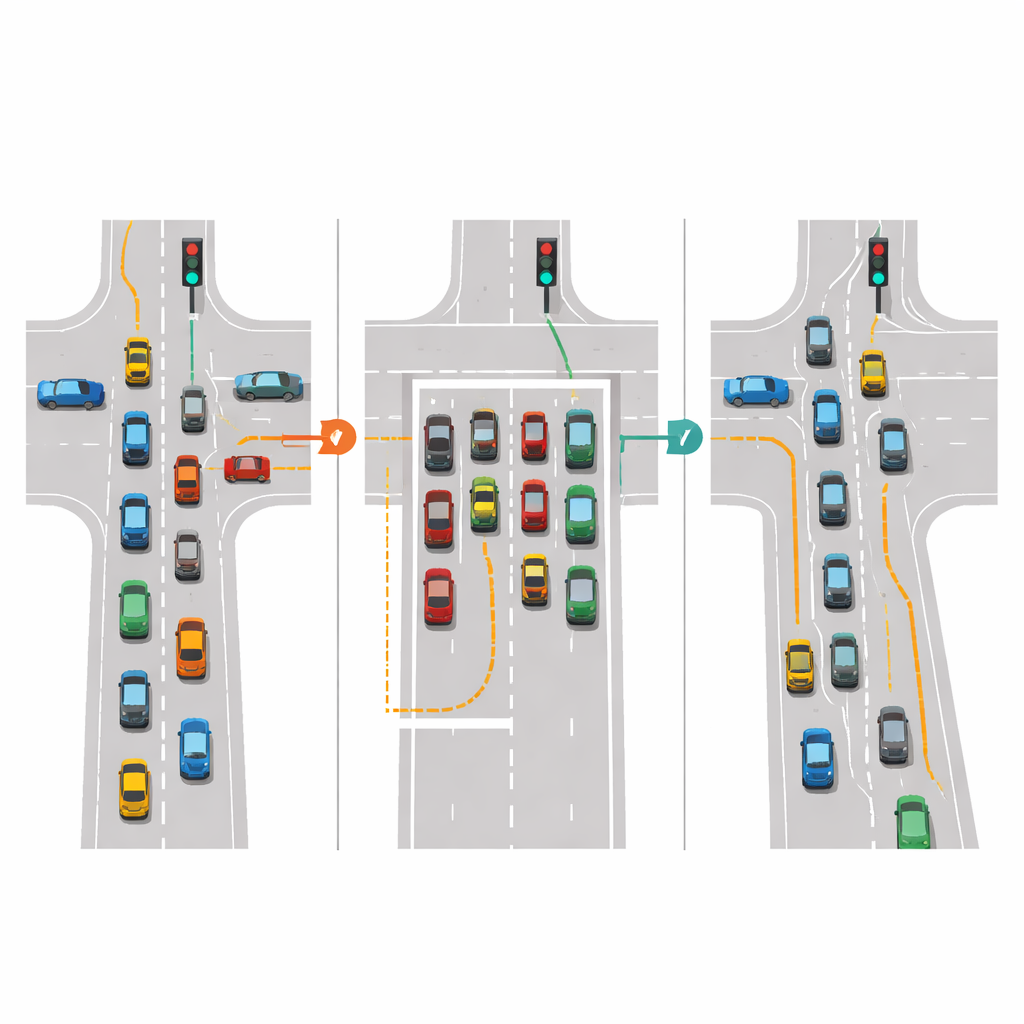
The work centers on a “pre-signal” system. Instead of every lane at an intersection serving just one fixed purpose (such as left turn only), a short stretch of road before the main stop line is turned into a flexible waiting area. A small upstream light meters vehicles into this space in waves: first left-turners, then through traffic, and so on. The main light at the intersection then releases each group at high, steady rates. This approach recycles the same bit of pavement for different movements within one cycle, significantly boosting how many vehicles can get through without expanding the roadway.
When smart ideas collide with real corridors
Most earlier research treated pre-signals one junction at a time. On a single intersection, the method can raise capacity by 15–50 percent under heavy demand. But along an arterial corridor with several intersections in a row, that extra capacity can backfire. The waiting area between the pre-signal and main light creates what the authors call “secondary queuing”: cars stack up in that pocket in ways that break the smooth, wave-like groups of vehicles that traditional “green wave” coordination relies on. If flows are not carefully matched, queues spill backward, block upstream lights, and waste green time that should have moved traffic forward.
A two-layer brain for busy streets
To tackle this, the authors design a bi-level control scheme, essentially giving the corridor a two-layer brain. The lower layer focuses on each pre-signalized intersection individually. It decides how long each light should stay green, how the phases are ordered, and how the upstream and main signals line up in time so that the waiting area fills and empties safely without overflowing. The upper layer looks across several intersections on the arterial and adjusts the shared cycle length and offsets between them to create a workable green wave that respects what is happening inside every waiting area. Together, these layers coordinate both the microscopic queues and the macroscopic progression of traffic.
Letting the computer search for balance
Because real traffic is messy and the new system juggles competing goals, the team treats the problem as a multi-objective search rather than aiming for a single “best” setting. They want to move as many vehicles as possible, keep average delays low, and keep queues short enough to avoid spillback. Instead of simple formulas, they connect an evolutionary search algorithm to a detailed traffic simulator. Thousands of trial timing plans are generated, tested in the simulator, repaired if they violate safety or storage limits, and then improved over many generations. The outcome is a set of compromise plans that trace a Pareto front, showing how gains in one objective trade off against others.
What the simulations reveal
Using a three-intersection test corridor, the authors compare traditional, uncoordinated control, single-goal tuning, and their full multi-goal, bi-level method. With the new approach, overall throughput along the arterial rises by roughly 11–14 percent compared with single-goal strategies and by 18–39 percent compared with uncoordinated control. At the same time, average delay drops by about 5–7 percent relative to single-goal tuning and 7–14 percent relative to uncoordinated control, and the longest queues on the main direction shrink by 6–15 percent. These improvements come with a conscious trade-off: some left-turn drivers wait longer so that through traffic, which carries most vehicles, can flow more freely without triggering backlogs that paralyze entire blocks.
What this means for everyday travel
In plain terms, the study shows that with a carefully coordinated two-layer control scheme, an extra set of upstream lights can turn problem intersections into pressure valves rather than choke points. Instead of trying to build more lanes, cities can use time and space more cleverly, pushing more vehicles through major routes while keeping queues from spilling back and causing gridlock. Because fewer cars sit idling and fewer stop-and-go waves are created, such control also supports cleaner air and lower fuel use. For commuters, the payoff would be modestly shorter and more predictable trips; for city planners, it offers a practical recipe for making existing arterial roads work harder and more sustainably.
Citation: Pan, J., Yang, Q. & Li, P. Bilevel multiobjective control enhances arterial performance via spatiotemporal optimization of presignalized intersections. Sci Rep 16, 9784 (2026). https://doi.org/10.1038/s41598-026-39344-3
Keywords: urban traffic signals, pre-signal intersections, arterial coordination, traffic congestion, multiobjective optimization