Clear Sky Science · en
Instability mechanism of deeply buried coal seam floor under mining effects and optimization of extraction roadway layout
Why safer mine tunnels matter
Deep underground coal mines do far more than produce fuel; they also create complex patterns of pressure in the surrounding rock. If those pressures become unbalanced, the floor can crack, water can rush in, gas can escape, and the tunnels that miners depend on may deform or collapse. This study looks at how the rock beneath a very deep coal seam responds when coal is removed, and how mine designers can place gas‑drainage tunnels in positions that keep both people and infrastructure safer.
How mining squeezes the rock
When a long stretch of coal is mined out, a hollow space called a goaf is left behind and the roof above eventually caves. The weight of the overlying rock does not disappear; it is redistributed onto the remaining coal pillars and down into the floor. Using a simplified physical model that treats the floor as a continuous half‑space of rock, the authors calculated how vertical, horizontal, and shear stresses spread beneath the mined area. They found that vertical stress is highest just below the coal pillars and drops off with depth, weakening sharply in the first five meters and then more slowly. Deep in the floor, the stress settles back toward the natural level that existed before mining began. 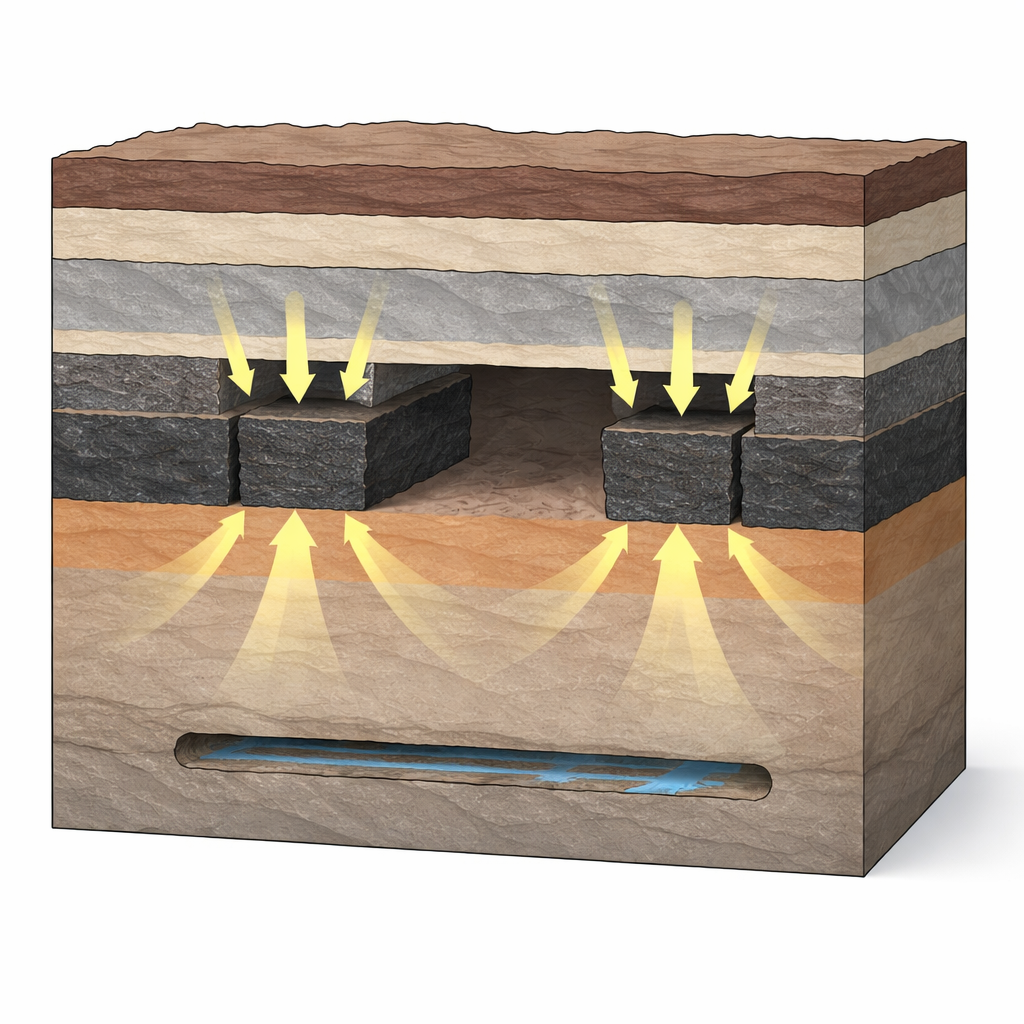
A distinctive underground stress pattern
For a real mine in Shanxi, China, the team plugged local rock properties and depth—about 730 meters underground—into their equations and then used numerical simulations to cross‑check the results. Both approaches showed that vertical stress under the mined‑out zone forms a characteristic “M‑shaped” pattern when viewed across the floor: two high peaks under the coal pillars and a lower trough beneath the center of the goaf. As you move deeper into the floor, these peaks shrink and the overall stress field becomes more uniform. The calculations also indicated that the fastest drop in extra stress occurs around 10 meters below the floor. Beyond that depth, mining‑related disturbances fade and the rock behaves more like undisturbed ground.
Choosing the best depth and position
Because gas‑drainage tunnels must sit in the floor below the coal seam, their location relative to this shifting stress field is crucial. Using an established rock‑failure formula, the authors estimated that mining could damage the floor to about 16.5 meters deep. To stay below this fractured zone but still close enough for effective gas drainage, they selected a tunnel depth of 17 meters beneath the coal seam. Next, they tested four different horizontal positions in computer models: directly under the center of the mined area, slightly inside the coal pillar, exactly beneath the pillar edge, and 30 meters outside the pillar. For each case, they examined peak vertical and horizontal stresses and the size and shape of the plastic (permanently damaged) rock zones around the tunnel. 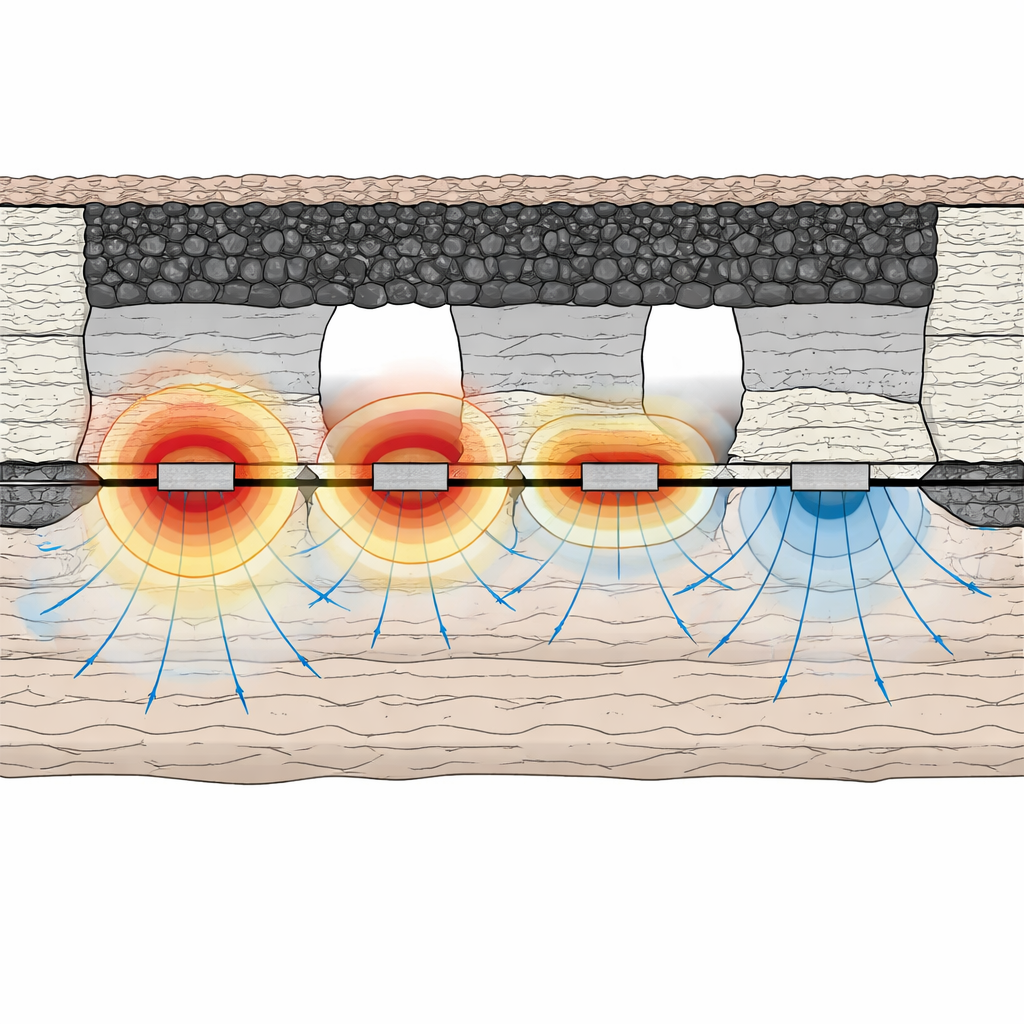
Finding the quietest spot underground
The simulations revealed that each tunnel position experiences a very different stress environment. A tunnel placed directly beneath the working face encounters high vertical and horizontal loads and a large butterfly‑shaped damage zone in the surrounding rock. Shifting the tunnel inward under the coal pillar reduces vertical stress but can still leave substantial damage above and below. Placing the tunnel right at the pillar edge creates uneven stresses from side to side, which risks asymmetric deformation. By contrast, the tunnel offset 30 meters outside the coal pillar sits in a relatively calm zone: both vertical and horizontal peak stresses are lower, and the damaged rock shell is only about 2 meters thick, the smallest of all the options.
Real‑world checks in a working mine
To test whether the design works in practice, the researchers monitored a gas‑drainage roadway built 17 meters below the floor and offset 30 meters from the coal pillar in the Shanxi mine. Using ultrasonic probes and down‑hole cameras, they measured how far fractures extended into the surrounding rock and tracked how the tunnel walls, roof, and floor moved over time. The fractured zone reached a maximum of about 1.9 meters—very close to the 2‑meter depth predicted by the simulations—and the tunnel’s deformations slowed and stabilized after several weeks, remaining within acceptable limits. This close match between theory, computer models, and field data gives confidence that the proposed layout offers a robust way to keep deep extraction roadways stable while still meeting gas‑drainage needs.
What this means for future mining
In everyday terms, the study shows that where you put a tunnel under a coal seam can make the difference between a slowly settling passageway and a heavily damaged one. By understanding how mining reshapes the hidden “pressure landscape” in the floor, engineers can deliberately place roadways just beyond the zones of strongest squeezing and cracking. For deep, high‑stress coal seams similar to those in Shanxi, setting extraction tunnels about 17 meters below the floor and roughly 30 meters away from the coal pillars appears to offer a safer, more economical compromise between gas control and structural stability.
Citation: Chen, X., Ma, R., Zhou, Y. et al. Instability mechanism of deeply buried coal seam floor under mining effects and optimization of extraction roadway layout. Sci Rep 16, 8558 (2026). https://doi.org/10.1038/s41598-026-39341-6
Keywords: deep coal mining, rock floor stability, gas drainage roadway, stress redistribution, mine safety