Clear Sky Science · en
Low noise sensorless control of a YASA AFFSPM motor using ADRC and improved PLL
Quieter, Smarter Electric Motors
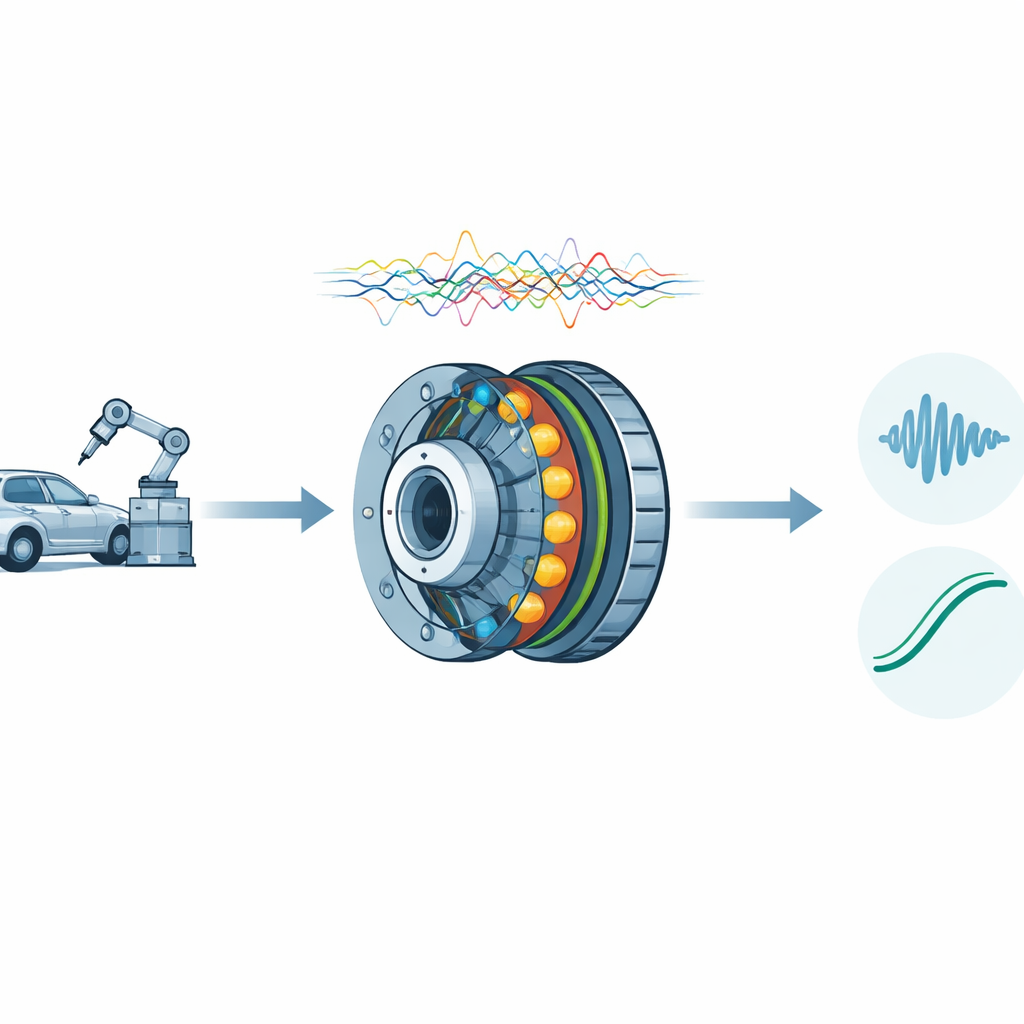
From electric cars to household appliances, many modern machines rely on compact, powerful electric motors. But the electronics that make these motors precise can also make them whine, buzz, and hum—especially at low speed, right where people notice it most. This paper explores a way to run a special high-torque motor without any mechanical sensors while cutting that irritating noise and keeping the drive fast, smooth, and reliable.
Why Getting Rid of Sensors Matters
Many advanced motors use devices such as encoders or resolvers to tell the controller exactly where the rotor is. These sensors add cost, wiring, and potential failure points, especially in hot, dusty, or cramped environments like under the hood of an electric vehicle. A growing alternative is “sensorless” control, in which the electronics estimate rotor position from electrical signals alone. For the high-torque YASA axial-flux motor studied here, conventional sensorless methods work well at higher speeds but struggle at low or zero speed, and they often create extra losses, torque ripple, and audible noise when they inject high-frequency test signals into the windings.
Spreading the Noise Instead of Shouting
The first innovation described in the paper tackles the noise problem at its source. Traditional sensorless schemes inject a high-frequency signal at one fixed tone, which can excite mechanical resonances in the motor and its housing—much like whistling at just the right pitch to make a glass ring. The authors instead inject a pseudo-random high-frequency signal whose frequency hops within a narrow band and whose amplitude is adjusted in sync. This “smears” the energy over a wider range of tones so there is no single loud whistle. Importantly, the signal is still strong and structured enough that the controller can read out the rotor’s magnetic fingerprint, and carefully chosen amplitude–frequency ratios keep the useful position information at a nearly constant level even as the frequency changes.
Listening More Carefully to the Motor’s Response
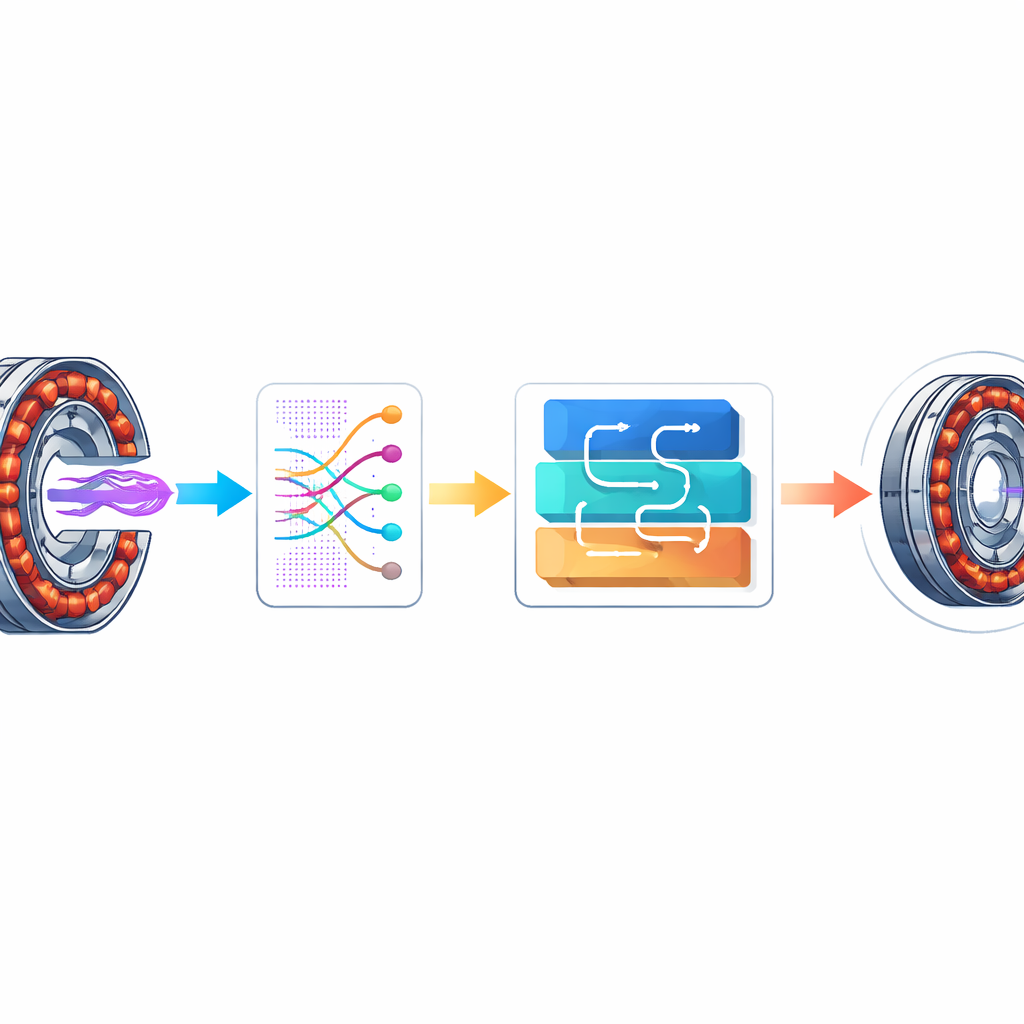
To turn these noisy electrical ripples into a clean estimate of rotor angle, the controller has to decode very small changes in motor currents. The paper replaces a standard phase-locked loop—a common way to track phase—with an “improved” version. First, it normalizes the incoming current signals so that their overall strength does not matter, only their phase. Then it uses a higher-order loop structure that behaves a bit like two cooperative trackers instead of one. This design keeps following the true rotor position accurately even when the signal’s amplitude wobbles or when the motor is speeding up, slowing down, or reversing. In tests, the estimated position stayed within about plus or minus two to three electrical degrees over a range of speeds and sudden changes in load.
Fighting Disturbances Before They Show Up
The second major upgrade is to the way the drive controls current, which directly sets motor torque. Most industrial drives rely on a tried-and-true proportional–integral (PI) controller that can work very well but must be carefully tuned for a specific operating point and does not naturally adapt when the motor warms up, the load changes, or the supply fluctuates. Here, the authors implement Active Disturbance Rejection Control in the main torque-producing current channel. This approach treats all unknown effects—such as parameter drift and sudden load changes—as a single “total disturbance” and uses a built-in observer to estimate it in real time. The controller then cancels that disturbance almost as it appears, keeping the current (and hence torque) close to its target with simple tuning and strong robustness.
Putting the System to the Test
All three ideas—pseudo-random injection, the improved phase-locked loop, and the disturbance-rejecting current controller—were combined and tested on a real 750-watt YASA motor rig. Compared with a well-tuned conventional setup using fixed-frequency injection, PI current control, and a standard phase-locked loop, the new method showed smaller speed dips and quicker recovery when the load was suddenly doubled, more accurate tracking during rapid speed reversals, and tighter position estimates overall. Power spectrum measurements of the motor’s high-frequency signals revealed that the sharp noise peaks of the traditional approach were replaced by a much flatter spectrum, consistent with a clear reduction in tonal acoustic noise.
What This Means for Everyday Machines
For a non-specialist, the takeaway is that this work shows how to make a particular class of high-torque electric motors both quieter and more robust by improving how their electronics “feel” the rotor’s position and react to disturbances. Rather than relying on extra hardware sensors or accepting a trade-off between silence and responsiveness, the proposed strategy uses smarter signal design and control algorithms to get both. The result is a promising path toward smoother, low-noise, sensorless drives for electric vehicles, precision robots, and other applications where comfort, reliability, and efficiency all matter.
Citation: Rahmani-Fard, J., Mohammed, M.J. Low noise sensorless control of a YASA AFFSPM motor using ADRC and improved PLL. Sci Rep 16, 8236 (2026). https://doi.org/10.1038/s41598-026-39335-4
Keywords: sensorless motor control, electric vehicle drives, axial flux permanent magnet motor, acoustic noise reduction, advanced motor control algorithms