Clear Sky Science · en
Performance optimization of ultra-lightweight foamed concrete using dimethicone-infused organosilicon compound
Building with Lighter, Smarter Walls
Modern buildings need walls that are not only strong, but also light, fire-safe, and good at keeping heat indoors. Ultra-lightweight foamed concrete already offers low weight and excellent insulation, yet it is often too weak and absorbs too much water for demanding use. This study explores how a common silicone-based ingredient called dimethicone can tune the tiny air bubbles inside foamed concrete so that it becomes both lighter and stronger, while also better at resisting water and harsh weather.
Why Bubbly Concrete Matters
Foamed concrete is made by mixing cement, sand, water, and a foam full of air bubbles. The bubbles make the material much lighter, which is attractive for tall buildings and energy-efficient walls. However, when the bubbles are large and uneven, the concrete loses strength and becomes full of pathways that let water and salts leak in. Engineers would like a version that keeps the benefits of air-filled concrete—low weight, good insulation, fire resistance—without turning the material into a fragile sponge.
A Silicone Twist to the Recipe
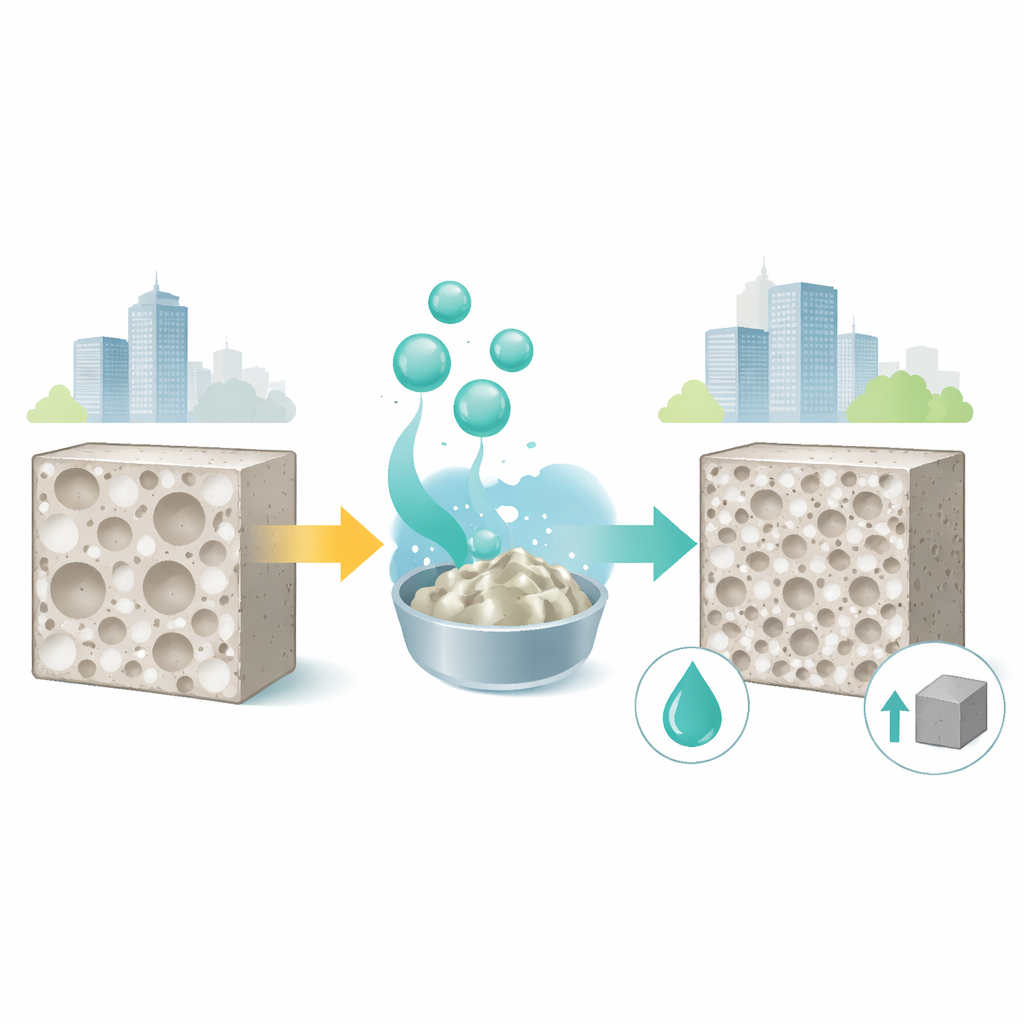
The researchers tested adding small amounts of dimethicone, a silicone compound widely used in everyday products, to ultra-lightweight foamed concrete. They prepared several mixes with the same target density but different dimethicone contents, from 0.5% to 2.5% of the cement weight. By carefully dispersing dimethicone in water and then blending it into a foam-rich cement mix, they aimed to change how bubbles form and stay in place, and to see how this affected flow, setting time, water movement, strength, and heat transfer.
What Happens Inside the Tiny Pores
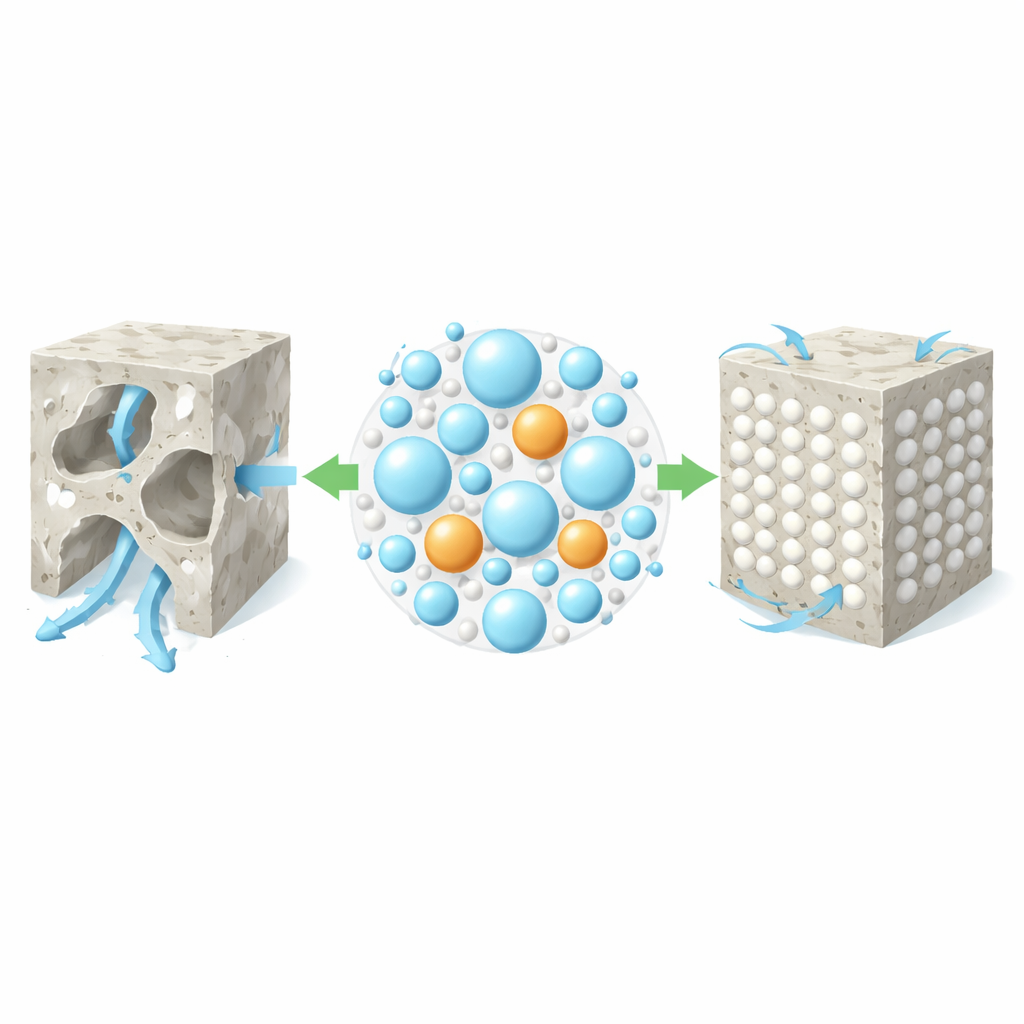
Detailed tests showed that dimethicone acts as a foam stabilizer and water repellent at the same time. It lowers the surface tension of the water in the mix, helping bubbles form more easily and stay separate instead of merging into big cavities. Microscopic images and pore measurements revealed that with dimethicone, the concrete contained far more small, well-shaped pores and far fewer large, connected voids. This refined internal structure reduced how quickly water could soak in or air could flow through, and cut the passage of damaging chloride salts by up to about one third compared with the untreated concrete.
Stronger, Drier, Yet Still Lightweight
These micro-level changes led to surprisingly large gains in performance. At the best dosage, around 2% dimethicone, the ultra-lightweight concrete more than doubled its stiffness and compressive strength and more than tripled its resistance to cracking under tension, all while remaining extremely light, with a dry density near 450 kilograms per cubic meter. The material shrank less as it dried, absorbed significantly less water, and showed lower overall connected porosity. Thermal behavior changed too: because the pore network became tighter and the solid matrix denser, thermal conductivity and thermal diffusivity rose modestly, but still stayed within the range suitable for insulation-grade materials.
Finding the Sweet Spot
By comparing all mixtures, the study found that about 2% dimethicone offered the best balance: it preserved the ultra-light character of the concrete while delivering much higher strength and durability and greatly improving resistance to moisture and salt penetration. Higher doses brought only small extra benefits and began to reduce workability. In practical terms, this means that a relatively simple silicone-based additive can turn fragile foamed concrete into a more robust, water-shedding, and still well-insulating building material, making it more viable for energy-efficient, long-lasting walls and other lightweight structural elements.
Citation: Othuman, M.A.O., Tobbala, D.E., Omar, R. et al. Performance optimization of ultra-lightweight foamed concrete using dimethicone-infused organosilicon compound. Sci Rep 16, 8108 (2026). https://doi.org/10.1038/s41598-026-39334-5
Keywords: foamed concrete, lightweight building materials, silicone additives, pore structure, thermal insulation