Clear Sky Science · en
Metabolomics reveal taste quality differences of black teas and the impact of withering on quality formation
Why your black tea tastes different
Anyone who enjoys black tea knows that not all cups taste the same: some are brisk and biting, others soft and sweet, still others rich and savory. This study asks a deceptively simple question behind those everyday experiences: how do the type of tea plant and the early steps of tea processing work together to create the bitterness, astringency, sourness, sweetness, and umami that we sense in the cup? By tracking hundreds of tiny molecules in tea leaves as they wither, the researchers uncover how subtle shifts in chemistry translate into noticeable differences in taste.
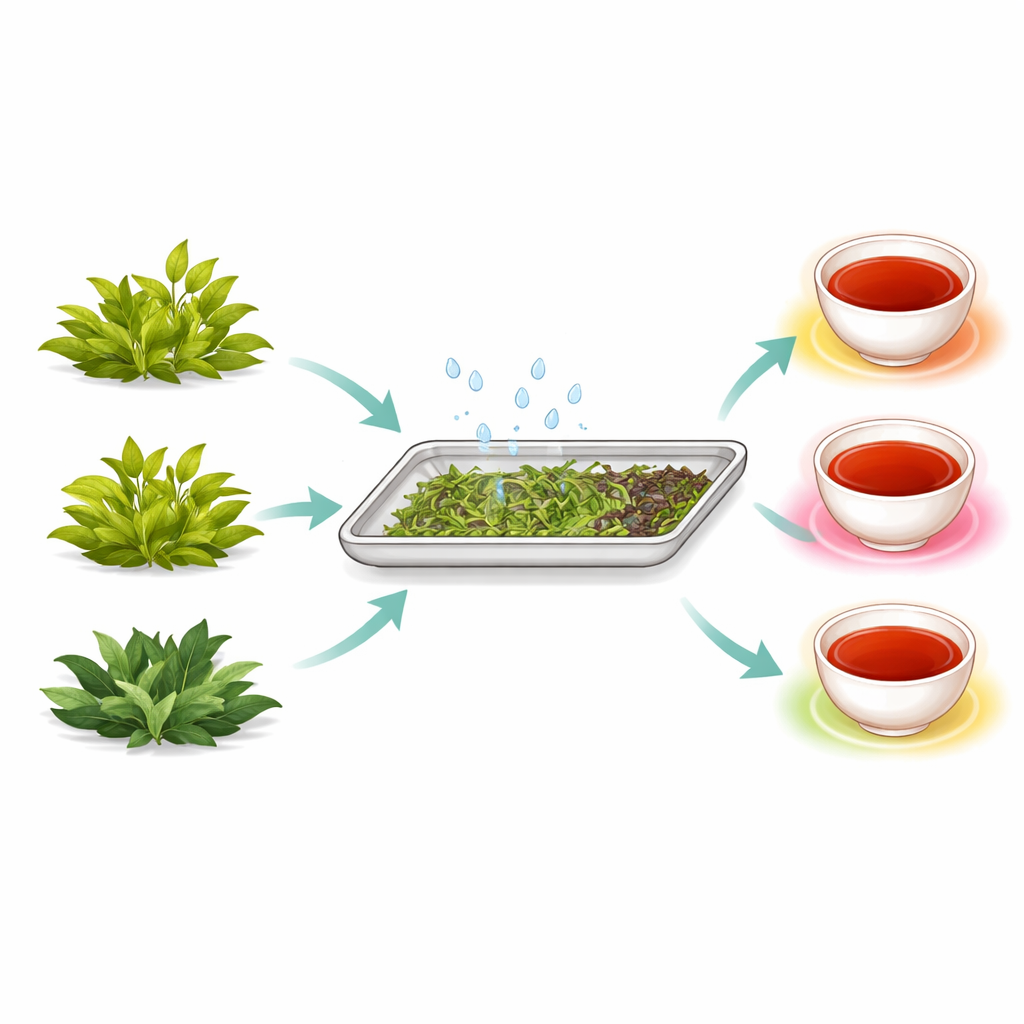
Three teas, three taste personalities
The team focused on Congou black tea, a traditional style from China’s Chongqing region, and compared teas made from three local cultivars. Trained tasters and an electronic “tongue” assessed the drinks for key taste qualities. One tea, SY-T, came across as the strongest and most intense, with clear bitterness and a drying astringency. FD-T was smoother, with a refreshing balance and relatively higher sweetness and umami, while SM-T was mellow and gentle, with softer overall impressions. These sensory tests confirmed that even when processed in the same way, different tea varieties produce distinctly different taste profiles.
What is hiding in the cup
To understand why these differences arise, the researchers measured familiar tea components such as polyphenols, amino acids, sugars, caffeine, and catechins. As expected, higher levels of polyphenols and caffeine tracked with stronger bitterness and astringency, while amino acids and sugars lined up with sweetness and savory notes. But the team went much further, using a high-powered analytical technique to catalog 564 non-volatile metabolites – a broad class of small molecules that do not readily evaporate and therefore contribute mainly to taste rather than aroma. Most of these compounds were shared across the three teas, but their amounts varied, especially for flavonoids (a large family of plant pigments and antioxidants), sugars and sugar alcohols, organic acids, and alkaloids.
Taste mapped to tiny molecules
By combining statistics with taste data, the scientists identified which of these molecules matter most for what we feel on the tongue. They found that the main differences between teas lay not in sweetness, but in bitterness, astringency, sourness, and umami. Certain flavonoids and related compounds were strongly linked to the biting and drying sensations, while specific sugars, sugar alcohols, and acids tracked with sourness or savory notes. From this complex network, the authors singled out 24 characteristic molecules whose patterns most clearly separated the three teas. For example, some flavonoids were abundant in the sharper SY-T, while other sugar-related molecules were more common in the smoother FD-T. Together, this molecular fingerprint helps explain why each tea has its own taste personality.
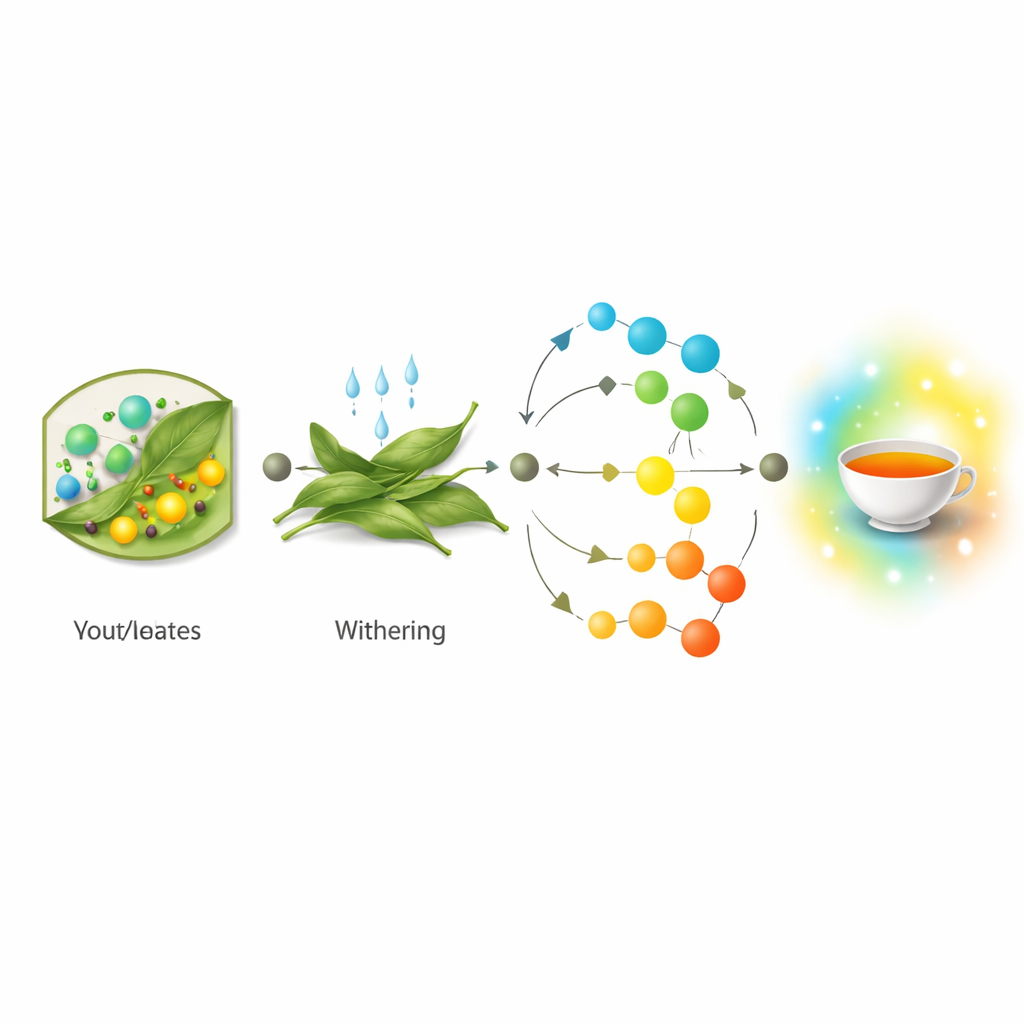
What happens while the leaves are wilting
All three teas went through the same sequence of processing: withering (a controlled wilting step), rolling, oxidation, and drying. The researchers zoomed in on withering, the first stage, because it sets the stage for later transformations. As the leaves slowly lost moisture over 16 hours, the team sampled them at several time points and tracked how metabolite levels rose or fell. Across all varieties, early and mid withering were dominated by shifts in amino-acid-related pathways, which influence savory and sweet sensations. Later in withering, the picture diverged by variety. Some teas showed more activity in flavonoid pathways, others in carbohydrate or fatty acid metabolism, and still others in stress- and defense-related compounds. These differences in how each plant variety “responds” to the stress of drying appear to drive the distinct mixes of taste molecules that end up in the finished tea.
How chemistry becomes flavor
When the researchers overlaid the 24 key molecules onto the changing metabolic pathways during withering, two main routes stood out: those involving flavonoids and those involving carbohydrates. Under withering, the plant seems to channel building blocks toward certain flavonoids associated with stronger bitterness and astringency, while competing compounds decline. At the same time, some sugars increase at the expense of sugar-phosphate forms, subtly reshaping sweetness and umami. In plain terms, the way a particular tea plant reallocates its internal chemistry while it wilts on the racks helps determine whether the eventual brew is bold and biting, soft and sweet, or somewhere in between. This work offers tea growers and processors a roadmap for tailoring withering conditions and cultivar choice to produce specific taste experiences in the cup.
Citation: Yang, J., Chen, S., Wang, J. et al. Metabolomics reveal taste quality differences of black teas and the impact of withering on quality formation. Sci Rep 16, 8105 (2026). https://doi.org/10.1038/s41598-026-39332-7
Keywords: black tea taste, tea processing, metabolomics, withering stage, flavonoids