Clear Sky Science · en
Hybrid intelligent optimization of a circularly polarized microstrip antenna array for safe and effective hyperthermia cancer therapy
Warming Tumors While Sparing Healthy Tissue
Cancer doctors have long known that gently warming a tumor can make radiation and chemotherapy work better, but the challenge is heating only the cancer and not the healthy tissue around it. This study presents a smart antenna system designed to focus microwave energy deep inside the body, raising a tumor’s temperature into the therapeutic range while keeping the skin and nearby organs as cool and safe as possible.
Why Gentle Heat Helps Fight Cancer
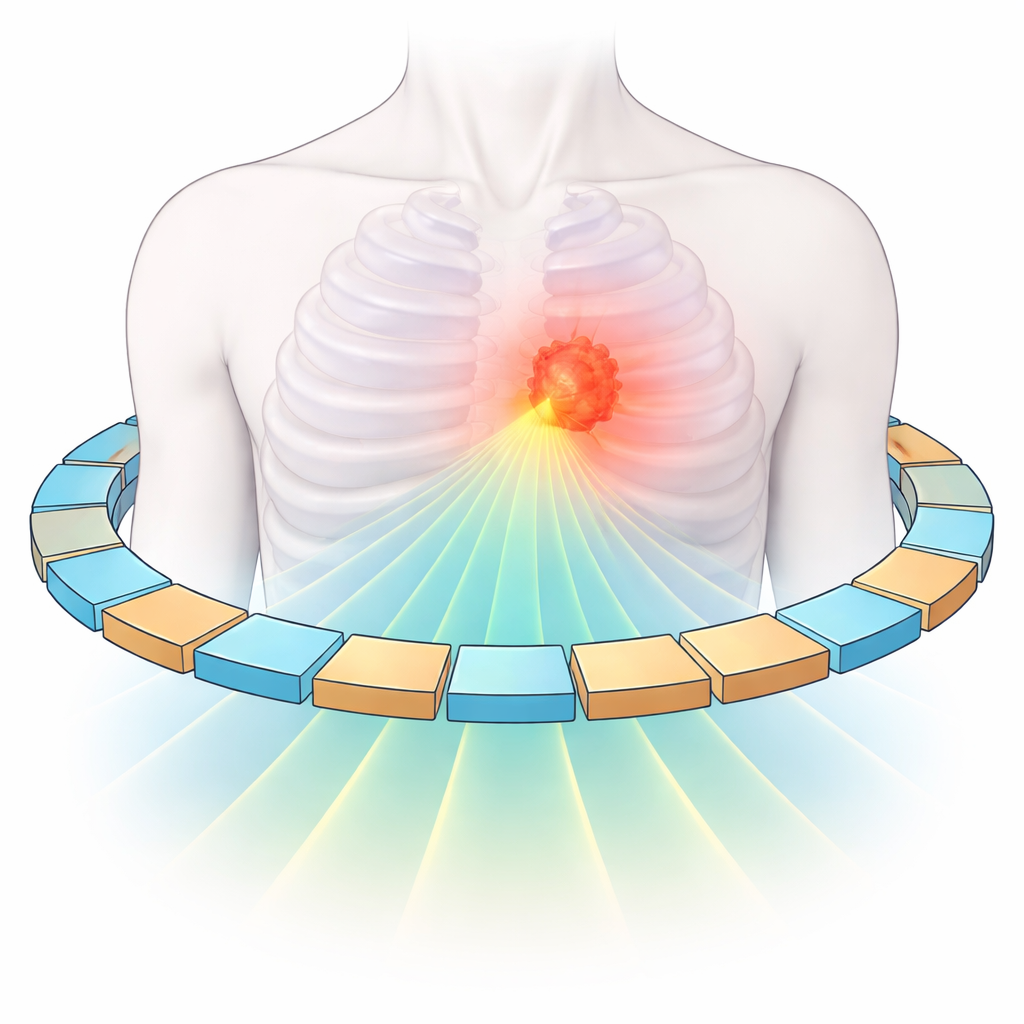
Hyperthermia therapy aims to warm cancerous tissue to about 40–45 degrees Celsius. At these temperatures, tumor cells become more vulnerable to standard treatments, while normal cells can still recover. The problem is that microwaves and radio waves spread out and bounce around inside the body, which can create dangerous “hotspots” on the skin or in healthy organs. The authors tackle this precision problem by designing a 16‑element microwave antenna array that surrounds the target area and can steer its energy much like a radio telescope focuses signals from space. Their goal is to give doctors fine control over where the heat goes, moment by moment, during treatment.
Turning Medical Images Into Precise Targets
The process begins with familiar medical scans, such as MRI or CT. Instead of trying to follow every irregular contour of a tumor, the authors use image-processing and clustering techniques to break the target region into a set of overlapping circles. Each circle’s center becomes a “focal spot” where the antennas should concentrate energy. This simplification strikes a balance: it is detailed enough to reflect the real tumor shape, but simple enough for a computer to handle quickly. The system also weighs how many circles to use, trading off better coverage of the tumor against the extra complexity and power needed to control more focal points.
Teaching Antennas Where and How to Heat
Once the focal spots are defined, the key is to adjust the microwave phases—essentially the timing—of the 16 tiny antennas so their waves add up at the tumor and cancel out elsewhere. The researchers use a nature-inspired search method called particle swarm optimization to hunt for the best combination of phase settings. This method evaluates how much energy, quantified as “specific absorption rate,” lands inside the tumor compared to healthy tissue. Over many fast iterations, it finds phase patterns that sharply concentrate power in the intended region. Simulations with detailed body models show that this phase-tuned array can double the heating inside the tumor while reducing energy spillage to surrounding tissue compared with a simple, untuned setup.
Smoothing Out Dangerous Hotspots
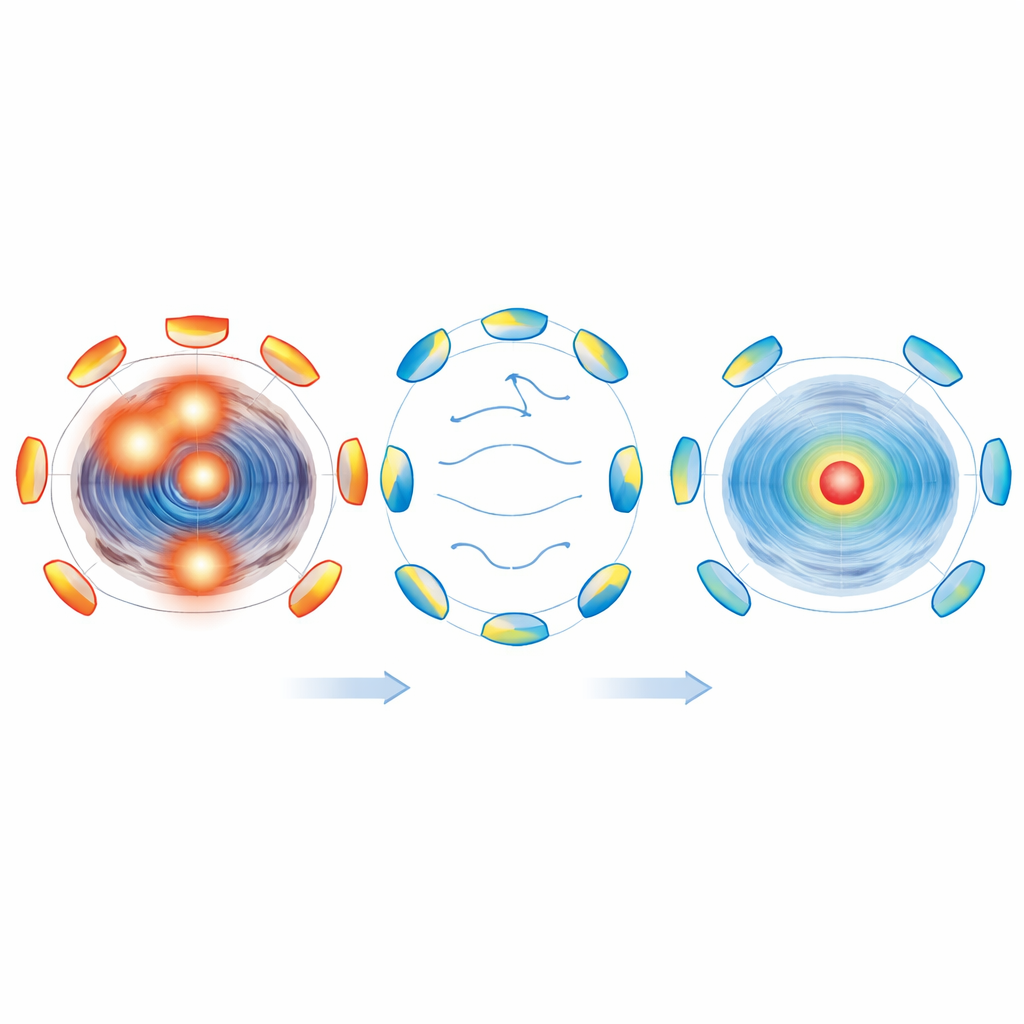
Even with careful focusing, wave interference can still create bright hot patches on the skin. To tackle this, the team adds a second layer of control called the Null Space Jacobian method. Starting from the optimized phase pattern, they apply tiny, coordinated phase shifts that are mathematically chosen to leave the focal spots essentially unchanged while weakening hotspots on the surface. In practice, this “swinging” of phases smooths out peaks of energy at the skin without blurring the heat inside the tumor. Tests in computer models that include skin, fat, and muscle layers show about one‑third reduction in surface energy peaks, while the energy in the tumor changes by only a few percent.
Building a Practical, Fast-Responding System
To prove this is more than a computer exercise, the authors design a circularly polarized microstrip antenna element and scale it up to a 4×4 array operating at 2.45 GHz, a common medical frequency. They engineer low‑cost, continuously tunable phase shifters controlled by a microcontroller, and integrate the optimization software on a PC and graphics processor. The full loop—from reading temperature or image feedback, through running the optimization, to updating the antenna phases—takes about 1.5 seconds. Experiments in realistic tissue‑mimicking phantoms with fiber‑optic temperature sensors confirm that the system can create strong, uniform heating in deeper layers while keeping the skin only mildly warmed, in line with accepted clinical safety standards.
What This Means for Future Cancer Care
In everyday terms, this work shows how a combination of smart imaging, advanced antennas, and intelligent algorithms can turn a blunt heating method into a targeted “thermal scalpel.” By automatically shaping and adjusting microwave beams in near real time, the proposed system delivers extra heat to tumors while sharply limiting accidental overheating of healthy tissue. If further developed and clinically tested, such hybrid intelligent hyperthermia systems could make cancer treatments more effective, safer, and more comfortable for patients.
Citation: Rajebi, S., Pedrammehr, S. & Shirini, K. Hybrid intelligent optimization of a circularly polarized microstrip antenna array for safe and effective hyperthermia cancer therapy. Sci Rep 16, 8411 (2026). https://doi.org/10.1038/s41598-026-39313-w
Keywords: hyperthermia cancer therapy, microwave antenna array, targeted tumor heating, treatment optimization, medical imaging guidance