Clear Sky Science · en
Objective suturing skill assessment in a hands-on course increases medical students’ aspiration to become surgeons
A Surge of Interest in Surgery
Across many countries, hospitals worry that there will not be enough surgeons to care for future patients. Long training, demanding hours, and relatively low pay are pushing young doctors toward other specialties. This study from Japan asks a simple question with big consequences: if medical students are given a short, hands-on lesson in stitching wounds, and get clear feedback on how well they performed, will more of them start imagining themselves as future surgeons?
Why Stitching Practice Matters
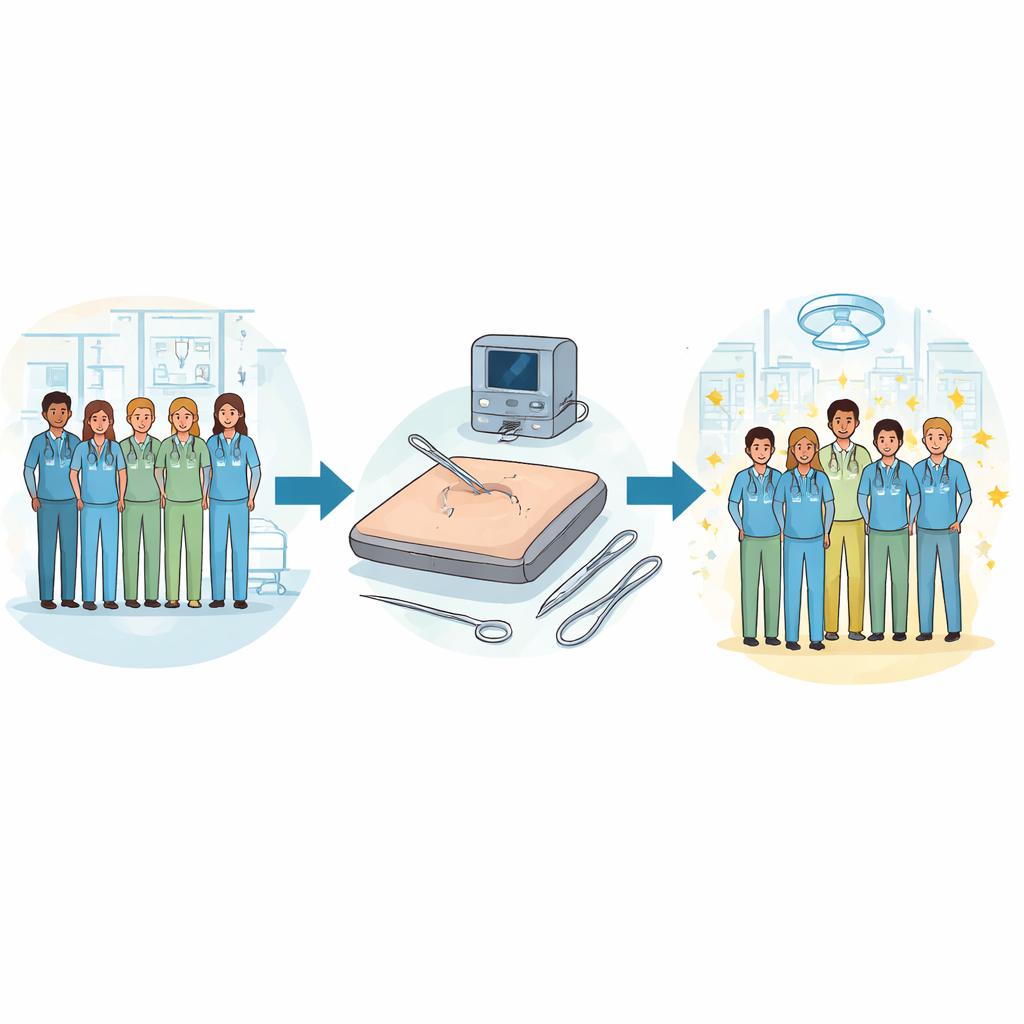
The researchers focused on fifth-year medical students rotating through a pediatric surgery department. During this hospital-based clerkship, each small group of students took part in a two-hour suturing session led by a senior pediatric surgeon. Instead of just watching operations, the students actually tied single stitches on a special practice pad. The key idea was to let them feel, in their own hands, what basic surgical work is like—then measure whether that experience changed how strongly they wanted to become surgeons.
A Training Tool That Scores Performance
To make practice more than just trial and error, the team used a device called the A-LAP mini, originally designed for keyhole (laparoscopic) surgery training. In this study, the same tool was used in a simple open setting: students placed three stitches in a soft sheet, which was then analyzed. The system scored five aspects of performance, including how long the task took, how neatly the stitch lines were formed, and how well the seam resisted leaking. Each student received a total score, turning a fuzzy skill into concrete numbers that showed progress.
Measuring Dreams Before and After
Before and after the session, students marked their career hopes on a visual line from “I would rather be a physician in internal medicine” at one end to “I would rather be a surgeon” at the other. This simple scale allowed the team to track changes in aspiration. Out of 215 participants, complete data from 185 students revealed a clear pattern: the typical score rose from a moderate interest in surgery to a stronger one after training. Students who already leaned toward surgery were especially excited and reported enjoying the practice. Those who had been less interested at first also showed a boost in motivation, although they tended to feel the task was harder.
Different Paths, Similar Benefits
The researchers then looked more closely at how individuals’ views shifted. Some students stayed strongly pro-surgery, some remained more drawn to non-surgical careers, and a small group shifted toward or away from surgery. In nearly every subgroup, the desire to become a surgeon increased after the suturing session. Interestingly, there was no clear link between how high a student’s technical score was and how much their interest grew. In other words, even students who were not top performers still became more open to a surgical career. At the same time, the hospital noticed that, after this program began, more students chose pediatric surgery as an elective clerkship in their final year.

What This Means for Future Patients
This study suggests that a brief, hands-on stitching lesson, combined with objective feedback, can nudge medical students toward considering surgery, regardless of their starting skill level. While this alone cannot fix deep-rooted issues such as workload, pay, and health system structure, it offers a practical step that any teaching hospital could adopt: let students experience the craft of surgery in a safe, measured way early on. Over time, such efforts may help ensure that more young doctors choose—and stay in—the operating room, ultimately benefiting patients who rely on timely surgical care.
Citation: Onishi, S., Sugita, K., Murakami, M. et al. Objective suturing skill assessment in a hands-on course increases medical students’ aspiration to become surgeons. Sci Rep 16, 8006 (2026). https://doi.org/10.1038/s41598-026-39306-9
Keywords: surgical career choice, medical student education, suturing training, simulation-based learning, surgeon workforce shortage