Clear Sky Science · en
Rheological investigation of the effects of tea polyphenols on SBS-modified bitumen before and after short-term aging
Why Tea and Roads Make an Unlikely Pair
Modern highways are built for speed and comfort, but the black binder that holds road stones together slowly hardens and cracks under heat, oxygen, and traffic. This study asks a surprising question: can natural compounds from green tea help asphalt pavements last longer? By blending tea polyphenols—well-known plant antioxidants—with a common elastic road binder, the authors explore whether a small dose of this green ingredient can make roads tougher against rutting and fatigue, while revealing where the trade-offs lie.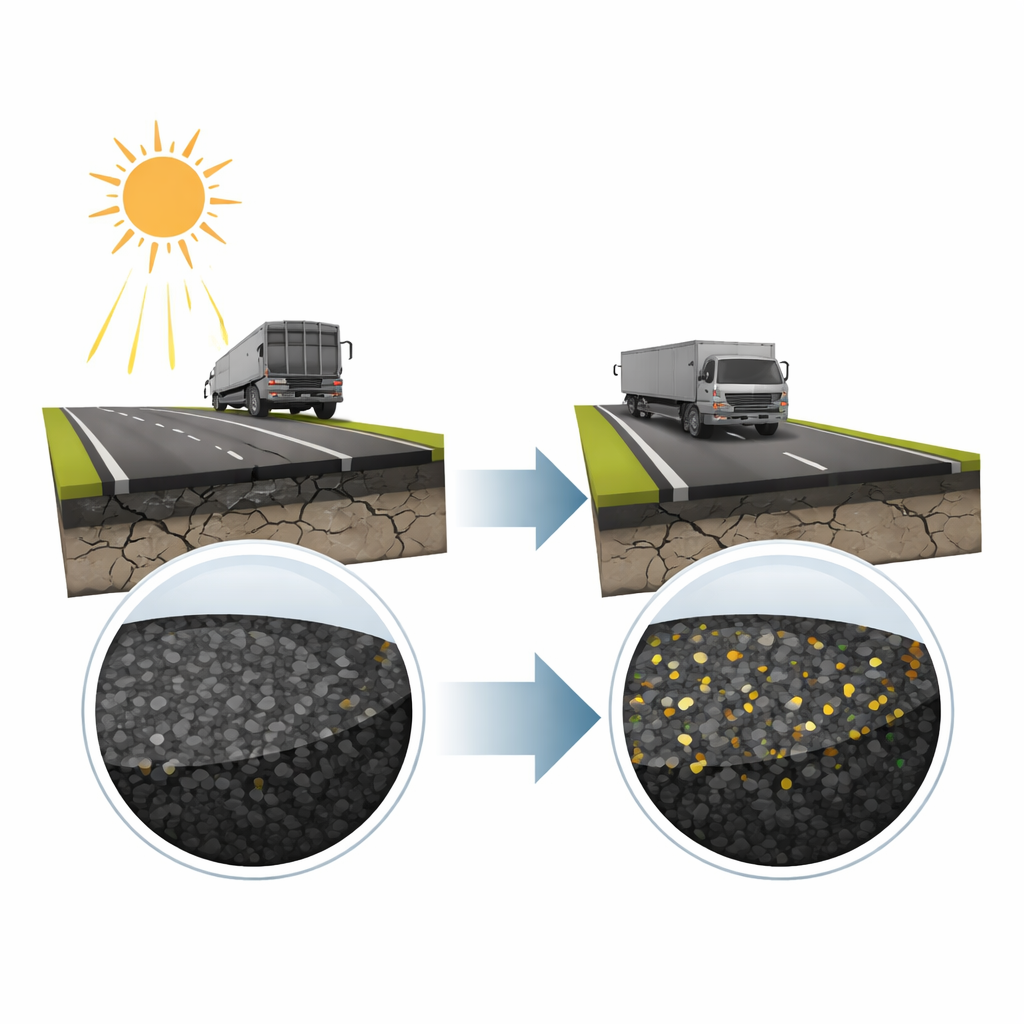
How Roads Age and Why It Matters
The smooth surface of an asphalt road depends heavily on the properties of its binder, a petroleum-based glue often improved with polymers such as SBS (styrene–butadiene–styrene). SBS makes roads more elastic and resistant to deformation under heavy trucks. Yet over time, sun and air cause chemical aging: the binder stiffens, the SBS network degrades, and the pavement becomes brittle and prone to cracks. Engineers have tried nano-additives and specialty chemicals to slow this damage, but many raise cost or sustainability concerns. Tea polyphenols, by contrast, are plant-derived molecules with strong antioxidant activity, already studied for their ability to mop up reactive species in bitumen. What has been missing is a clear, whole-picture view of how they change the binder’s mechanical behavior across the full temperature range a road experiences.
Brewing a New Type of Road Binder
To tackle this, the researchers blended a standard penetration-grade bitumen with 4.5% SBS and then added tea polyphenols at five levels: 0%, 3%, 6%, 9%, and 12% by weight of the original bitumen. Each mixture was tested in two states: fresh and after a controlled short-term oven treatment that mimics the aging that occurs during mixing and paving. Using a suite of rheological tests, they measured how each binder responded to loading at high, medium, and low temperatures, and then used mathematical models to capture its time-dependent behavior. In simple terms, they looked at how stiff or springy the material was, how much it bounced back after being deformed, how long it could endure repeated strains before damage accumulated, and how well it could relax locked-in stress at cold temperatures.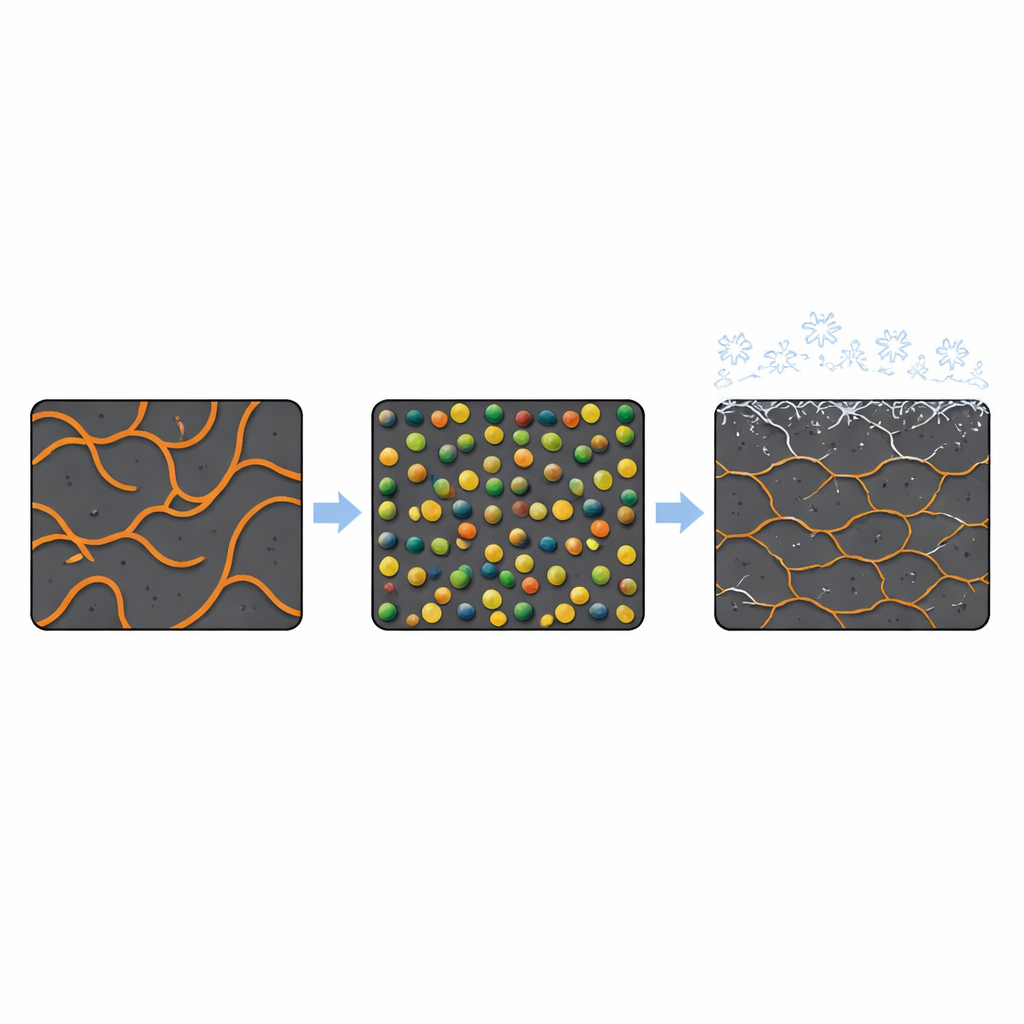
Stronger at High Heat, Tougher Under Traffic
The findings show that adding tea polyphenols consistently makes the SBS-modified binder stiffer and more elastic, especially at elevated temperatures where rutting is a major concern. This is because the tea particles behave like tiny rigid fillers inside the sticky matrix, reinforcing it much like fine sand stiffens wet clay. Among all mixtures, the one with 3% tea polyphenols stands out in the unaged state: it has the highest complex modulus (a measure of overall stiffness), the lowest phase angle (indicating more spring-like response), the greatest ability to recover from deformation, and the best resistance to permanent ruts under repeated loads. At moderate temperatures, the 3% mixture also shows the longest fatigue life, meaning it can survive more loading cycles before cracking. After short-term aging, higher tea contents further improve resistance to deformation and fatigue, with the 12% mixture offering the strongest rutting resistance, showing that the antioxidant and filler roles become more prominent as aging progresses.
Trade-Offs in the Cold
The benefits at warm and hot temperatures come with a cost in the cold. Because tea polyphenols increase stiffness, the binder struggles more to relax internal stresses when temperatures drop. The study’s low-temperature tests reveal that mixtures with tea polyphenols exhibit higher peak stresses under the same small imposed strain and retain a larger fraction of that stress over time. Model parameters that track how quickly stress dies away confirm this picture: with more tea, the binder dissipates its stored energy more slowly and becomes less sensitive to relaxation, implying a greater tendency to hold onto stress that can trigger microcracks. Notably, the 3% mixture—so favorable for high-temperature performance—shows the poorest stress-relaxation ability among fresh binders, and the 12% mixture fares worst after aging, underlining that strengthening the binder can also make it less forgiving at low temperatures.
What This Means for Future Roads
For road engineers, the main message is that tea polyphenols offer a promising, bio-based way to toughen SBS-modified asphalt against high temperatures and heavy traffic, especially around a 3% dosage in fresh binders and higher levels after some aging. These natural antioxidants not only slow down damage but also act as reinforcing particles, improving rutting and fatigue resistance. However, they make the binder less able to relax stress in the cold, which could raise the risk of low-temperature cracking in harsh climates. The authors therefore see tea-enhanced SBS binders as especially suitable for warm or hot regions with intense traffic, and they call for future work to track long-term aging, study the microscopic distribution of tea particles, and ensure that storage and field performance remain stable over time.
Citation: Han, Z., Xu, L., Sun, P. et al. Rheological investigation of the effects of tea polyphenols on SBS-modified bitumen before and after short-term aging. Sci Rep 16, 7842 (2026). https://doi.org/10.1038/s41598-026-39300-1
Keywords: asphalt binder, tea polyphenols, SBS-modified bitumen, pavement aging, rutting and fatigue