Clear Sky Science · en
Exploring sectoral energy structures for decarbonization: an analysis of leading global emitting countries
Why this matters for everyday life
Burning coal, oil, and gas powers our homes, cars, and industries—but it also drives climate change. This study looks under the hood of the world’s ten biggest greenhouse-gas polluters to see exactly which parts of their economies are cleaning up and which are still stuck in the fossil-fuel past. By tracking changes from 2000 to 2023 across eight major sectors—like farming, buildings, power plants, and transport—the authors show where real progress toward a cooler planet is happening, and where urgent action is still missing.
Taking apart the pollution puzzle
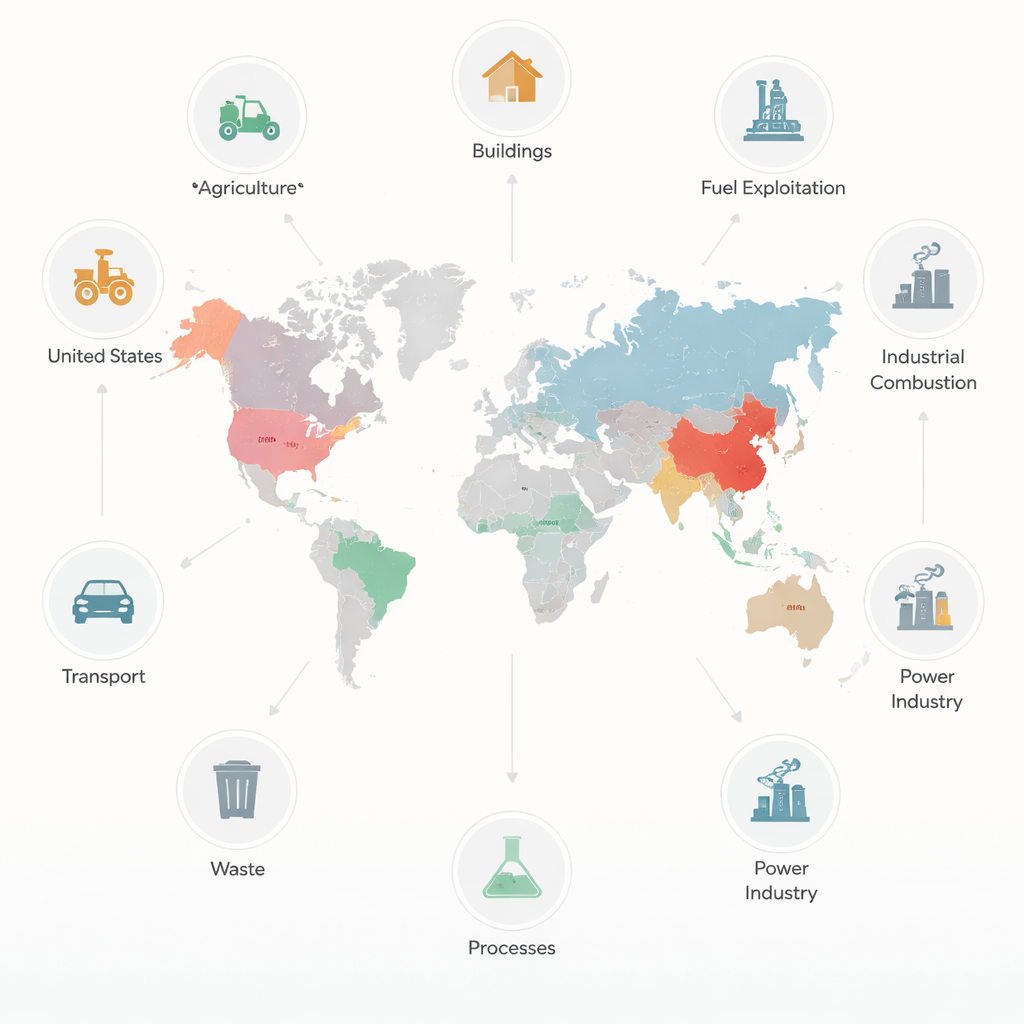
Instead of treating emissions as one big number per country, the researchers split them into eight everyday sectors: agriculture, buildings, fuel extraction, industrial fuel burning, power generation, industrial processes, transport, and waste. They then used a statistical approach called index decomposition analysis to separate three drivers in each sector: how efficiently it uses energy and resources, how much economic activity is happening, and how much pollution is emitted for each unit of output. This allowed them to see whether countries are truly “decoupling” economic growth from pollution—that is, getting richer without automatically pumping more greenhouse gases into the air.
Where we are winning: farms, homes, and trash
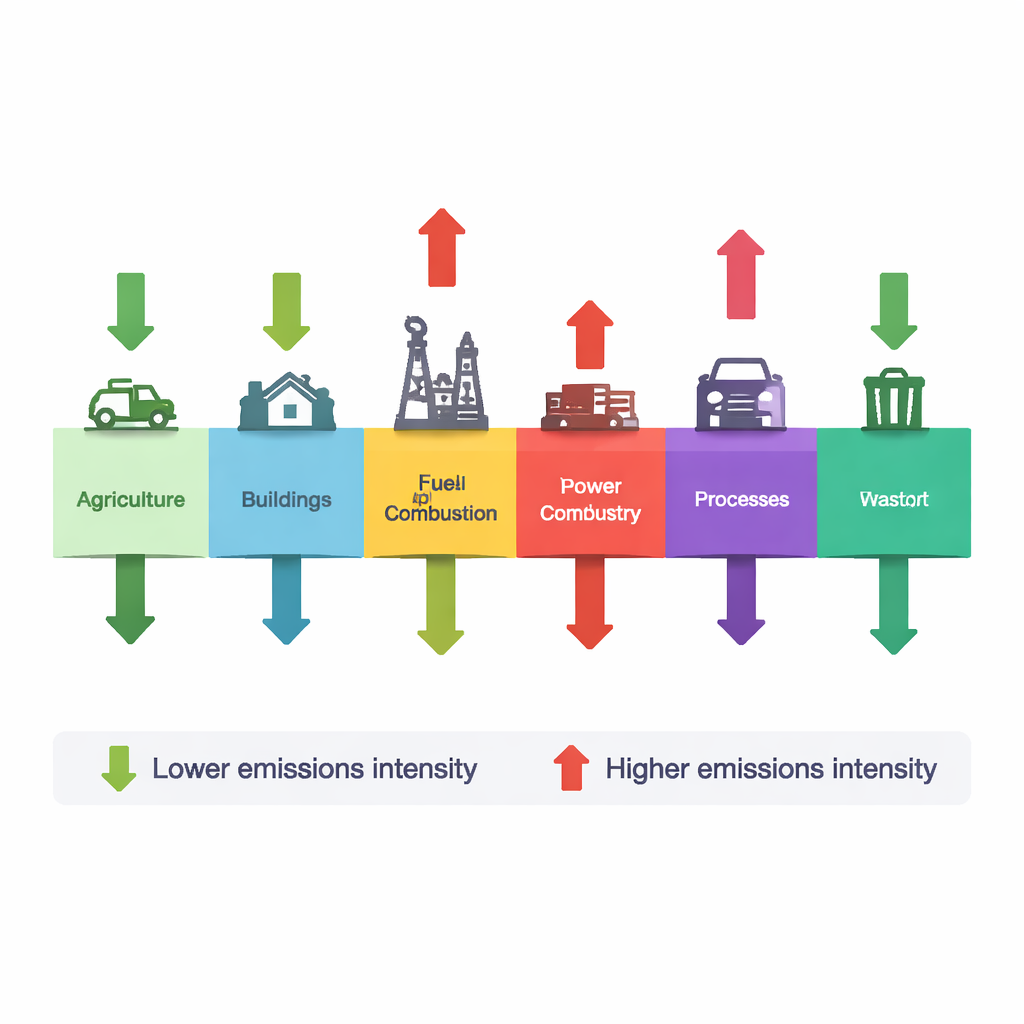
The clearest good news comes from agriculture, buildings, and waste. Across the ten countries, farming and construction together cut average emissions by about 13 million metric tons of carbon dioxide per year compared with what would have happened if 2000-era patterns had continued. In agriculture, better use of fertilizers, improved crop and soil management, and more efficient energy use helped many nations grow more food with less added warming. Buildings saw strong gains from better insulation, more efficient heating and cooling systems, and smarter design. The waste sector is the star performer: it achieved the largest cuts of all—over 16 million tons per year on average—largely driven by changes in the United States, where landfill gas capture and modern waste treatment sharply reduced methane leaks.
Where we are stuck: energy, industry, and transport
Other sectors tell a more worrying story. Transport—the cars, trucks, ships, and planes that keep economies moving—still trends in the wrong direction overall. Average emissions intensity crept upward, especially in rapidly growing economies where rising incomes and urbanization fueled more vehicle use and more freight. Fuel extraction and industrial fuel burning show only modest net progress: some countries improved efficiency and cut emissions, but these gains were partly cancelled by rising output and continued reliance on coal, oil, and gas. In power generation and industrial processes such as cement and steel, several major emitters actually became more carbon intensive, while countries like the United States, Canada, and Japan showed that cleaner power mixes and modern technologies can bend the curve down.
Uneven progress across countries
Because the study compares ten large emitters—China, the United States, India, Russia, Brazil, Indonesia, Japan, Iran, Saudi Arabia, and Canada—it highlights striking contrasts. Some high-income countries steadily lowered emissions per unit of economic output in several sectors at once, especially in power, buildings, and waste. In contrast, several emerging economies saw efficiency gains but were overwhelmed by rapid growth in energy demand and industrial output, leading to higher overall emissions in transport, industry, and fuel extraction. The analysis shows that there is no single “global” pattern: each country’s mix of technologies, policies, and economic structure produces a distinct emissions fingerprint.
What this means for climate action
For non-specialists, the core message is simple: cutting greenhouse gases is not a vague global task, but a set of very concrete, sector-by-sector jobs. The study shows that targeted measures—like capturing landfill gas, tightening building standards, modernizing farm practices, and upgrading waste systems—can deliver large, measurable climate benefits. At the same time, it warns that the hardest work still lies ahead in transport, heavy industry, fuel extraction, and parts of the power sector, where emissions are still rising or barely improving. To keep global warming in check, countries will need focused policies, new technologies, investment, and behavior changes tuned to the realities of each sector, from electric buses and trains to low-carbon industrial processes and cleaner fuels. The roadmap to a low-carbon world, the authors argue, is not a single highway but many parallel lanes that must all move forward together.
Citation: Alamri, F.S., Janjua, A.A. & Aslam, M. Exploring sectoral energy structures for decarbonization: an analysis of leading global emitting countries. Sci Rep 16, 7365 (2026). https://doi.org/10.1038/s41598-026-39298-6
Keywords: decarbonization, greenhouse gas emissions, sectoral analysis, energy transition, climate policy