Clear Sky Science · en
Calibration of physical and mechanical property parameters of broccoli seedling stalks
Why gentle handling of young plants matters
Factory-style farming increasingly relies on machines to plant crops, but delicate seedlings often pay the price. For broccoli, bruised or crushed stalks during transplanting can stunt growth, reduce yield, or even kill the plant. This study explores how to predict and prevent such damage by building a detailed digital model of a broccoli seedling’s stalk, allowing engineers to test clamping devices on a computer screen before they ever touch a real plant. 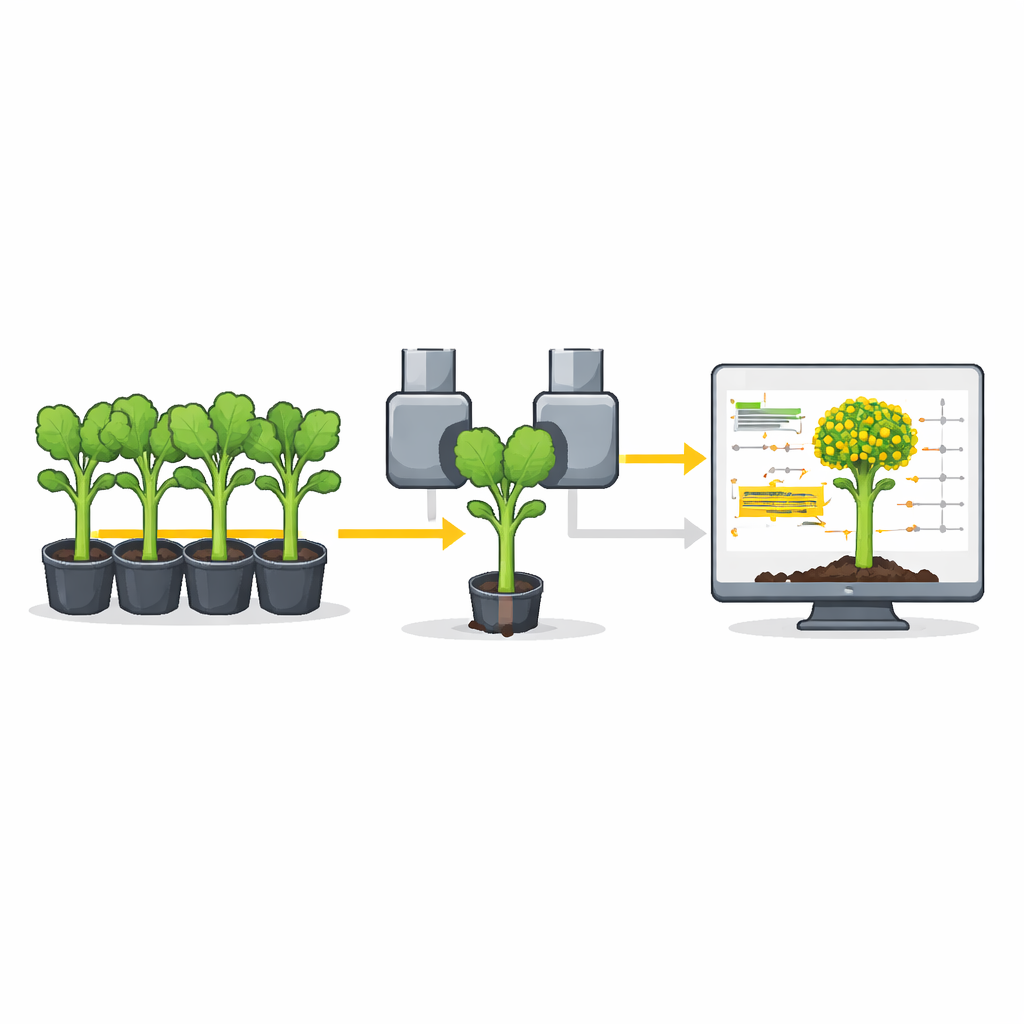
Delicate stems meet hard metal
Broccoli seedlings look sturdy, but their juicy stalks are more like soft straws than wooden sticks. When mechanical grippers squeeze these stalks to lift and place seedlings, too little force and the plant slips; too much and the stalk crushes or snaps. To improve this balance, the researchers first measured how real stalks behave under pushing, shearing, sliding, and bouncing. They tested hundreds of young ‘Yanxiu’ broccoli seedlings grown under controlled temperature and humidity, carefully recording their stiffness, density, sideways bulging, friction against steel, and how they deform or break under load.
Turning a stalk into thousands of tiny pieces
Instead of treating each stalk as a solid rod, the team used the discrete element method, a simulation approach that represents matter as a collection of many small particles. In their computer model, each broccoli stalk is built from nearly 3,000 tiny spheres bonded together, a bit like a column of tightly glued beads. These bonds give the virtual stalk strength, while contact rules between spheres and with metal surfaces control how they slide, roll, and bounce. By tuning these properties, the digital stalk can be made to bend, shear, and compress almost like the real thing.
Calibrating the virtual stalk
To make sure the model behaved realistically, the authors used a step-by-step calibration process. First, they created small piles of cut stalk segments and measured the angle at which the pile naturally rested, a simple but sensitive indicator of friction between pieces. They then ran virtual piling tests, adjusting friction and bounce settings until the simulated pile matched the real one within about half a degree. Next, they focused on the strength of the internal bonds by cutting stalks with a mechanical tester and measuring the peak force just before failure, then repeating the same action in the simulation. Using statistical design tools, they searched for the combination of bond stiffness, strength, and size that reproduced the observed average shear force of roughly 31 newtons with less than 1% error. 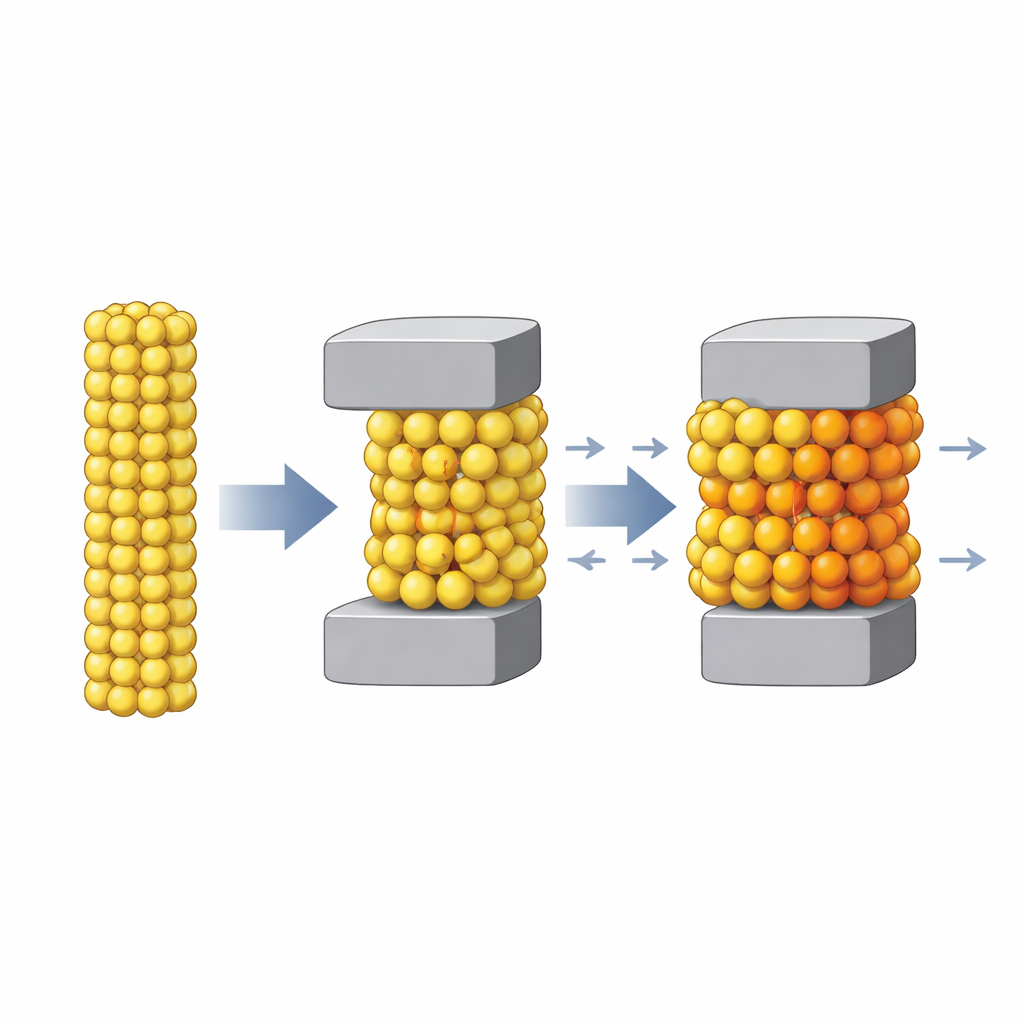
Putting the model to work on clamping
With the digital stalk tuned, the team simulated what actually happens in a transplanter: a pair of jaws clamp the stalk and hold it for several seconds. They compared computer-predicted deformation with real measurements at three practical force levels—10, 15, and 20 newtons. The differences stayed below about 12%, well within the range commonly accepted for biological materials. The simulations also visualized how compression and internal stresses build up as force increases, highlighting when stalks are merely bent versus at risk of permanent damage or breakage.
What this means for smarter farm machines
For non-specialists, the key takeaway is that this work turns fragile broccoli stalks into a reliable digital test subject. Designers of transplanting machines can now explore jaw shapes, surface materials, and force settings in a virtual environment, greatly reducing trial-and-error on real plants. The calibrated model is tailored to the specific broccoli variety, moisture level, stalk diameter, and force range tested, so it must be re-tuned for other conditions. Even so, the overall workflow—careful measurements, particle-based modeling, and statistical optimization—offers a blueprint for protecting many types of tender seedlings as agriculture moves toward more automation.
Citation: Qin, L., Gong, Y., Zhang, K. et al. Calibration of physical and mechanical property parameters of broccoli seedling stalks. Sci Rep 16, 8008 (2026). https://doi.org/10.1038/s41598-026-39286-w
Keywords: broccoli seedlings, mechanized transplanting, plant stem mechanics, discrete element modeling, agricultural robotics