Clear Sky Science · en
Study on the damage mechanism of deep ingate lining structure disturbed by cyclic blasting
Why mine tunnels need extra protection
As coal mines reach deeper underground, the tunnels that connect vertical shafts to horizontal roadways become vital lifelines for air, people, and equipment. These junctions, called ingates, are lined with thick concrete to keep the surrounding rock at bay. Yet the very blasting used to carve nearby tunnels can gradually weaken this lining, raising the risk of cracking and long‑term instability. This study explores how repeated blasting affects deep ingate linings and how using tougher concrete can keep these underground "throats" safer over time.
The underground crossroads at risk
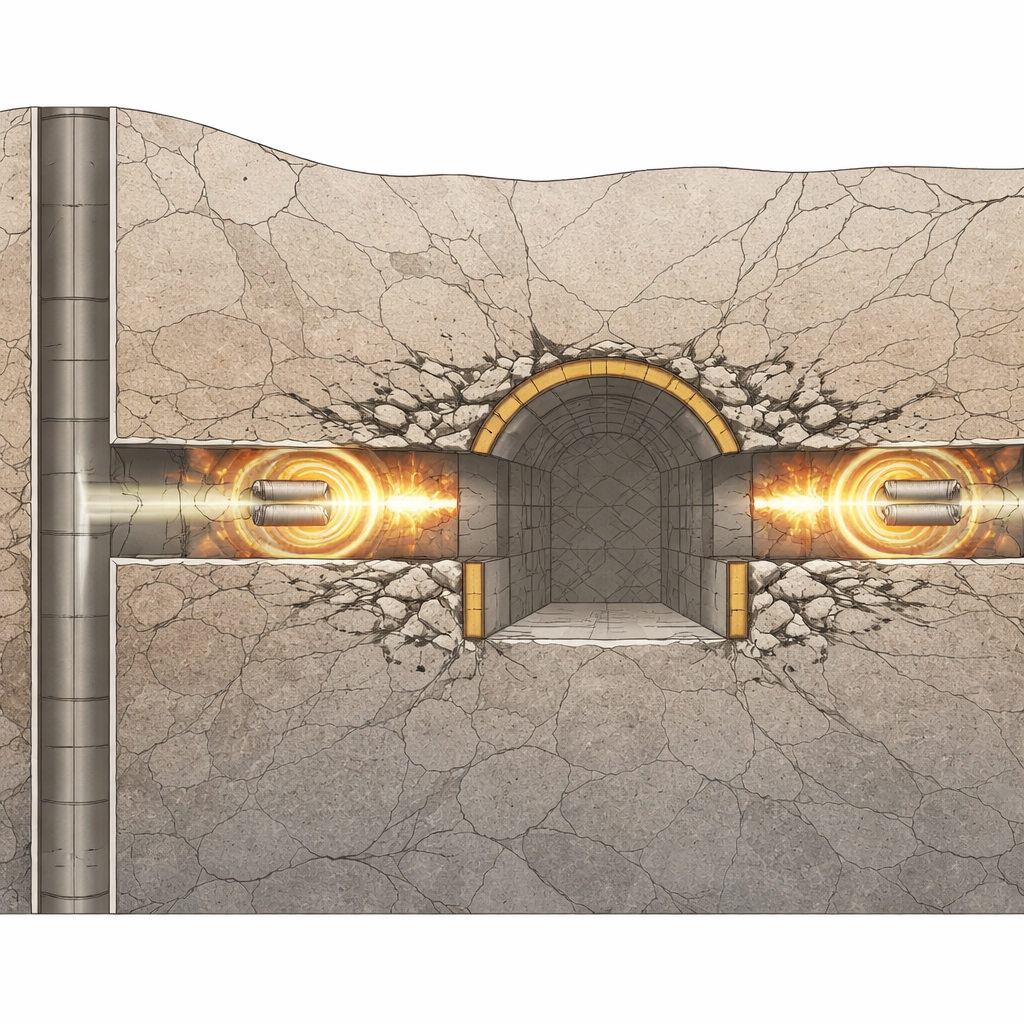
The researchers focused on a deep coal mine in eastern China, where a new air shaft connects to horizontal tunnels through a large, complex ingate. Because of its size, curved shape, and many intersecting openings, this junction concentrates stress and is difficult to support. Tunnel boring machines are not practical here, so engineers rely on drilling and blasting to excavate the surrounding roadways. Once built, the concrete lining around the ingate must withstand both the steady squeeze of deep rock pressure and the repeated shock waves from nearby blasts. Understanding where and how damage starts in this lining is crucial for designing safer excavation plans and choosing better materials.
Simulating blasts instead of breaking rock
Rather than running risky full‑scale field tests underground, the team built a detailed three‑dimensional computer model of the ingate, surrounding mudstone rock, and explosive charges. Using the LS-DYNA simulation software, they recreated both the constant pressure from deep rock and the dynamic loading from a series of blasts in the horizontal tunnels on either side of the shaft. They compared two lining materials: conventional high‑strength concrete and steel fiber reinforced concrete, which is similar but contains short metal fibers that help bridge and hold back cracks. By applying different levels of confining pressure and varying the blast charge, they tracked stresses, vibration speeds, and the gradual accumulation of damage in the lining.
Where stresses pile up and cracks begin
The simulations showed that under static rock pressure alone, the weakest spots in the lining are not where it is being squeezed the hardest, but where it is pulled apart in tension—especially along the lower corners and sidewalls of the horizontal tunnel. As the confining pressure increases, the overall compressive stresses stay well below the concrete’s crushing limit, but the tensile stresses approach a significant fraction of its capacity. When blasting is added, there is a clear minimum explosive charge, or threshold, above which damage begins to appear at the arch crown where the shaft and roadway meet. This threshold drops as the surrounding rock pressure rises, and it is always higher for the fiber‑reinforced concrete than for the plain high‑strength concrete, showing that the fibers make the lining less sensitive to blast shocks.
How repeated blasts wear down the lining
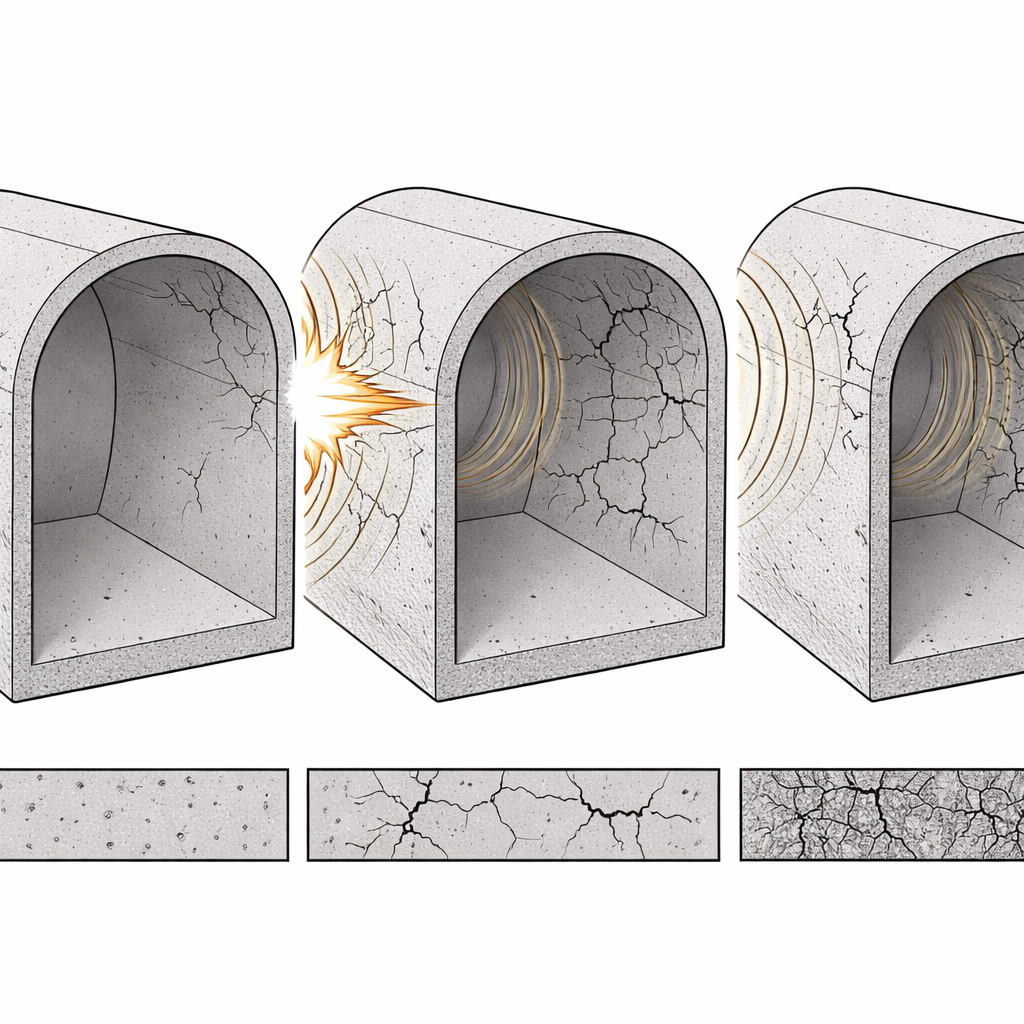
By modeling cyclic blasting as the tunnel face advances step by step, the researchers followed how vibration and damage evolve over time. The largest particle speeds occurred in the arch regions of the horizontal tunnel, and the early blasts—roughly the first four—were responsible for the strongest shaking. Elements that cracked first went on to accumulate the most damage, especially on the side of the ingate facing the initial strong blast. A sequence of “first strong, then weak” blasts on one side produced more cumulative damage than “first weak, then strong” blasts on the opposite side, because the initial cracks made later shocks more effective at extending damage. The simulations also revealed a safe distance: once the advancing blast face moved far enough away—about 26 meters for the plain concrete lining and 18.2 meters for the fiber‑reinforced lining—additional blasts no longer increased damage.
Why tougher concrete and careful blasting matter
Overall, the study found that the steel fiber reinforced concrete lining suffered far less long‑term harm than the conventional high‑strength concrete. After two full blasting cycles, the total damage in the fiber‑reinforced lining was only about one‑fifteenth that of the plain lining. For mine designers and safety engineers, this means two things. First, choosing materials with better resistance to crack growth—especially higher tensile performance—can greatly extend the life and reliability of deep ingates. Second, paying special attention to the very first blasts near these structures, and limiting their charge, can sharply reduce the cumulative damage that builds up as excavation proceeds. Together, smarter materials and more cautious blasting strategies offer a practical path to safer deep mining infrastructure.
Citation: Li, X., Yao, Z., Liu, X. et al. Study on the damage mechanism of deep ingate lining structure disturbed by cyclic blasting. Sci Rep 16, 8171 (2026). https://doi.org/10.1038/s41598-026-39273-1
Keywords: deep mine tunnels, blasting vibration, concrete lining damage, steel fiber reinforced concrete, underground excavation safety