Clear Sky Science · en
Gold-polymer hybrid metasurface for polarization-independent enhanced third harmonic generation in the ultraviolet
Turning Invisible Light into a Useful Tool
Ultraviolet light can etch microchips, read tiny data tracks, probe delicate molecules and even drive future quantum technologies. But generating bright, compact UV beams is difficult: most materials that turn one color of light into another work poorly in this part of the spectrum. This study introduces a new kind of nano‑engineered surface, made from gold and a transparent polymer, that can efficiently transform common near‑infrared laser light into deep‑ultraviolet light, and do so regardless of how the incoming light is polarized. 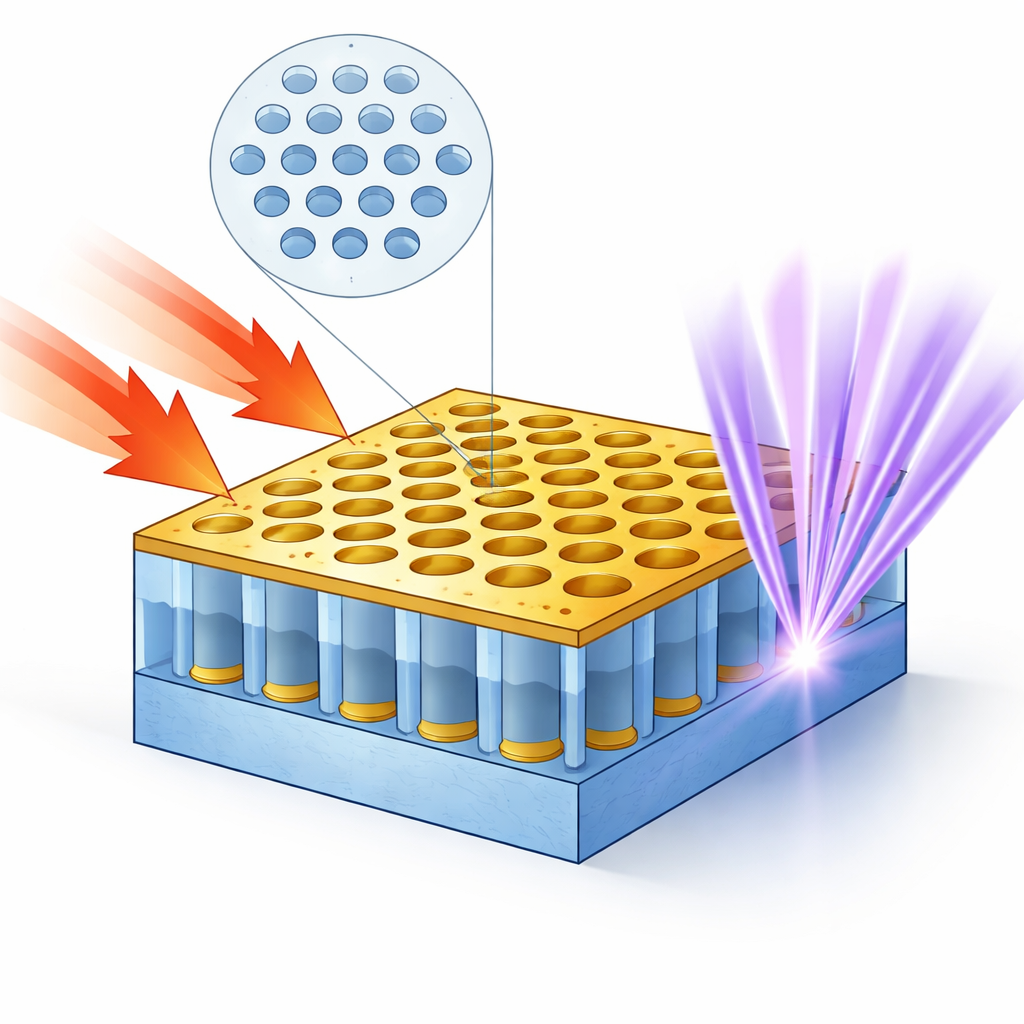
A Tiny Forest of Gold‑Lined Wells
Instead of a flat metal film, the researchers built a “quasi‑3D” landscape. They patterned a thin polymer layer on a silicon chip with a regular hexagonal array of cylindrical wells, each a few hundred nanometers across—far smaller than a wavelength of visible light. Then they coated the entire surface with a 50‑nanometer layer of gold. This creates two distinct gold regions: a perforated gold film on top, and separate gold disks at the bottoms of the wells, separated by the polymer. Light encountering this structure sees not a simple mirror, but a three‑dimensional crystal of metal and dielectric that can trap and reshape electromagnetic fields in all directions.
How Light is Trapped and Intensified
Using detailed computer simulations, the team showed that this hybrid structure supports a special optical mode known as a surface lattice resonance. At a particular near‑infrared wavelength around 790 nanometers, the periodic pattern and the metal’s response combine to form a collective resonance that spreads the electromagnetic field across the array while sharply confining it near the gold–air interfaces. Compared to more localized resonances in isolated nanoparticles, this lattice mode suffers fewer energy losses inside the metal, leading to a very narrow spectral line and strong field enhancement. Crucially, the three‑dimensional layout allows both main polarizations of light to generate field components along the wells, so the resonance—and all the benefits that follow—appear nearly the same whether the incoming beam is oriented as TE or TM. 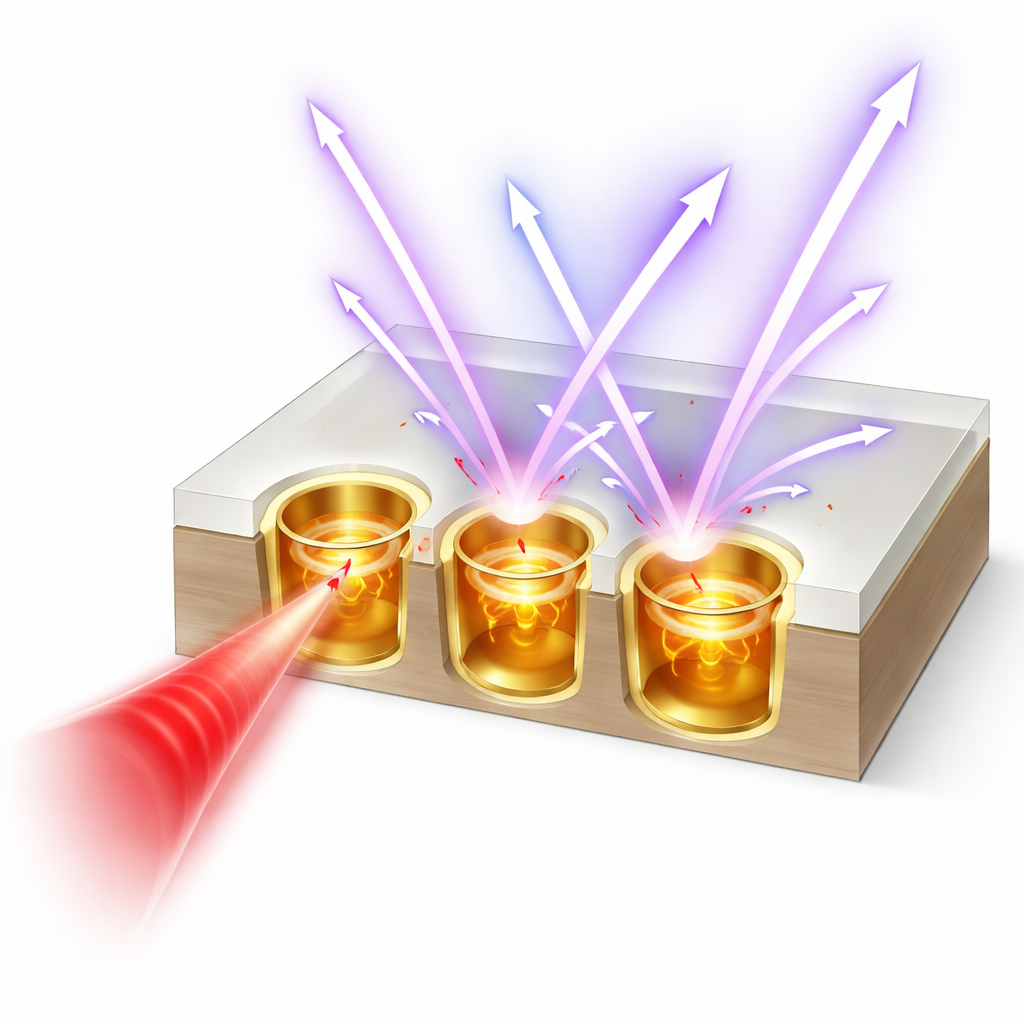
Measuring Third Harmonics in the Deep UV
When the resonant structure is illuminated with ultrafast pulses from a standard titanium–sapphire laser near 800 nanometers, the intensified fields at the gold surfaces drive a nonlinear process called third‑harmonic generation: three photons from the pump combine to create one photon at a wavelength about three times shorter, roughly 263 nanometers, in the deep ultraviolet. The team built a carefully calibrated detection system that filters out the pump light, separates polarizations, and measures extremely weak UV signals. By comparing the patterned region with a neighboring flat 50‑nanometer gold film under identical conditions, they found that the quasi‑3D metasurface boosts the reflected third‑harmonic power by almost two orders of magnitude. When diffraction is taken into account—since the periodic pattern sends UV light into several distinct directions—the total enhancement factor reaches about 400.
Why the Surfaces Do the Heavy Lifting
Although the structure contains both metal and polymer, the simulations and prior work indicate that the third‑harmonic signal arises mainly from just a few nanometers at the gold surfaces, where bound electrons respond strongly to the intense fields. The polymer and the silicon substrate contribute very little, because their nonlinear response is weaker and the fields inside them are not as enhanced. The three‑dimensional design, however, is essential: it positions metal surfaces and nanogaps so that incoming light can excite strong plasmonic oscillations regardless of polarization, concentrates energy at the metal–air boundaries, and then allows the newly generated UV light to radiate into specific directions set by the hexagonal lattice.
Looking Ahead to Brighter, Smarter UV Sources
The authors also explore how replacing the 50‑nanometer gold layer with ultra‑thin gold films around the metal’s skin depth could further increase both absorption and nonlinear conversion, especially if fabricated on a transparent substrate so that UV light can be collected from both sides. Their results show that clever geometry, not just more structural complexity, is what truly controls efficiency. In simple terms, this work demonstrates a robust, polarization‑independent nano‑surface that can turn common near‑infrared laser light into deep‑ultraviolet light hundreds of times more efficiently than a flat gold film. Such metasurfaces could underpin compact UV and deep‑UV sources for spectroscopy, sensing, high‑density data storage, and integrated quantum photonic circuits, bringing powerful short‑wavelength light into much smaller and more versatile devices.
Citation: Mukhopadhyay, S., Conde-Rubio, A., Trull, J. et al. Gold-polymer hybrid metasurface for polarization-independent enhanced third harmonic generation in the ultraviolet. Sci Rep 16, 8362 (2026). https://doi.org/10.1038/s41598-026-39260-6
Keywords: ultraviolet light, metasurfaces, plasmonics, nonlinear optics, third harmonic generation