Clear Sky Science · en
Enhancing chromium coating thickness estimation with multi-head attention LSTM and data augmentation
Why the thickness of a tiny coating matters
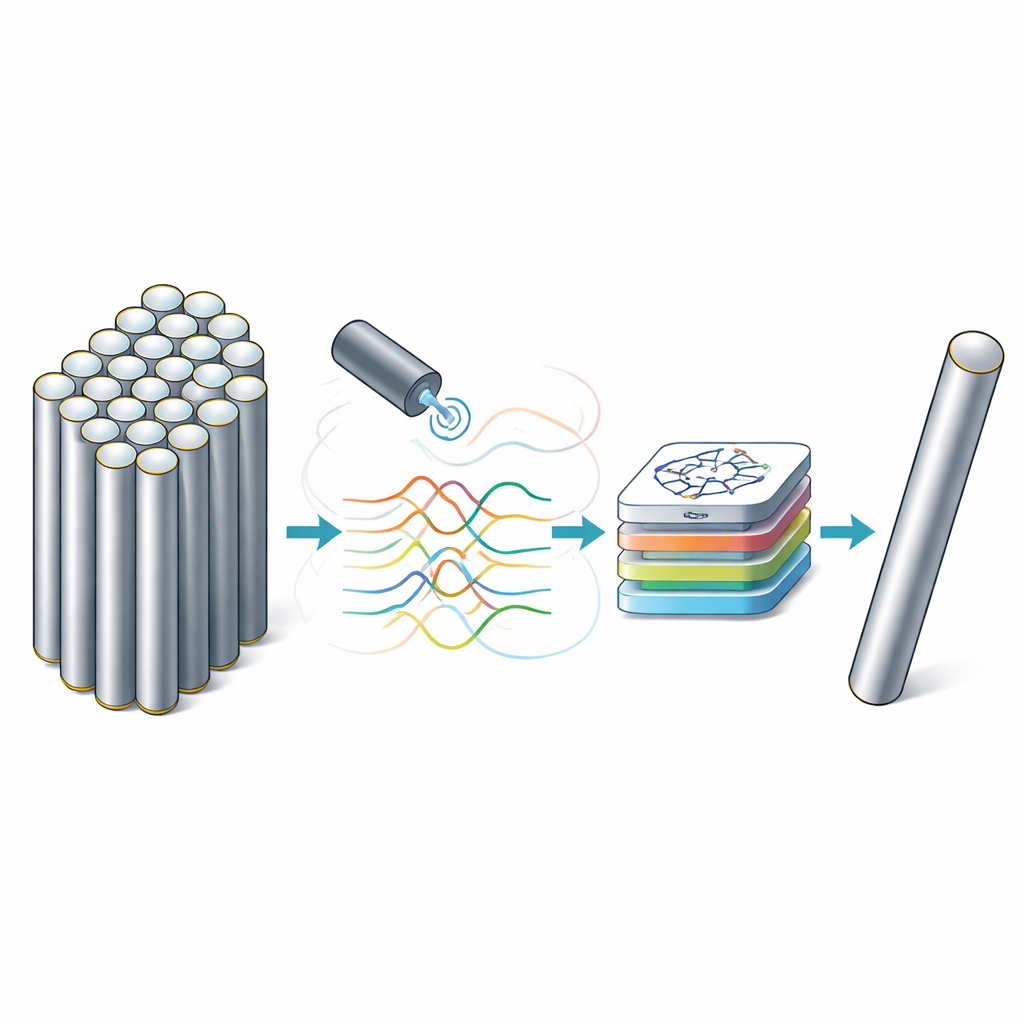
Nuclear power plants rely on long metal tubes, called fuel rods, to hold radioactive fuel safely. After the Fukushima disaster, engineers began adding a thin chromium coating to these tubes to help them better withstand extreme heat and corrosion. But this safety layer only works as intended if its thickness is just right along many meters of each rod. Measuring such a tiny layer without cutting the rod open is difficult, and traditional inspection methods struggle to turn raw sensor signals into precise thickness values—especially when only a small amount of test data is available. This study shows how an artificial intelligence (AI) model, combined with clever ways of multiplying limited data, can make these thickness estimates much more accurate and reliable.
From nuclear accident lessons to safer fuel rods
The work is motivated by the way zirconium, a metal commonly used in fuel rod cladding, reacts with water at high temperatures to produce hydrogen gas and heat. In Fukushima, this contributed to explosions that damaged the plant. A chromium coating on the zirconium surface can slow corrosion, reduce wear, and improve behavior in accident scenarios. However, if the coating is too thin, it may fail under stress; if too thick, it can affect heat transfer and fuel performance. Because rods cannot be destroyed for testing once installed, operators must rely on non-destructive tools such as eddy current testing (ECT), which uses changing magnetic fields to probe the metal surface. The central challenge is translating the complex ECT waveforms into accurate numbers for coating thickness.
Listening to electrical whispers in metal
ECT sensors induce swirling electric currents near the rod surface and record how these currents respond to the chrome layer and the underlying zirconium. Earlier approaches relied on hand-designed features—such as resistance and reactance values—and simple mathematical fits, like quadratic curves, to link these features to thickness. These methods worked reasonably well but had clear limits: they struggled when conditions changed, and they could not fully capture subtle relationships burying in the time-varying signals. The authors instead collected full time-series signals from pancake-shaped ECT probes placed near chromium-coated fuel rod samples of known thickness, measured at several different operating frequencies. This gave them four simultaneous signal channels per measurement, each thousands of time steps long, forming a rich but relatively small dataset.
Teaching an AI to focus on what matters
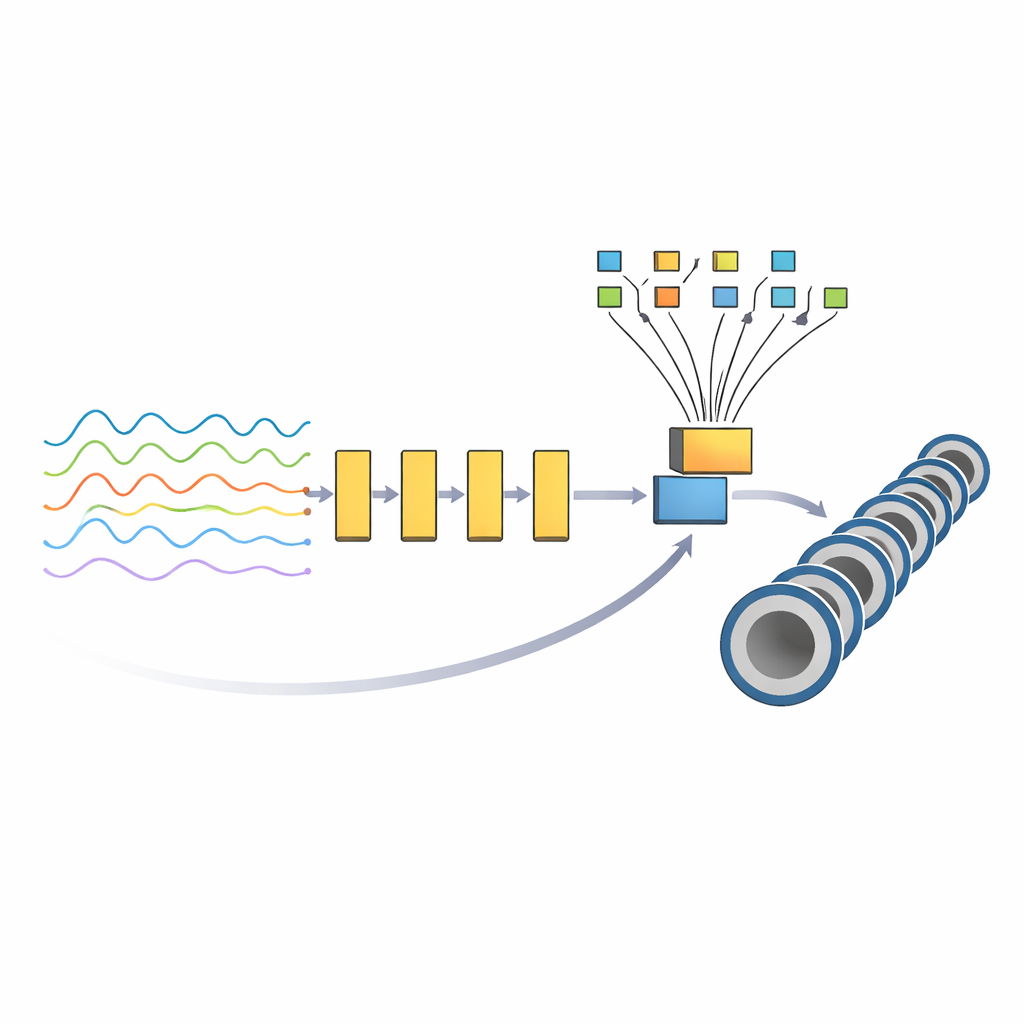
To make the most of this limited data, the researchers combined two ideas. First, they used transformation-based data augmentation for time series: they sliced signals into overlapping windows, added carefully scaled random noise (jittering), warped amplitudes and timing, perturbed the signals in the frequency domain, and flipped them in time. These operations create many realistic variations while preserving the underlying physics of how thickness affects the average signal. Second, they designed an AI model built on a long short-term memory (LSTM) network, a type of neural network well-suited for sequences, and enhanced it with multi-head attention. The LSTM tracks how the signal evolves over time, while the attention mechanism learns to emphasize particularly informative parts of the signal and interactions among the four channels. Together, these components allow the model to discover patterns that earlier hand-crafted formulas could not capture.
Results that hold across different inspection settings
The team tested their model using a strict cross-validation scheme in which entire thickness levels were held out from training, forcing the AI to predict thicknesses it had never seen before. They also evaluated performance at multiple excitation frequencies, mirroring how sensor settings vary in real inspections. Compared with a previous method based on polynomial regression, the new attention-enhanced LSTM reduced the average error in thickness estimates by more than one third and delivered more consistent results across frequencies. Among the augmentation strategies, simple jittering and time flipping—both of which preserve the signal’s mean value—were especially effective, and using them together produced the best performance. Simpler neural networks without attention tended to collapse toward predicting an average thickness, underscoring the importance of the attention mechanism.
What this means for nuclear safety and beyond
In plain terms, the study shows that a carefully designed AI model, supported by realistic data augmentation, can turn noisy electrical signals into precise, trustworthy measurements of a life-saving coating that is only micrometers thick. This improves confidence that chromium-coated fuel rods will perform as intended, without requiring destructive tests or large, expensive datasets. Beyond nuclear fuel, the same strategy—combining time-series augmentation with attention-based sequence models—could help engineers in many fields build smarter sensors and more accurate inspection tools whenever physical measurements must be inferred from limited experimental data.
Citation: Jeon, M., Choi, W., Park, J.W. et al. Enhancing chromium coating thickness estimation with multi-head attention LSTM and data augmentation. Sci Rep 16, 8286 (2026). https://doi.org/10.1038/s41598-026-39258-0
Keywords: nuclear fuel safety, chromium coating, eddy current testing, time series AI, data augmentation