Clear Sky Science · en
Outcomes of emergency conversion to general anesthesia during thrombectomy for anterior circulation stroke
Why this matters for stroke patients
When a major stroke strikes, every minute counts. Doctors now routinely thread tiny instruments into blocked brain arteries to pull out clots in a procedure called mechanical thrombectomy. But there is still an important practical question: should patients be fully asleep under general anesthesia, lightly sedated but awake, or started awake and then urgently put to sleep if problems arise? This study examines what happens to patients when that last scenario—an emergency switch to full anesthesia—becomes necessary.
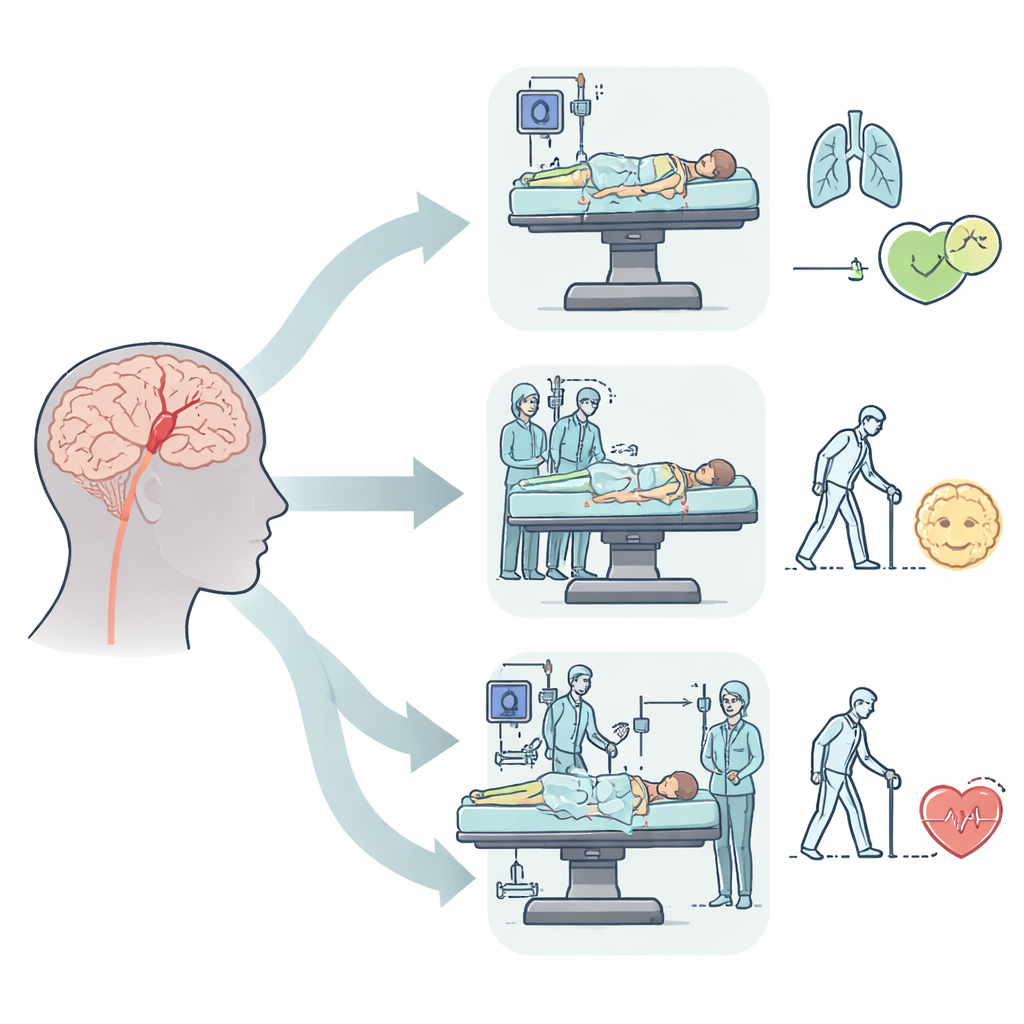
Different ways to keep the patient still
To remove a clot from a large brain artery, the medical team must keep the patient very still while guiding catheters through delicate blood vessels. Some centers prefer general anesthesia, with a breathing tube and complete unconsciousness. Others often use local numbing medicine and light sedation, so patients can breathe on their own and sometimes cooperate during the procedure. However, a portion of these awake or lightly sedated patients become too restless, confused, or medically unstable to continue safely, forcing the team to switch urgently to general anesthesia in the middle of the procedure. Until now, it has not been clear whether this emergency switch itself harms patients in the long run.
How the study was carried out
Researchers reviewed real-world data from three major stroke centers in Italy and the United Kingdom. They focused on 669 adults who had a large clot in a major brain artery in the front part of the brain and who were mostly independent before their stroke. All underwent mechanical thrombectomy between early 2022 and late 2023. Patients were grouped into three categories: those put under general anesthesia from the start, those treated entirely with non-general approaches (local anesthesia or conscious sedation), and those who began under non-general anesthesia but then required an emergency conversion to general anesthesia during the procedure. The team compared recovery three months after stroke, using a standard disability scale, and also tracked complications such as pneumonia and death.
What happened to recovery after stroke
The central finding is reassuring: patients who needed an emergency switch to general anesthesia did not have worse overall functional recovery at three months than those who were under planned general anesthesia or who stayed with non-general anesthesia throughout. In other words, the late decision to put a struggling or agitated patient fully to sleep did not, by itself, appear to rob them of their chance to regain independence. This held true even after statisticians carefully adjusted for differences in age, stroke severity, and many other medical factors, and after testing whether results varied by hospital, age group, or treatment details.
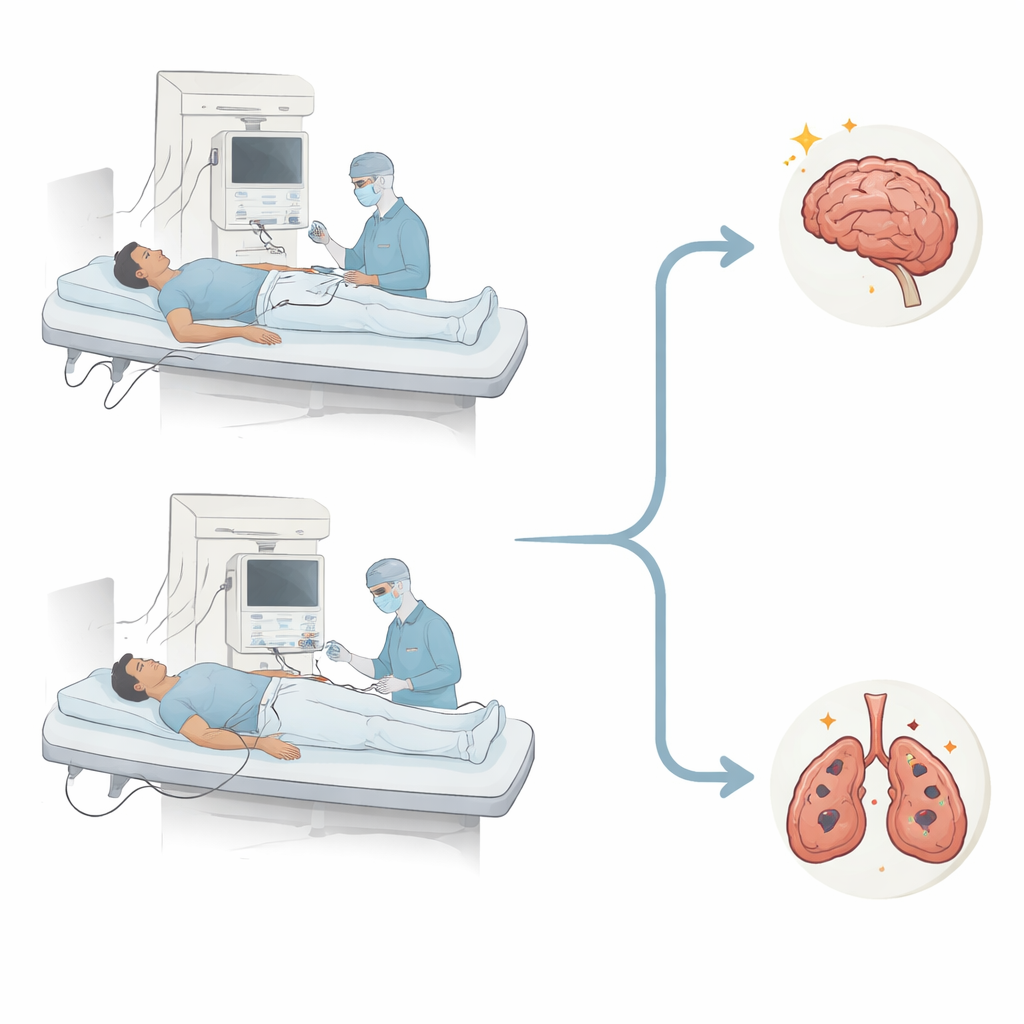
Hidden trade‑offs: lungs and life
Although long-term disability looked similar across groups, important differences emerged in complications. Patients who remained on non-general anesthesia had a much lower risk of pneumonia than those who needed an emergency switch, likely because intubation and deeper sedation make it easier for germs to reach the lungs. On the other hand, those who were placed under general anesthesia from the start had a lower death rate at three months than patients who were converted in an emergency. This suggests that when general anesthesia is clearly the safer choice, giving it in a planned, controlled way may be better than waiting for problems to arise mid-procedure.
What this means for patients and doctors
For patients and families facing a sudden, severe stroke, these findings offer both reassurance and nuance. Starting the procedure with lighter anesthesia can be a reasonable option when the patient is stable and cooperative: even if doctors later have to make the urgent call to put the patient fully to sleep, their chances of functional recovery are not necessarily worse. At the same time, the higher pneumonia rates and higher mortality compared with planned general anesthesia highlight that emergency switches carry real risks. The study supports a tailored approach: choose non-general anesthesia when it is truly suitable, but do not hesitate to use general anesthesia from the outset in patients who are very sick, uncooperative, or at high risk of breathing problems.
Citation: Merlino, G., Kuris, F., Cesco, G. et al. Outcomes of emergency conversion to general anesthesia during thrombectomy for anterior circulation stroke. Sci Rep 16, 8450 (2026). https://doi.org/10.1038/s41598-026-39248-2
Keywords: stroke, mechanical thrombectomy, anesthesia, pneumonia, stroke outcomes