Clear Sky Science · en
Evaluation of shale gas reserve recoverability and three-dimensional development potential: a case study of the Weiyuan Block, Sichuan basin
Why this buried gas matters to daily life
As the world looks for cleaner alternatives to coal and oil, natural gas locked deep inside shale rock has become an important bridge fuel. China, which imports much of its gas, is especially interested in getting more energy from its own ground. This study examines a major shale gas field in southwest China—the Weiyuan Block in the Sichuan Basin—to find out how much gas is truly recoverable today, how much is still being left behind, and how smarter three-dimensional drilling could unlock far more of this hidden resource.
A gas field using only a thin slice of its rock
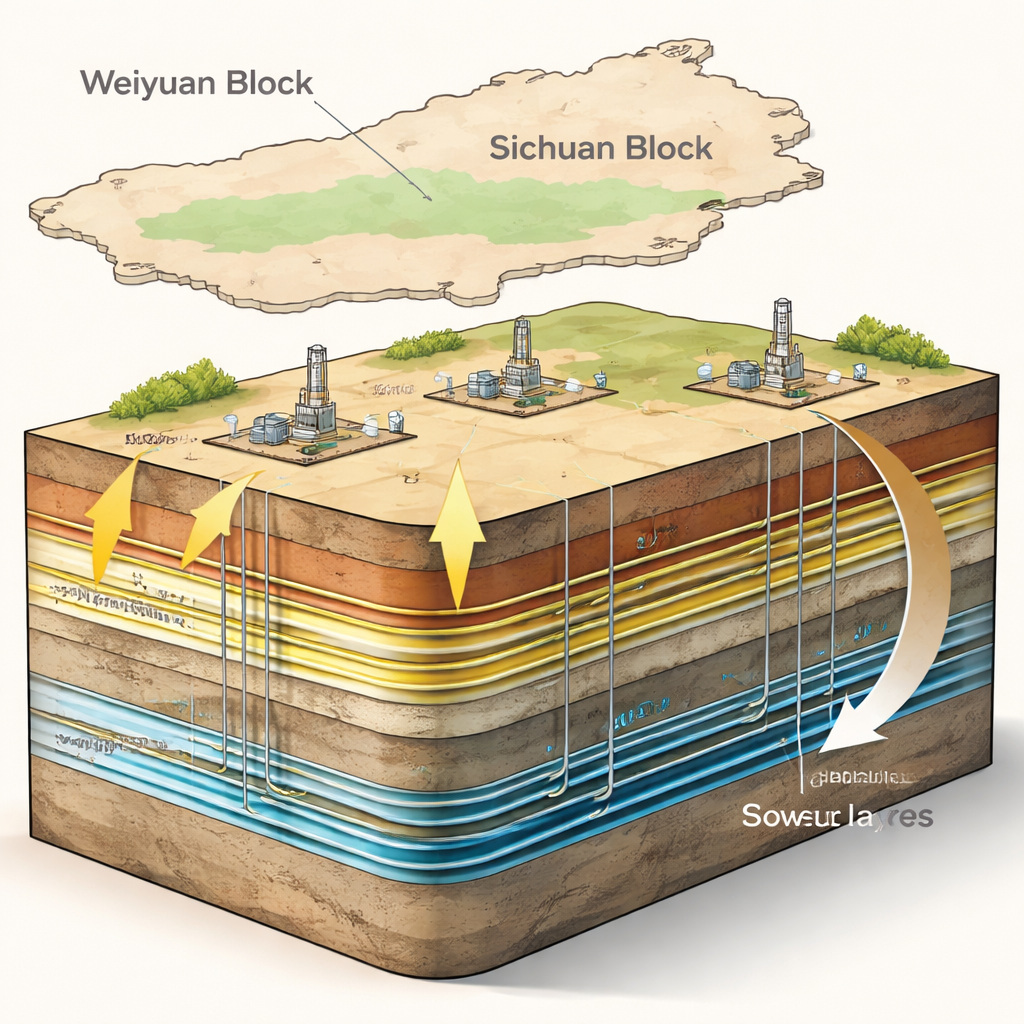
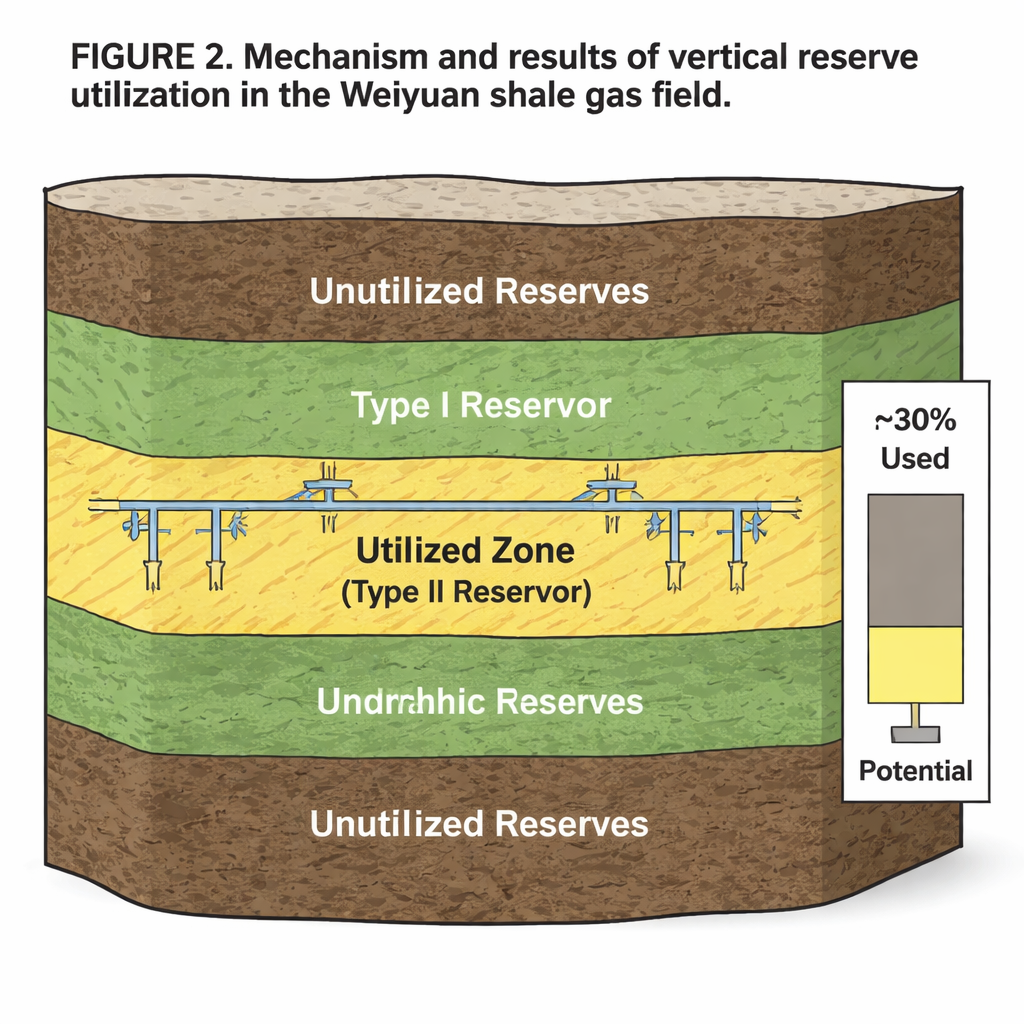
In the Weiyuan Block, hundreds of horizontal wells have already been drilled into a stack of gas-bearing shale layers known collectively as the Wufeng–Longmaxi interval. Yet, despite the total shale thickness of about 44–54 meters, the existing wells mainly tap only a narrow zone in the middle. The authors show that the fractures created during hydraulic fracturing typically reach just 10–15 meters high, so they sweep only a fraction of the vertical rock column. When they carefully matched each well’s long-term production to rock properties and fracture height, they found that, on average, only about 13.8 meters of thickness is truly contributing gas—roughly 30 percent of the available reservoir.
Measuring how much has been used and what remains
To understand how efficiently the field is being drained, the researchers estimated the “ultimate recovery” of gas for hundreds of wells and compared it with the amount of gas originally present in the rock volume each well can influence. They combined several engineering methods, then iteratively adjusted the assumed vertical thickness of rock feeding each well until the calculated recovery matched real-world production. Across the Weiyuan Block, the typical well ultimately recovers about three-quarters of the gas contained in its actively swept rock volume. However, because the wells touch only a limited height of the shale stack, a huge share of the total gas remains outside the reach of existing fractures.
Hidden gas in untouched layers above and below
By subtracting the gas already under control of the current well network from the total geological endowment, the team calculated that about 1,690 × 108 cubic meters of gas still sit in the ground in the main producing area—far more than has yet been brought to the surface. Much of this remaining gas lies in vertical “leftover” zones above and below the currently used band, rather than in unexplored horizontal gaps between wells. On average, more than 26 meters of shale thickness per location remains unused, with the thickest untouched intervals and richest remaining reserves concentrated in the eastern part of the field. These findings point to clear geographic hotspots where extra layers could be targeted by new wells.
Not all rock layers are created equal
The study also divides the shale into higher-quality “Type I” rock and more modest “Type II” rock, based on organic content, pore space and brittleness. Using data from over 180,000 locations in a geological model, the authors quantified how much gas each type of rock can deliver per meter of thickness. They found that, for the same thickness and area, top-tier Type I rock produces about 3.7 times as much gas as Type II. Put another way, it would take nearly four times more Type II thickness to match the output of one meter of Type I. This distinction is vital when planning new three-dimensional development: simply adding more layers is not enough—operators must focus on where the remaining rock is thick and of good quality.
Finding the sweet spots for future drilling
Combining maps of unused thickness, rock quality and remaining gas richness, the authors screened for areas most suitable for multi-layer, or “three-dimensional,” development. They favored zones where both the total unused thickness and the unused high-quality rock were substantial, and where remaining gas per square kilometer was high. This process singled out about 116.7 square kilometers of especially promising ground in the eastern Weiyuan Block, holding an estimated 700.7 × 10⁸ cubic meters of gas that could be tapped by carefully placed new well layers above or below the existing ones.
What this means for future gas supplies
For non-specialists, the core message is that the Weiyuan shale gas field—and likely many others—still contains far more gas than current wells are reaching, even in areas that already look crowded on a map. Today’s wells mostly skim a middle band of the rock, leaving thick zones of gas-rich shale above and below. By better mapping which layers are most productive and where unused rock is thickest, operators can design stacked horizontal wells that work like shelves in a tall storage unit, drawing gas from top to bottom instead of just from one level. If applied carefully, this three-dimensional approach could significantly boost domestic gas output and improve energy security, while making better use of infrastructure that is already in place.
Citation: He, S., Li, X., Lin, Y. et al. Evaluation of shale gas reserve recoverability and three-dimensional development potential: a case study of the Weiyuan Block, Sichuan basin. Sci Rep 16, 7625 (2026). https://doi.org/10.1038/s41598-026-39245-5
Keywords: shale gas, Weiyuan Block, three-dimensional development, reservoir utilization, Sichuan Basin