Clear Sky Science · en
Investigation on thermochemical energy network for efficient waste heat recovery
Turning Waste Heat into a Hidden Energy Resource
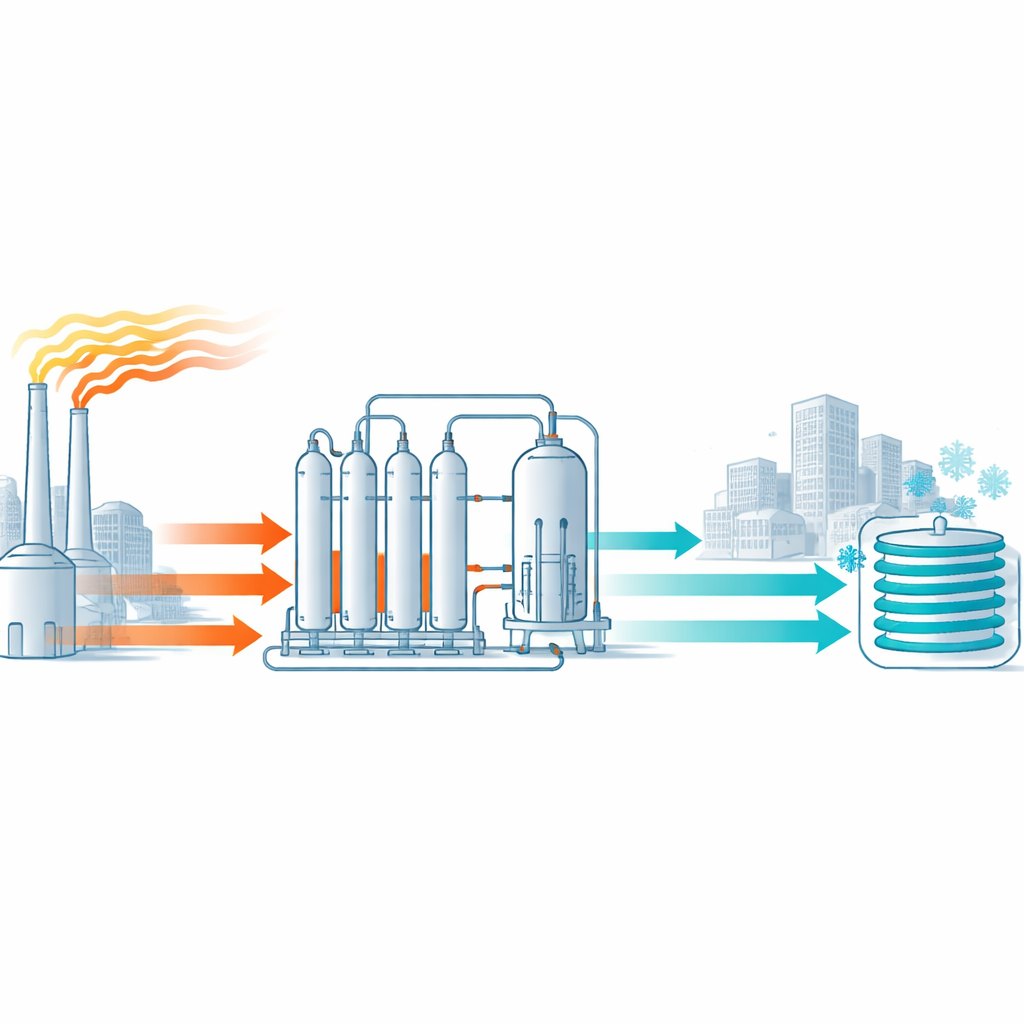
Factories and power plants constantly release warm air and gases into the atmosphere. Much of this heat is low in temperature and usually considered too weak to bother capturing, so it is simply wasted. This study shows how a special fluid network can soak up that forgotten warmth, store it, and then use it to dry air or provide useful heating and cooling. For everyday life, that could mean more efficient buildings and cleaner industry without building new power plants.
A Network Built Around a Working Fluid
The researchers built a full thermochemical fluid energy network in the lab. Instead of using plain water as in traditional heating systems, the network circulates a salty solution that loves to absorb moisture from the air. This fluid travels through two main zones: dehumidifier columns on the demand side and regenerator columns on the supply side. In the dehumidifiers, moist air from a room or process is dried as the fluid takes up water vapor. In the regenerators, waste heat warms the fluid, driving that water back out as vapor so the fluid becomes strong and ready to absorb again. Tanks, pumps, fans and heaters link these pieces together into a closed loop that can move both heat and moisture where they are needed.
Exploring Different Ways Waste Heat Arrives
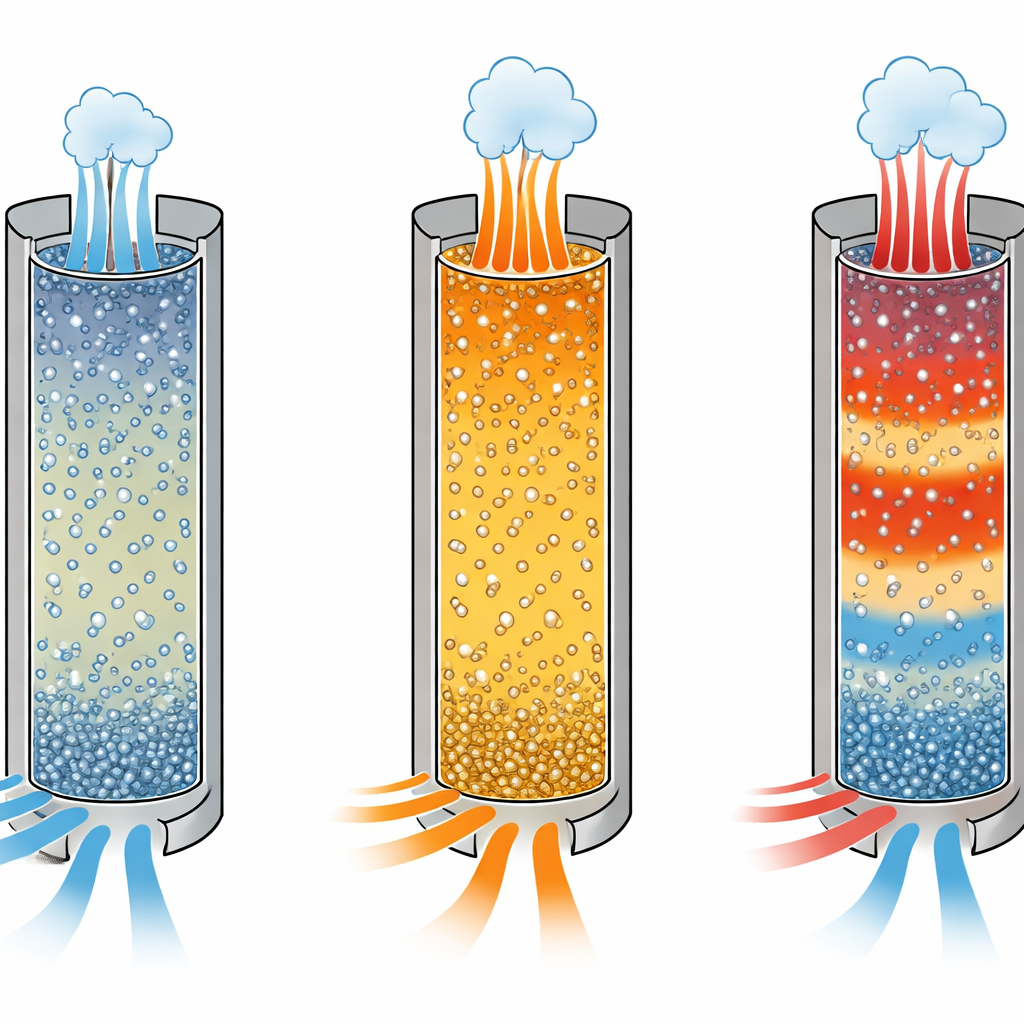
In real factories, waste heat does not arrive as a steady, gentle flow. Sometimes it comes in smooth rises and falls, other times it is nearly constant, and in some systems it appears as sharp bursts. To mirror this variety, the team tested three heating patterns. A steady profile held the temperature at a fixed level. A Gaussian, or bell-shaped, profile slowly climbed to a peak temperature and then fell away, like a controlled pulse of warmth. A third profile mimicked a regenerative thermal oxidiser, a common pollution‑control device, in which the temperature jumps up and down in repeating cycles. By running the same network through all three patterns and sweeping air and solution flow rates and regeneration temperatures, the authors could see how well the system coped with realistic, time‑varying waste heat.
How Flow Rates and Temperature Shape Performance
Several simple measures were used to judge performance: how much the air’s moisture changed, how much water was removed per unit of heat supplied, and how closely the system approached its ideal drying ability. Lower liquid flow rates generally gave higher efficiency, because a smaller amount of fluid received and used the available heat more effectively. At a solution flow of about 0.03 kilograms per second, the network recovered roughly 30% of the theoretical energy available. Raising the regeneration temperature had a powerful effect: at around 80 degrees Celsius, the fluid could drive large changes in air humidity while becoming less sensitive to the exact liquid‑to‑gas flow ratio. In other words, hotter waste heat made the system not only stronger but also easier to operate over a wider range of conditions.
Which Heating Pattern Works Best
When the three waste‑heat patterns were compared directly, one stood out. The bell‑shaped Gaussian heating gave the highest amount of water removed per unit of heat at low liquid‑to‑gas ratios, beating both steady heating and the sharp on‑off cycles of the oxidiser‑like profile. The steady pattern still did well at low liquid flows but dropped off as more fluid was pumped, while the rapid on‑off pattern generally lagged behind. Across all cases, increasing the liquid‑to‑gas ratio reduced performance: pushing more solution through the system demanded more heat for only limited added drying. These trends highlight a clear design message: pair moderate or pulsed waste heat with relatively low fluid flow to get the most benefit.
Smart Prediction with Artificial Intelligence
To help future designers, the team also built a lightweight artificial‑intelligence simulator based on a multi‑layer perceptron, a form of neural network. Instead of solving complex physical equations in real time, this model learns from experimental data how the system responds to different combinations of air and fluid flow, temperature, and time. Once trained, it can instantly estimate key outputs such as humidity change and drying effectiveness. The simulator performed especially well at lower liquid‑to‑gas ratios and under steady and Gaussian heating, with small errors between predicted and measured values. Accuracy declined somewhat at higher liquid flows, pointing to directions for future refinement.
What This Means for Cleaner Industry
Seen from a broad perspective, the work demonstrates that low‑temperature waste heat, often dismissed as useless, can be turned into a valuable resource when coupled to a thermochemical fluid network. By choosing suitable flow rates and targeting regeneration temperatures around 70 to 80 degrees Celsius, industries can recover meaningful amounts of energy and moisture control from exhaust streams that would otherwise be thrown away. The added ability to predict performance with an AI‑based tool makes it easier to plan and operate such systems in complex, changing factories. For the wider public, this points toward industrial sites that run more efficiently, emit less carbon dioxide, and make better use of every bit of heat they already produce.
Citation: Bhowmik, M., Giampieri, A., Ma, Z. et al. Investigation on thermochemical energy network for efficient waste heat recovery. Sci Rep 16, 8523 (2026). https://doi.org/10.1038/s41598-026-39243-7
Keywords: waste heat recovery, thermochemical fluid, industrial energy efficiency, liquid desiccant, AI energy modelling