Clear Sky Science · en
Expanded Heisenberg Hamiltonians from a Mn/Bi DFT+U study on hexagonal antiferromagnet CaMn2Bi2: excitations and strain-controlled magnetic anisotropy switching
Why this strange magnet matters
Computers, phones and future quantum gadgets all rely on how fast and precisely we can flip tiny magnetic bits. A relatively little-known material, the compound CaMn2Bi2, has recently drawn attention because its magnetism can be steered by ultrafast light pulses and by gently squeezing the crystal. This paper digs into the microscopic workings of that behavior, revealing how the atoms, electrons and crystal structure conspire to make its magnetism both robust and exquisitely tunable—features that could be harnessed in next-generation spin-based electronics and light-controlled devices.
The material with a honeycomb heart
CaMn2Bi2 belongs to a family of layered materials built from manganese and bismuth, with the manganese atoms forming a puckered honeycomb network. In this compound the spins on neighboring manganese atoms point in opposite directions, creating an antiferromagnet rather than an ordinary bar-magnet state. Earlier experiments had shown a small electronic gap, unusual magnetoresistance and hints that light can reorient its internal magnetic pattern in trillionths of a second. These features marked CaMn2Bi2 as a promising playground for ultrafast magnetism, but they also raised questions: Why is the gap so small? What fixes the preferred spin directions? And how exactly does the crystal respond when it is strained or excited? 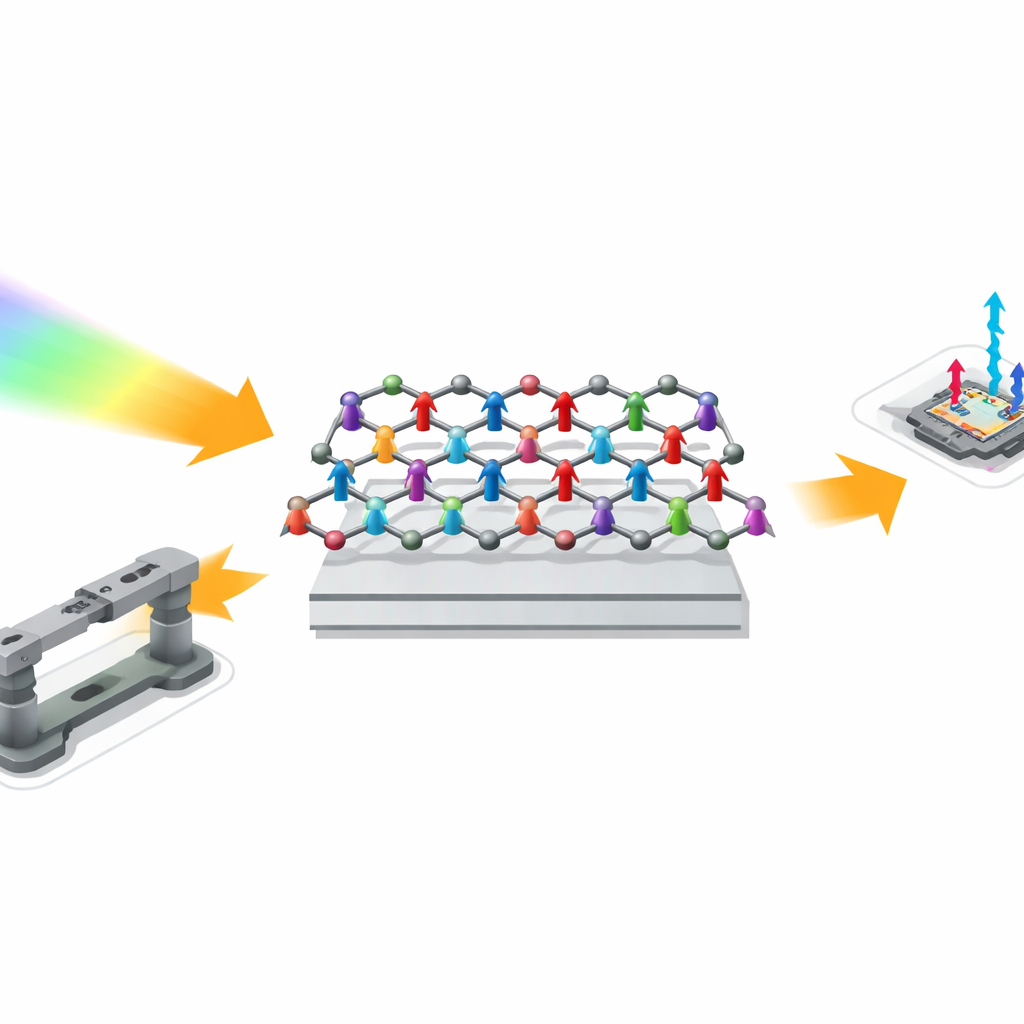
How electrons open a tiny window in energy
To answer these questions, the authors used advanced quantum-mechanical simulations based on density functional theory, augmented with extra terms to capture strong electron–electron interactions on both manganese and bismuth atoms. They show that the small band gap arises from a delicate hybridization between localized manganese d states and more extended bismuth p states. When spin–orbit coupling—a relativistic effect that ties an electron’s spin to its motion—is switched on, it reshapes these hybridized bands and dramatically shrinks the gap to about 20 milli–electron volts, consistent with transport experiments. The calculations also reveal that the valence band edge is dominated by in-plane bismuth orbitals, while the conduction band edge is largely manganese-like, with strong mixing between them; this mixing is anisotropic in the crystal and hints at possible topological behavior.
Beyond the textbook picture of magnetism
Understanding how the spins in CaMn2Bi2 can be driven out of equilibrium requires more than the usual textbook model of interacting spins. When the team tried to reproduce the energies of many different magnetic patterns with a standard Heisenberg model—where spins simply prefer to align or anti-align with their neighbors—the results were systematically off. Even adding more distant neighbors did not fix the problem. By carefully comparing dozens of simulated spin configurations, they discovered that the total imbalance between the two magnetic sublattices, known as the Néel vector, plays a central role. This led them to propose an extended spin model that adds a term depending on the square of the total magnetization, a contribution that naturally emerges from more complete treatments of strongly interacting electrons. With this extra ingredient, the model reproduces the energy hierarchy of magnetic excitations with high accuracy, even in larger simulated cells, capturing the kinds of states that ultrafast laser pulses are likely to create. 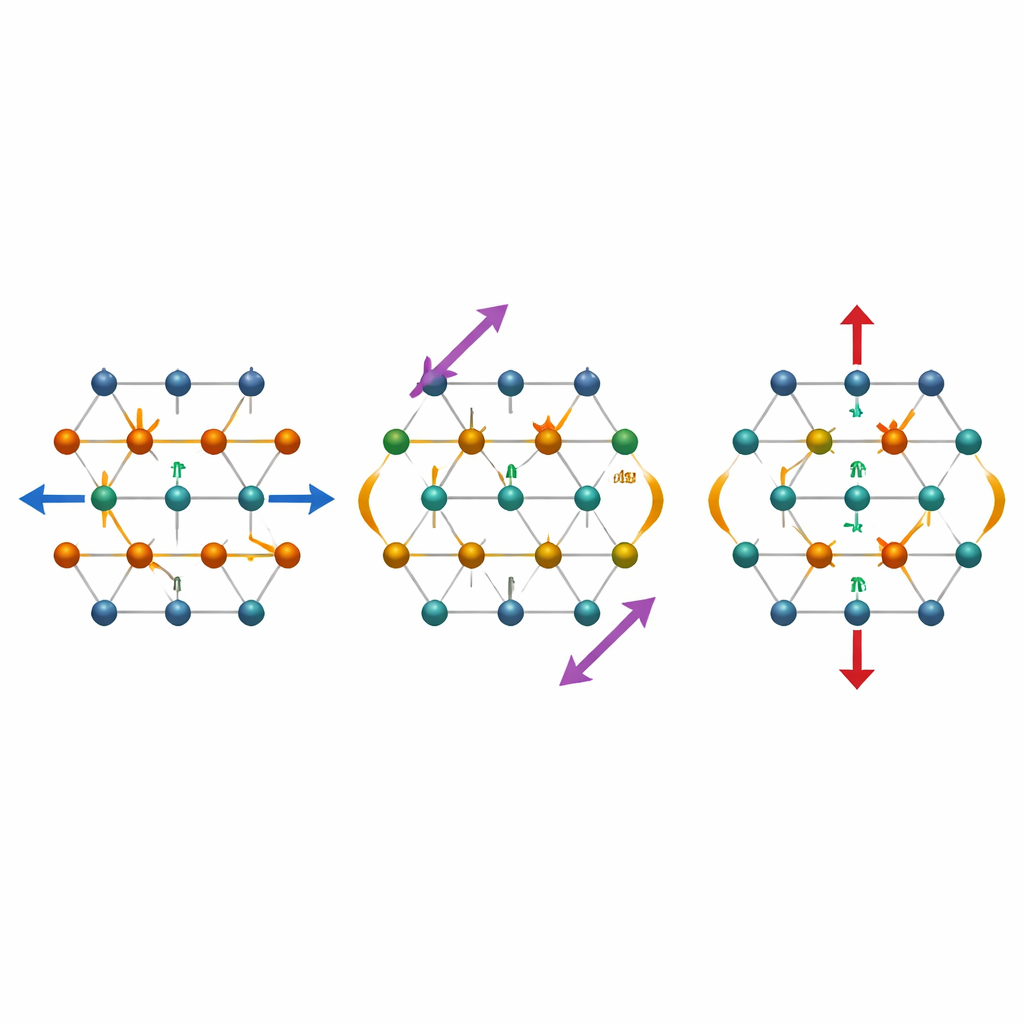
Gently stretching spins into new directions
The same simulations were used to probe how the preferred spin orientation—called magnetic anisotropy—changes when the crystal is slightly stretched or compressed in different in-plane directions. Thanks to strong spin–orbit coupling, CaMn2Bi2 already has a much larger anisotropy than common ferromagnets like iron or nickel, and it strongly prefers the spins to lie within the atomic layers rather than pointing out of the plane. The authors found that applying less than half a percent of uniaxial strain along specific crystallographic directions can rotate the in-plane easy axis, effectively steering the spins from one direction in the layer to another. This rotation is not smooth and linear: the favored direction can switch abruptly and even oscillate as the strain is varied, revealing a rich landscape of competing energy scales tied to the underlying Mn–Bi bonding.
What this means for future devices
Taken together, the results paint CaMn2Bi2 as an antiferromagnetic semiconductor whose behavior is governed by a subtle interplay between electron correlations, spin–orbit coupling and lattice distortions. For a non-specialist, the key message is that this material allows its internal magnetic compass to be reoriented by two gentle "knobs": light and strain. The refined spin model shows how unconventional magnetic excitations can emerge, while the strain study demonstrates that tiny mechanical deformations can switch the preferred spin direction without destroying the antiferromagnetic order. Such controllable, fast, and reversible switching is precisely what is needed for future spintronic and magneto-optical technologies that aim to store and process information using spins instead of charges.
Citation: Aguilera-del-Toro, R.H., Arruabarrena, M., Leonardo, A. et al. Expanded Heisenberg Hamiltonians from a Mn/Bi DFT+U study on hexagonal antiferromagnet CaMn2Bi2: excitations and strain-controlled magnetic anisotropy switching. Sci Rep 16, 10346 (2026). https://doi.org/10.1038/s41598-026-39215-x
Keywords: antiferromagnetic semiconductors, spintronics, spin orbit coupling, strain engineered magnetism, CaMn2Bi2