Clear Sky Science · en
Psychological distress and problematic social media use among Moroccan youth mediated by fear of missing out and social media engagement
Why this matters for young people and parents
For many teenagers, checking their phone is the first and last thing they do each day. This study looks at when such habits stop being harmless and start to harm mental health. Focusing on Moroccan adolescents and young adults, the researchers asked: how common is unhealthy social media use, and how is it tied to feelings of sadness, worry, and stress? They also examined whether the pull of constantly staying online—the fear of missing out—and the sheer intensity of daily use help explain this link. Their findings offer a window into how digital life and emotional well-being are becoming tightly intertwined for today’s youth.
How social media use can turn into a problem
Social media brings clear benefits: it helps young people stay in touch, build friendships, and explore who they are. But the same platforms can also encourage nonstop scrolling, late-night checking, and a sense that life offline is never quite enough. In this study, the authors define “problematic social media use” as a pattern in which online activity becomes so dominant that it disrupts daily life, sleep, schoolwork, or relationships, and continues despite negative consequences. Drawing on earlier research, they note that this pattern looks less like simple heavy use and more like an addictive style of engagement, driven by the constant rewards of likes, comments, and endlessly refreshed feeds.
What the researchers did in Moroccan schools
The team surveyed 2,202 students aged 14 to 23 from secondary schools across urban and rural regions of Morocco. Using validated questionnaires, they measured symptoms of depression, anxiety, and stress; how strongly students feared missing out on what others were doing; how often and intensely they engaged with social media throughout the day; and how many signs of problematic use they showed. They also collected background information, such as gender, family income, type of school program, and hours spent daily on social platforms. With these data, they estimated how common problematic use was and built a statistical model to see how emotional distress, fear of missing out, and engagement interacted. 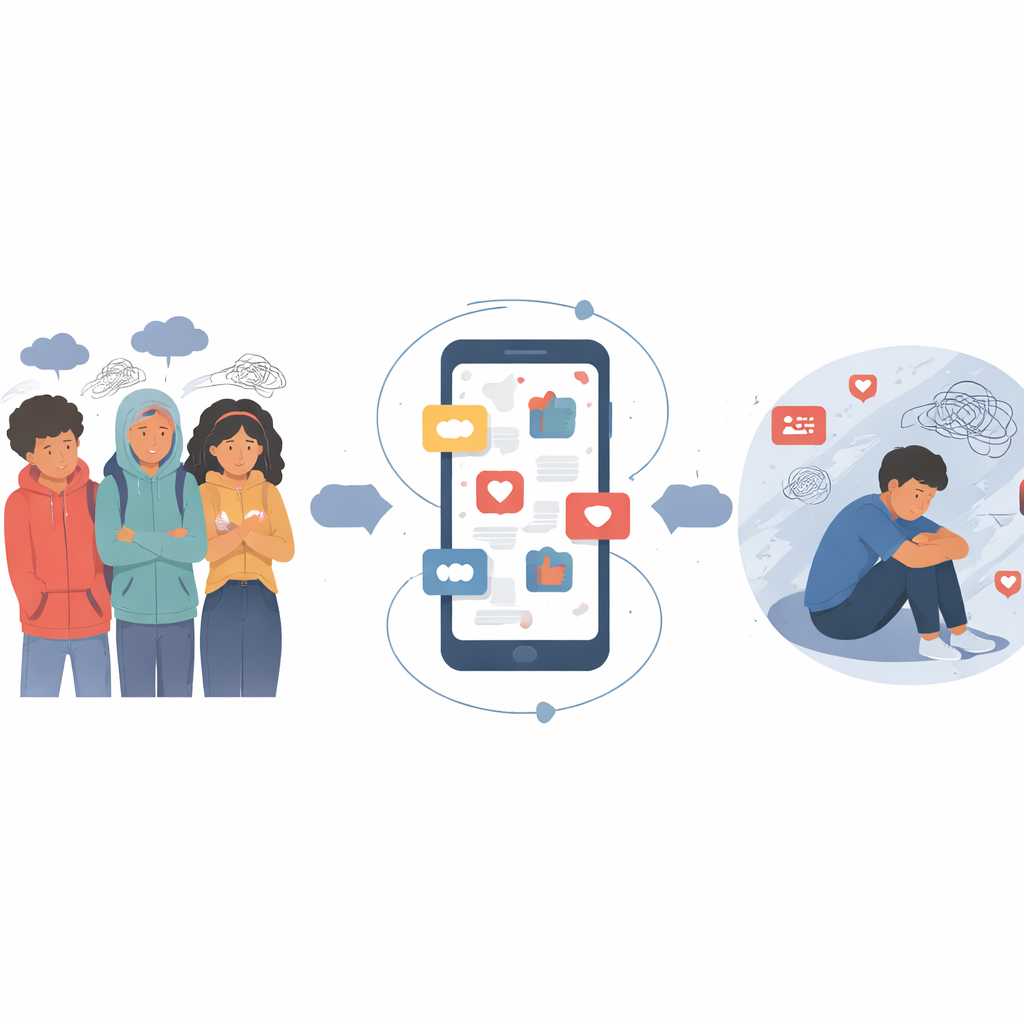
Who is most affected and how emotions play a role
Roughly one in four participants (25.5 percent) met the threshold for problematic social media use—a level similar to some studies in Turkey and Iran and higher than many Western estimates. Rates were especially elevated among girls, older teens and young adults, students in urban areas, and those from families with fewer economic resources. Young people who spent more than seven hours a day on social platforms were particularly likely to report difficulties. Just as striking, the more severe a student’s depression, anxiety, or stress, the more likely they were to show problematic patterns; for instance, over half of those with extremely severe depression fell into the risk group. These patterns suggest that emotional struggles and heavy social media involvement often go hand in hand.
The pull of staying connected all the time
To dig deeper, the researchers tested whether the fear of missing out and everyday engagement with platforms helped translate emotional distress into problematic use. Their structural equation model—an advanced way of mapping connections among many factors at once—showed that depression, anxiety, and stress all had both direct and indirect links to problematic use. Indirect links operated through fear of missing out and through how woven into daily routines social media had become. For example, a teenager feeling depressed might be more prone to worry that others are having better experiences, which pushes them to check apps more often, spend more hours online, and gradually slide into more compulsive behavior. Together, these psychological and behavioral pathways explained about 35 percent of the differences in problematic use across students, a substantial share for such a complex human behavior. 
What this means for protecting youth
The study concludes that problematic social media use is a significant concern among Moroccan adolescents and young adults, closely tied to emotional distress and shaped by fears of being left out and by heavy, routine engagement with platforms. For families, educators, and policymakers, the message is not to demonize social media but to recognize when it becomes a fragile coping strategy rather than a source of connection. Preventive efforts, the authors argue, should combine mental health support with practical guidance on healthy digital habits—limiting excessive screen time, encouraging offline hobbies and friendships, and helping young people resist the constant pressure to stay online. Tailoring such programs to local culture and conditions will be key to safeguarding youth well-being in an increasingly connected world.
Citation: Abbouyi, S., Bouazza, S. & Zarrouq, B. Psychological distress and problematic social media use among Moroccan youth mediated by fear of missing out and social media engagement. Sci Rep 16, 8184 (2026). https://doi.org/10.1038/s41598-026-39206-y
Keywords: problematic social media use, adolescent mental health, fear of missing out, digital well-being, Moroccan youth