Clear Sky Science · en
Research on drowsiness detection in UAV operators based on the random decision forest method
Why keeping drone pilots awake matters
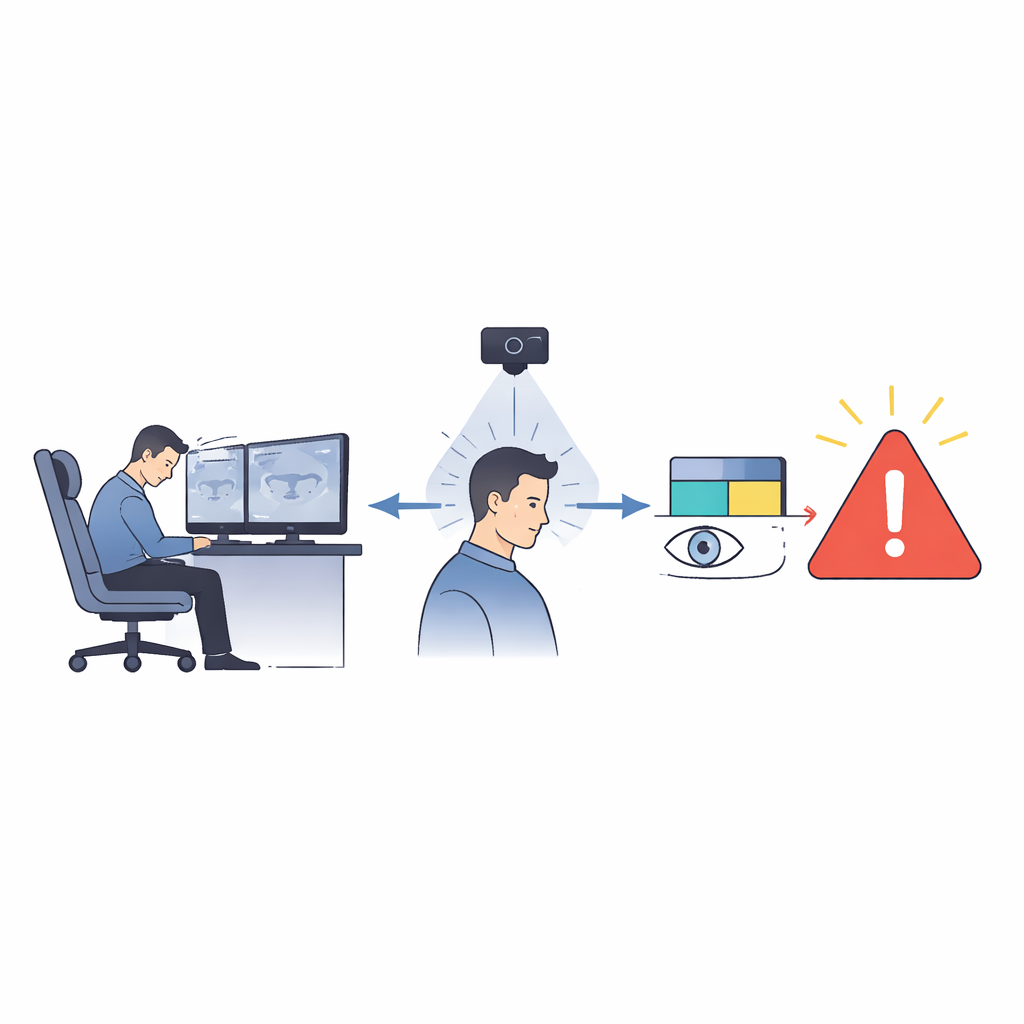
As drones take on more jobs—from inspecting power lines to supporting rescue missions—the people flying them from the ground must stay sharply focused. Yet long missions, repetitive screens, and night shifts can quietly push operators toward drowsiness, raising the risk of costly or even deadly mistakes. This paper explores how a camera-based system can watch a pilot’s face in real time and use a transparent machine-learning method to decide when someone is getting too sleepy to fly safely.
Three ways to spot a sleepy operator
The authors begin by outlining three broad families of drowsiness detection. One looks at how a vehicle behaves: weaving within a lane, drifting off course, or making more control errors. Another monitors signals from the body and brain, such as brain waves, heart rhythm, breathing, or skin conductance. These approaches can be accurate but often require people to wear sensors, which can be uncomfortable and impractical in real control rooms. The third family watches outward behavior: how often someone blinks, how long their eyes stay closed, whether they yawn, and how their head tilts. Because cameras can capture this information without touching the operator, behavioral methods are especially attractive for drone control centers.
Reading signs from the face
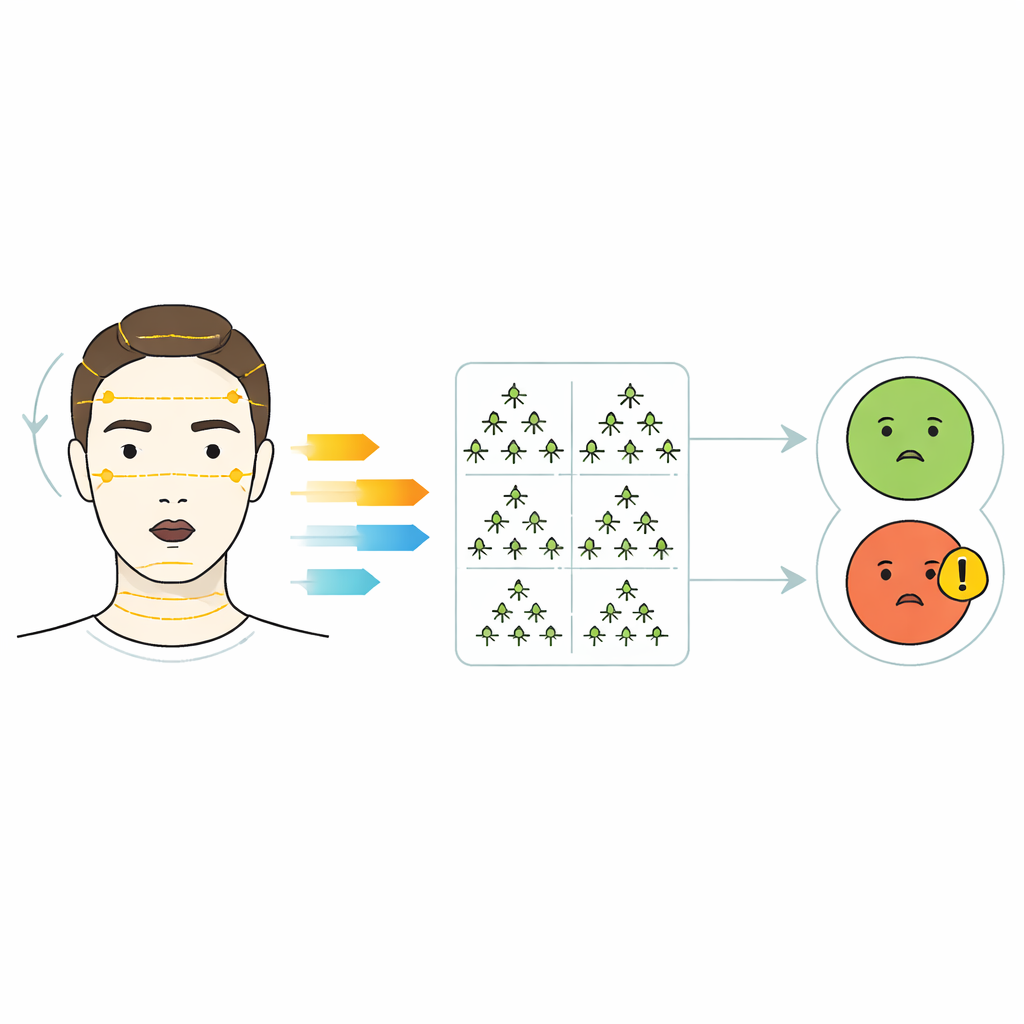
The system developed in this study focuses on a handful of facial clues that past research links to drowsiness. A computer-vision library tracks 3D points on the operator’s face in a live video feed. From these landmarks, the program computes the “eye aspect ratio” to gauge how open the eyes are, the fraction of time the eyes stay mostly closed over a minute (a well-known measure called PERCLOS), how wide the mouth opens, and how far the head tilts forward, backward, or sideways. The software runs quickly enough on consumer hardware to give near-real-time feedback, and it also logs all measurements for later analysis.
A simple rule with a smart backup
To decide whether a pilot is drowsy, the authors combine a trusted rule with a more flexible model. PERCLOS, which has strong support in sleep and safety research, serves as the primary gatekeeper: very low values indicate alertness, very high values indicate drowsiness. When PERCLOS falls in an in-between range, the system turns to a random forest classifier that looks at eye opening, mouth opening, and head tilt together. A random forest is a group of many small decision trees, each voting on the state; their combined vote determines the outcome. The system also smooths decisions over a short time window, so a single odd frame does not trigger an unnecessary alarm.
Seeing inside the model’s thinking
Unlike many deep-learning systems that act as opaque “black boxes,” a random forest can be probed to reveal how it reaches its decisions. The authors trained their model on a widely used driving-drowsiness video dataset and tested it both on held-out subjects from that set and on a separate database. Performance was solid, with the system more likely to raise a false alarm than to miss a genuinely sleepy operator—a safer trade-off in aviation. By plotting how the predicted risk changes as each feature varies, they show, for example, that very small eye openings strongly push the model toward a drowsy verdict, while extreme head tilts become suspicious only beyond a certain angle. A feature-importance analysis confirms that eye openness dominates the model’s judgement, with mouth opening and head tilt playing supporting roles.
What this means for safer drone flights
The study concludes that an interpretable facial-monitoring system, anchored by a well-validated eyelid-closure measure and supported by a random forest, can reliably flag drowsiness in drone operators without wiring them to medical instruments. At the same time, the transparent model exposes biases and gaps in the training data, guiding how future systems should be improved—for example, by adding more varied subjects, lighting conditions, and additional signals from the drone itself. In plain terms, this work shows a path toward cockpit-style safety monitoring for remote pilots that is both practical to deploy and open to inspection, helping organizations trust and refine the technology that watches over their crews.
Citation: Wojtowicz, K., Wojciechowski, P. & Panasiewicz, A. Research on drowsiness detection in UAV operators based on the random decision forest method. Sci Rep 16, 9726 (2026). https://doi.org/10.1038/s41598-026-39195-y
Keywords: drowsiness detection, drone operators, facial monitoring, random forest, flight safety