Clear Sky Science · en
Turbulence and particle dynamics in volcanic clouds in humid atmospheres
Why watery volcanoes matter
When we picture a volcanic eruption, we tend to focus on fire, ash, and lava. But in January 2022, the Hunga Tonga–Hunga Ha’apai eruption added something unusual to the mix: an enormous dose of water, blasted higher into the atmosphere than ever seen before. That moisture helped drive record-breaking lightning and a vast mushroom-shaped cloud that wrapped halfway across a continent. This study asks a deceptively simple question with big consequences for aviation, climate, and hazard warnings: how does extra moisture in the air and in the eruption itself change the way a volcanic cloud grows, churns, and flashes with lightning?

A record-setting blast above the ocean
The researchers take the 2022 Hunga Tonga–Hunga Ha’apai (HTHH) event as their starting point. This undersea volcano produced one of the most powerful eruptions ever measured by modern instruments, sending a towering column of material up to roughly 57–58 kilometers high and expanding into an umbrella-shaped cloud some 400 kilometers wide in under an hour. Unusually, the eruption pumped immense amounts of water vapor into layers of the atmosphere that are normally very dry. At the same time, lightning detection networks recorded almost 400,000 flashes in about six hours, many of them forming striking circular “rings” of activity around the eruption column. Later weather-balloon data showed that after the first phase of the eruption, the air tens of kilometers up had become much more humid, setting the stage for a second series of explosive pulses.
Following rings of light to hidden motions
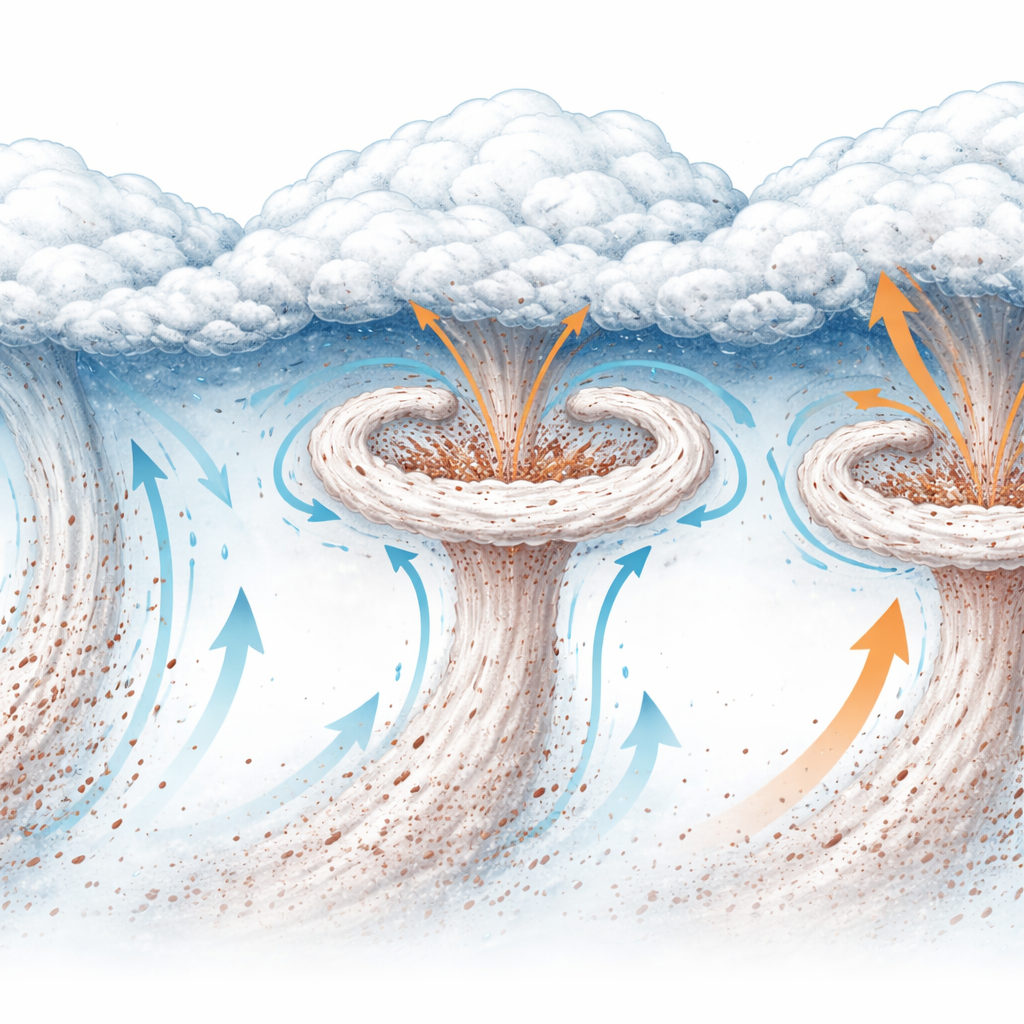
Those lightning rings turned out to be more than just a curiosity. Because thick ash clouds block direct views into the heart of the plume, the pattern of lightning offers a rare window into the invisible churning motions—eddies, vortex rings, and turbulent swirls—inside. Earlier work had suggested that turbulence within the umbrella cloud pushes ash and ice particles into ring-like zones, where they collide more often and build up electric charge, triggering lightning. However, that earlier modeling treated the atmosphere as dry, even though HTHH clearly unfolded in an extremely moist environment. The new study sets out to explore how humidity, both in the background air and in the erupting mixture, reshapes those turbulent rings, affects plume height, and changes how particles move and collide.
Building a digital volcano in a moist sky
To tackle this, the team used high-resolution three-dimensional computer simulations of a moist, stably layered atmosphere, into which they injected a simple, continuous “eruption” from below. Instead of recreating every detail near the volcanic vent, they focused on the umbrella region where the plume spreads out and produces most lightning. Their model can independently adjust how humid the atmosphere is and how much water the plume carries, allowing them to compare “drier” and “wetter” worlds while keeping the eruption’s overall power similar. Millions of virtual particles, representing ash and ice of two different sizes, were tracked as they rose, spread, and clustered. By counting how often fast and slow particles overlapped in turbulent regions, the scientists could estimate where collisions—and therefore electrification—would be most intense.
How extra moisture squeezes and lifts the cloud
The simulations reveal a consistent story. As humidity increases, either because the surrounding air is more saturated or because the plume itself carries more water, condensation occurs at lower heights and releases additional heat. This boosts the buoyancy of the rising column, sending particles to greater altitudes—up to about 60 kilometers or more in the wettest cases. At the same time, the strongest turbulent eddies and the associated ring of concentrated particles shift inward, closer to the eruption axis. In relatively dry conditions, the main turbulent ring forms at about 40 kilometers from the vent, resembling the wide lightning ring seen during the first HTHH pulse. In moister scenarios, the ring contracts to roughly 20 kilometers, matching the tighter ring observed during the second phase, which erupted into an atmosphere already moistened by the earlier blast. The cloud’s horizontal spread also slows as humidity rises, trading breadth for height and stronger internal churning.
Ripples, waves, and what lightning can tell us
Another feature emerging from the simulations is a gentle, wave-like bobbing of the plume top. These gravity-wave oscillations, with periods of several minutes, become more prominent in humid cases and modulate how high particles reach. Yet the places where collisions peak still line up mainly with pockets of intense turbulence, rather than with the waves alone. Overall, the work supports the idea that lightning patterns—especially rings—can serve as a real-time proxy for invisible properties of the plume, such as turbulence strength, moisture content, and the distribution of ash and ice. That, in turn, could help scientists infer how an eruption is evolving even when direct visual data are blocked by previous clouds, night-time conditions, or distance.
What this means for future eruptions
To a non-specialist, the key message is that water is not just a passenger in giant eruptions—it is an active driver. Moisture can make volcanic clouds grow taller, squeeze their turbulent cores inward, and reshape where particles collide and lightning flashes. The Hunga Tonga eruption provided a natural experiment in an unusually wet stratosphere, and this study shows how such conditions can leave a clear fingerprint in lightning rings and plume behavior. In the future, combining models like this with satellite and lightning data may allow faster assessments of eruption strength and hazards, improving warnings for aviation and for communities living under these towering, watery thunderclouds from below the sea.
Citation: Zapata, F., Mininni, P.D., Ravichandran, S. et al. Turbulence and particle dynamics in volcanic clouds in humid atmospheres. Sci Rep 16, 8111 (2026). https://doi.org/10.1038/s41598-026-39193-0
Keywords: volcanic lightning, ash plumes, atmospheric moisture, turbulence, Hunga Tonga eruption