Clear Sky Science · en
The evolution characteristics of leakage current in traction network surge arresters under complex operating conditions
Why keeping freight trains running safely matters
Modern heavy freight railways move huge amounts of coal, ore, and goods with electric locomotives. To do this safely, the power lines above the tracks must survive lightning strikes, sudden load changes, and electrical disturbances created by the trains themselves. This paper looks at a key protective device on those lines—the surge arrester—and explains how its tiny leakage currents reveal whether it is quietly standing guard or has just fought off a dangerous surge. Understanding these patterns could make rail power systems more reliable while cutting unnecessary maintenance.
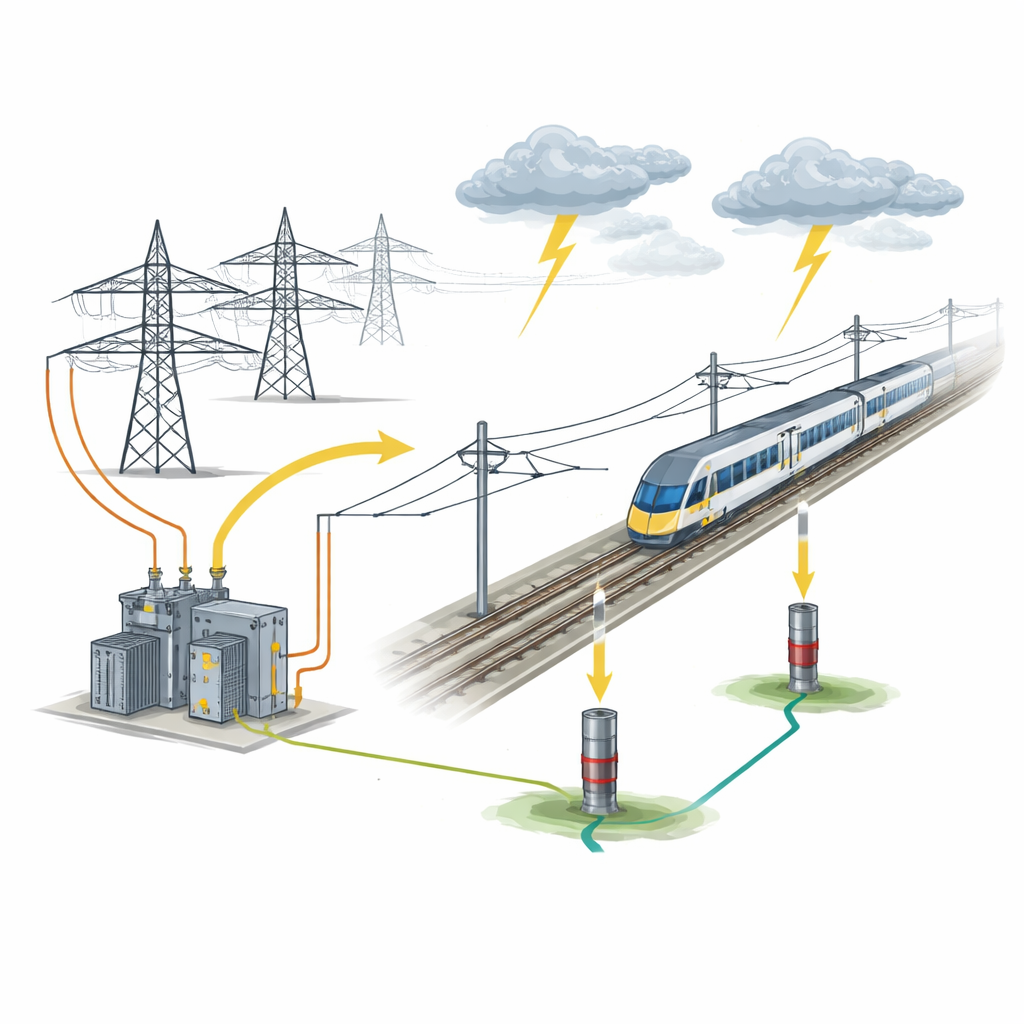
The hidden guardians of the rail power grid
Electric freight railways use a special single‑phase power system with overhead wires and the rails themselves carrying current. When lightning strikes or when voltages swing too high, surge arresters act like safety valves, channeling excess energy safely to ground and preventing damage to substations, insulators, and signaling equipment. Today, many railways simply count how often these arresters operate using mechanical counters. But counters cannot tell whether a recorded operation was due to lightning, a switching event, or harmless voltage ripple from train equipment, leading to either over‑servicing healthy arresters or leaving stressed ones in place.
Simulating a real railway in the computer
The authors built a detailed digital model of a 30‑kilometer heavy‑haul railway in the PSCAD simulation program. The model includes the traction substation, a constant‑power electric locomotive that produces realistic high‑frequency harmonics, the overhead contact system and rails, and surge arresters placed 10 and 20 kilometers from the train. With this virtual railway, they replayed a variety of real‑world situations: normal operation with and without harmonics, faults and line breaks on the upstream grid, switching events, and direct lightning strikes on the line. For each case, they tracked how voltage and leakage current in the arresters evolved in time.
How different disturbances leave distinct electrical fingerprints
Under normal conditions without strong harmonics, the leakage current in arresters along the line is small and almost the same at different locations, and it hardly changes as the train moves. When high‑frequency harmonics from the locomotive are added, the arrester closest to the train sees a much larger current—enough to trigger it and increment its counter—while the more distant arrester hardly notices. Faults on the external power grid behave differently. Short‑circuit faults actually lower the voltage on the rail side, slightly reducing arrester current. By contrast, line breaks and out‑of‑phase switching create overvoltages rich in low‑frequency components around 20 Hz, causing the arrester current to rise in slow, periodic pulses tied to the overvoltage peaks.
Separating routine surges from true lightning events
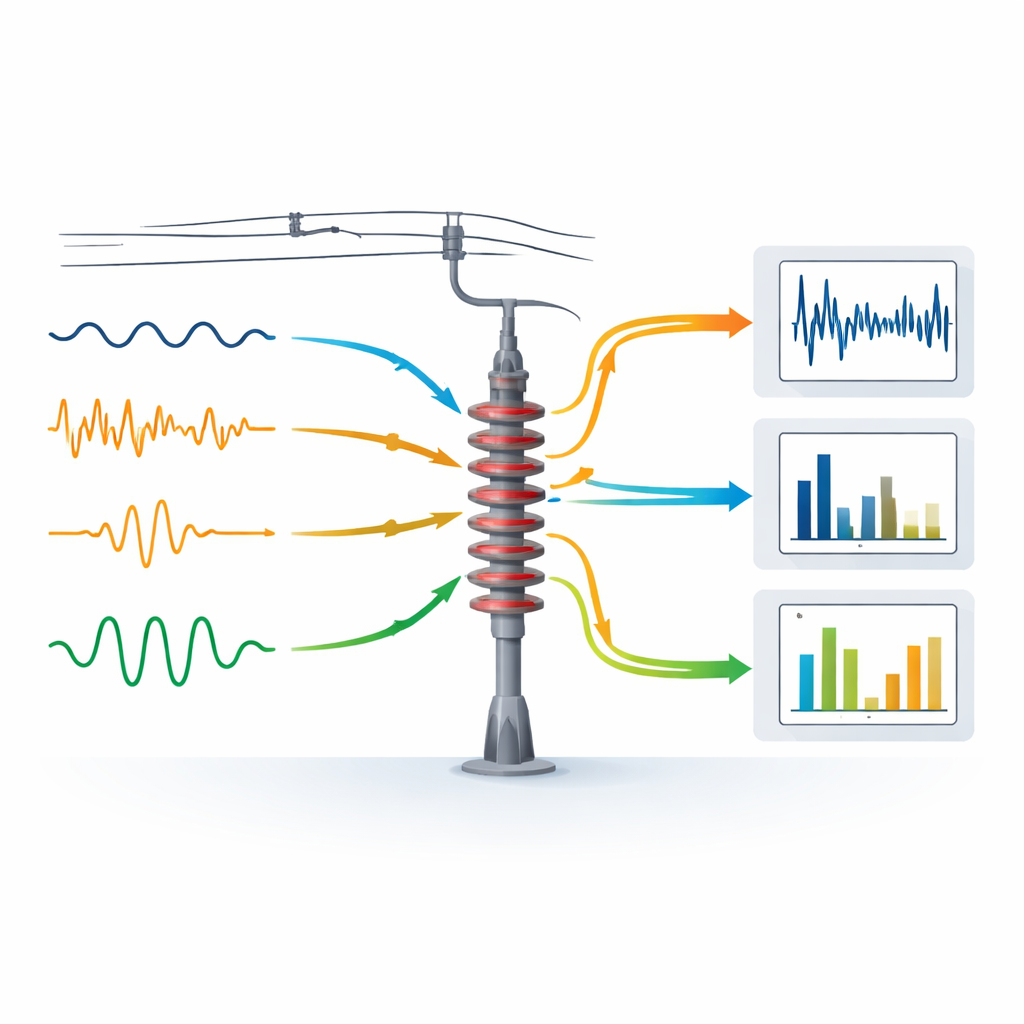
Switching operations on the railway generate brief overvoltages that drive the arrester current to roughly 1,100 microamps—about two and a half times the normal level—for only a few thousandths of a second. Lightning impulses look similar but far more extreme: the arrester current can double again to around 2,200 microamps, and the oscillations occur on a microsecond scale. To tell these cases apart automatically, the authors analyze the monitored leakage current in three complementary ways. First, they track simple mathematical indicators: the average current and a fast energy measure called the Teager Energy Operator, which highlights sharp changes. Second, they decompose the current into its frequency components, revealing whether it is dominated by power‑frequency, low‑frequency, or very high‑frequency content. Third, they estimate how much heat is being generated inside the arrester over time, which rises sharply after certain types of line breaks but barely changes during the very brief lightning and switching surges.
A roadmap for smarter, targeted monitoring
By combining these three views—overall level, frequency makeup, and heating—the paper proposes thresholds that let an online monitoring system distinguish between harmless harmonics, external grid faults, operational overvoltage, and genuine lightning strikes using just the arrester’s leakage current. For example, low‑frequency components below the normal power frequency point to broken‑line faults, while strong bursts of very high‑frequency energy and large average current jumps signal lightning. This richer interpretation of what surge arresters “feel” in service could help rail operators schedule maintenance only when it is truly needed and react more quickly to dangerous faults, improving both safety and efficiency on heavy‑load railways.
Citation: Pengxiong, W., Lifeng, F., Yongqiang, G. et al. The evolution characteristics of leakage current in traction network surge arresters under complex operating conditions. Sci Rep 16, 8106 (2026). https://doi.org/10.1038/s41598-026-39185-0
Keywords: railway electrification, surge arrester monitoring, lightning protection, power system harmonics, fault diagnosis