Clear Sky Science · en
Entanglement swapping through the amplitude damping noise channel
Why vanishing quantum links matter
Quantum technologies promise ultra-secure communication and powerful new kinds of computing, all built on a strange connection called entanglement—where two particles share a linked fate, no matter how far apart they are. But in the real world, these fragile links must travel through optical fibers and devices that inevitably lose energy. This paper asks a simple but crucial question: when we try to build long-distance quantum connections using a process called entanglement swapping, how badly does ordinary signal loss damage the invisible ties between particles, and under what conditions do those ties disappear altogether?
Building distant links without touching
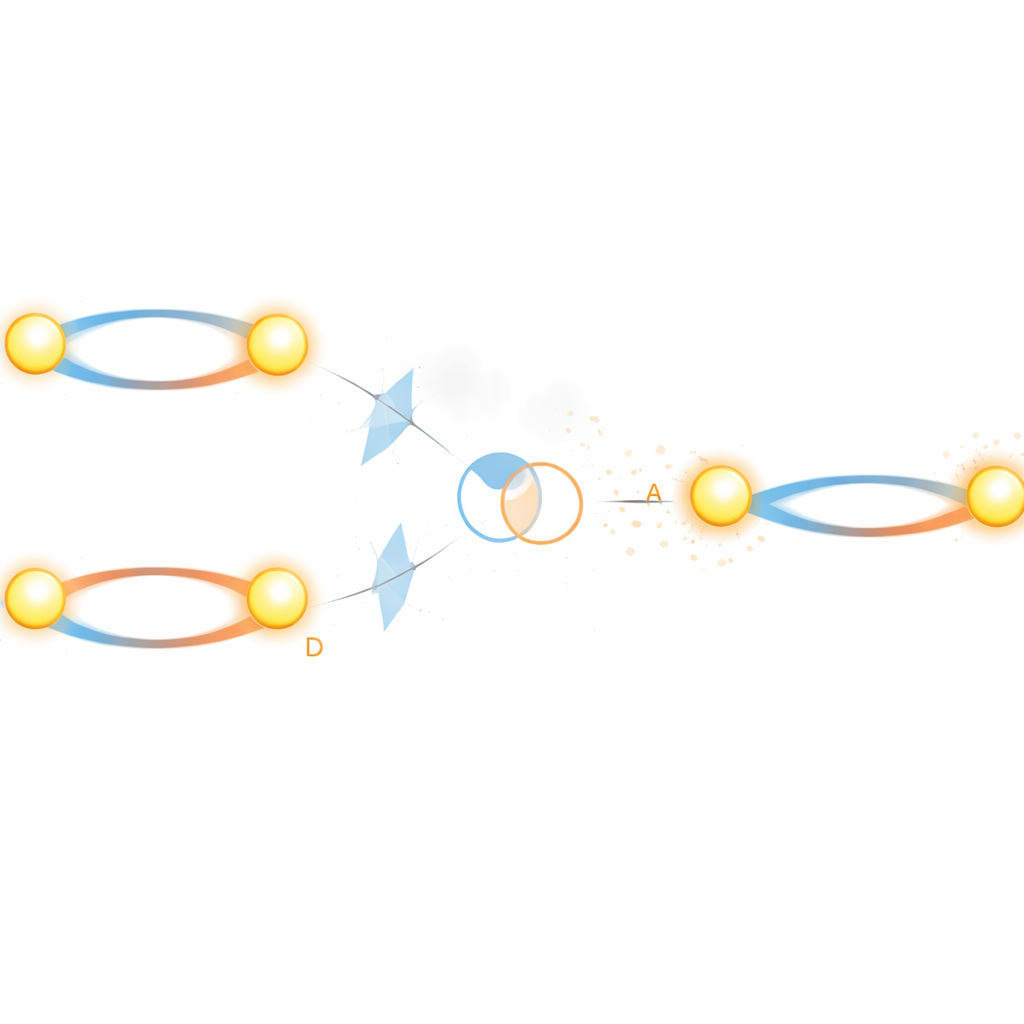
Entanglement swapping lets two far-apart particles become linked even though they never meet. Imagine two separate pairs of entangled photons: one shared between Alice and Bob, and another between Bob and Charlie. If Bob performs a special combined measurement on his two photons, the remaining photons—one with Alice and one with Charlie—end up entangled with each other. In a perfect, noiseless world, this trick would reliably generate strong entanglement across long distances and could be chained together to create quantum repeaters and ultimately a quantum internet.
When the channel itself eats the signal
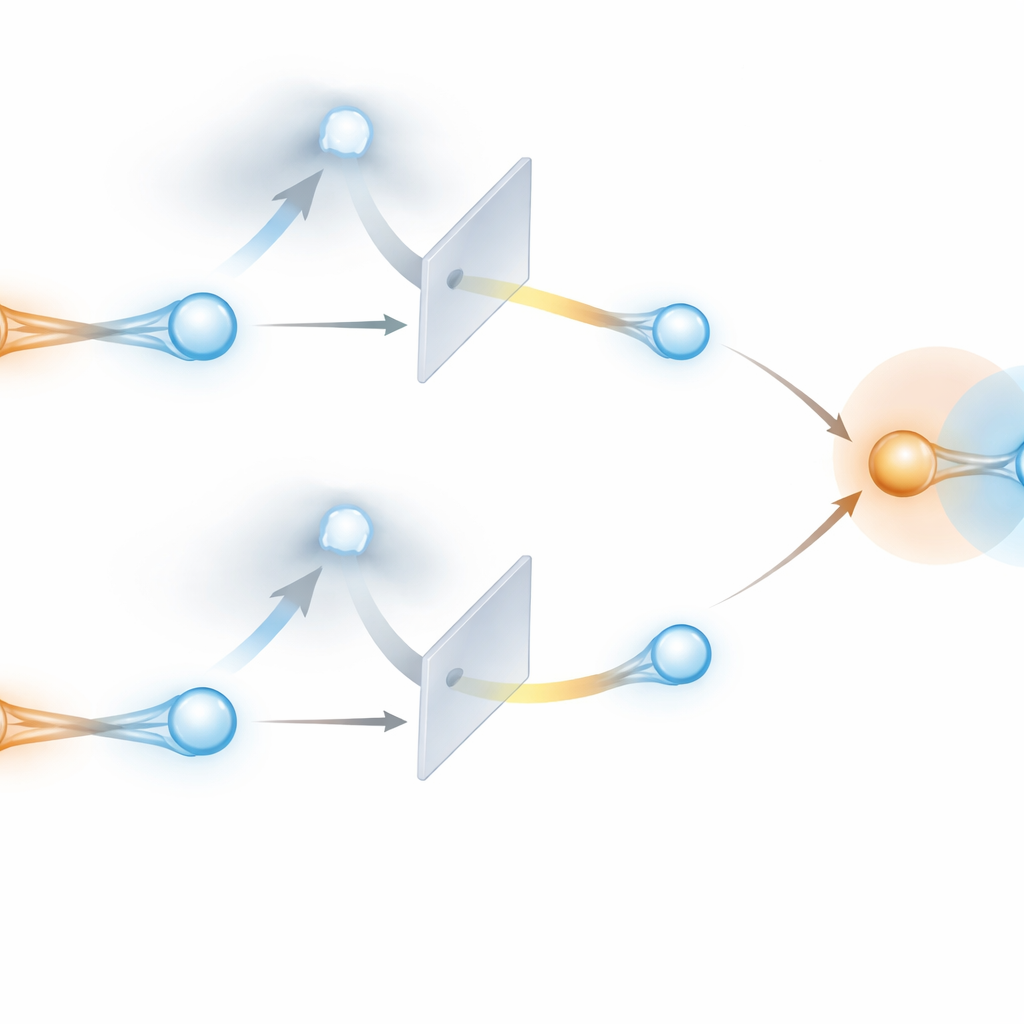
The authors focus on a very common kind of disturbance known as amplitude damping, which captures simple energy loss—like photons being absorbed or scattered as they travel. They model this loss using beam splitters, devices that route part of a light beam forward and part of it away, mimicking how some photons are transmitted while others are lost to the environment. By sending the “middle” photons involved in entanglement swapping through such lossy channels, they derive exact mathematical expressions that describe how the shared quantum state evolves, how close it remains to the ideal target state (its fidelity), and how strongly it stays entangled (its concurrence).
Tracking how quality and linkage decay
With these formulas in hand, the paper turns to the especially important case where both starting pairs are as entangled as nature allows. Even then, the results show that increasing loss in the channels steadily lowers both fidelity and concurrence of the final distant pair. In practical terms, the output pair becomes both less like the ideal “perfectly linked” state and less entangled overall. The authors simulate how these quantities change as they vary the transmission and reflection of the beam splitters, which stand in for different levels of channel loss. Better transmission corresponds to weaker noise and yields higher fidelity and stronger entanglement; stronger reflection, which directly represents photon loss, drives both measures downward.
A sharp threshold for keeping quantum ties
Strikingly, the study finds that entanglement swapping does not automatically guarantee entanglement in the final pair. There is a clear threshold: the product of the transmissions of the two lossy channels must exceed the product of their reflections. If this condition is not met, the entanglement in the output state vanishes completely, even though the input pairs began perfectly entangled. A particularly revealing example is the widely used 50:50 beam splitter, which transmits and reflects light equally. In this symmetric case, the threshold condition fails exactly, and the swapped state ends up entirely unentangled—its quantum link has been destroyed, even though the process still produces a state with a nonzero apparent “closeness” to the ideal target.
What this means for future quantum networks
For non-specialists, the message is clear: simply starting with perfect quantum links is not enough. The channels and devices that connect them must be engineered so that genuine transmission outweighs loss beyond a precise threshold, or else entanglement swapping will silently fail. By providing explicit formulas and a simple design rule for when entanglement survives, this work gives engineers and physicists a practical yardstick for building quantum repeaters and networks that can withstand everyday noise. It highlights both the vulnerability of quantum connections to ordinary loss and the possibility of taming that fragility with carefully designed hardware.
Citation: Xing, J., Zhang, F. Entanglement swapping through the amplitude damping noise channel. Sci Rep 16, 8194 (2026). https://doi.org/10.1038/s41598-026-39183-2
Keywords: quantum entanglement, entanglement swapping, quantum communication, photon loss, quantum repeaters