Clear Sky Science · en
Work-related factors and mental health among home care nurses identified by two-step cluster analysis
Why this story matters
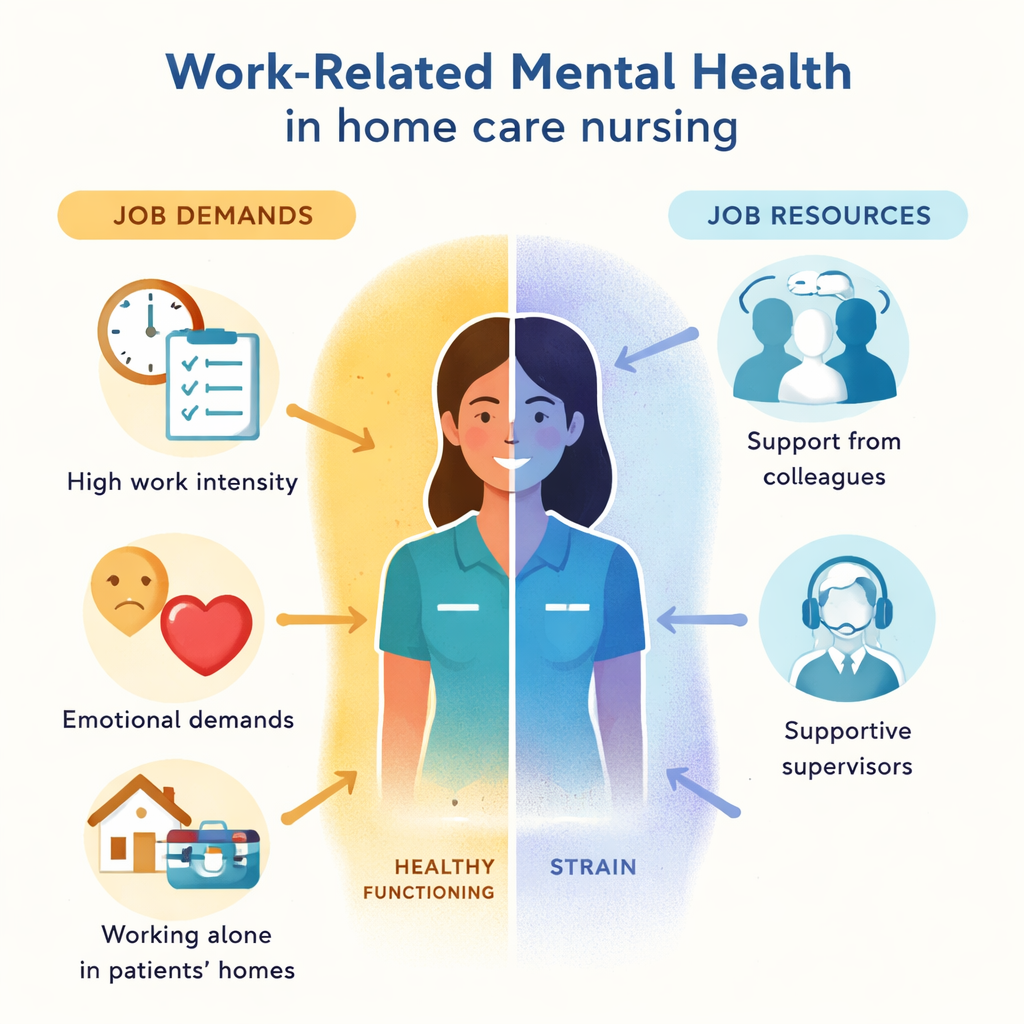
Across aging societies, more people want to stay in their own homes as they grow older or live with chronic illnesses. That makes home care nurses the quiet backbone of modern healthcare. Yet these nurses often work alone, under time pressure, and in emotionally intense situations. This study from Germany asks a simple but urgent question: which aspects of their daily work are most closely tied to their mental well-being, and what could be changed to protect both nurses and patients?
A closer look at nurses on the road
The researchers surveyed 976 home care nurses across Germany using a detailed online questionnaire. They asked about working conditions, such as how fast nurses must work, how emotionally demanding their tasks feel, and how much support they receive from colleagues and supervisors. They also measured signs of mental strain, including how easily nurses can “switch off” after work, how exhausted they feel, and how energized and enthusiastic they remain about their jobs. By comparing results with data from the general working population, the authors could see whether home care nurses face unusually high levels of stress.
Warning signs beneath the surface
The responses revealed a demanding everyday reality. Over a third of nurses said they often or always had to work very fast, and more than half described their work as strongly emotionally demanding. Many reported needing to hide their feelings or opinions while on the job. At the same time, signs of strain were common: about half frequently felt physically or emotionally exhausted, and many struggled to mentally disconnect from work during their free time. A key signal was “irritation” — being preoccupied with work problems or quickly annoyed. On average, home care nurses scored much higher on irritation than a representative sample of German workers, suggesting that this group is especially at risk for longer-term problems such as burnout or depression.
Two groups, two very different mental states
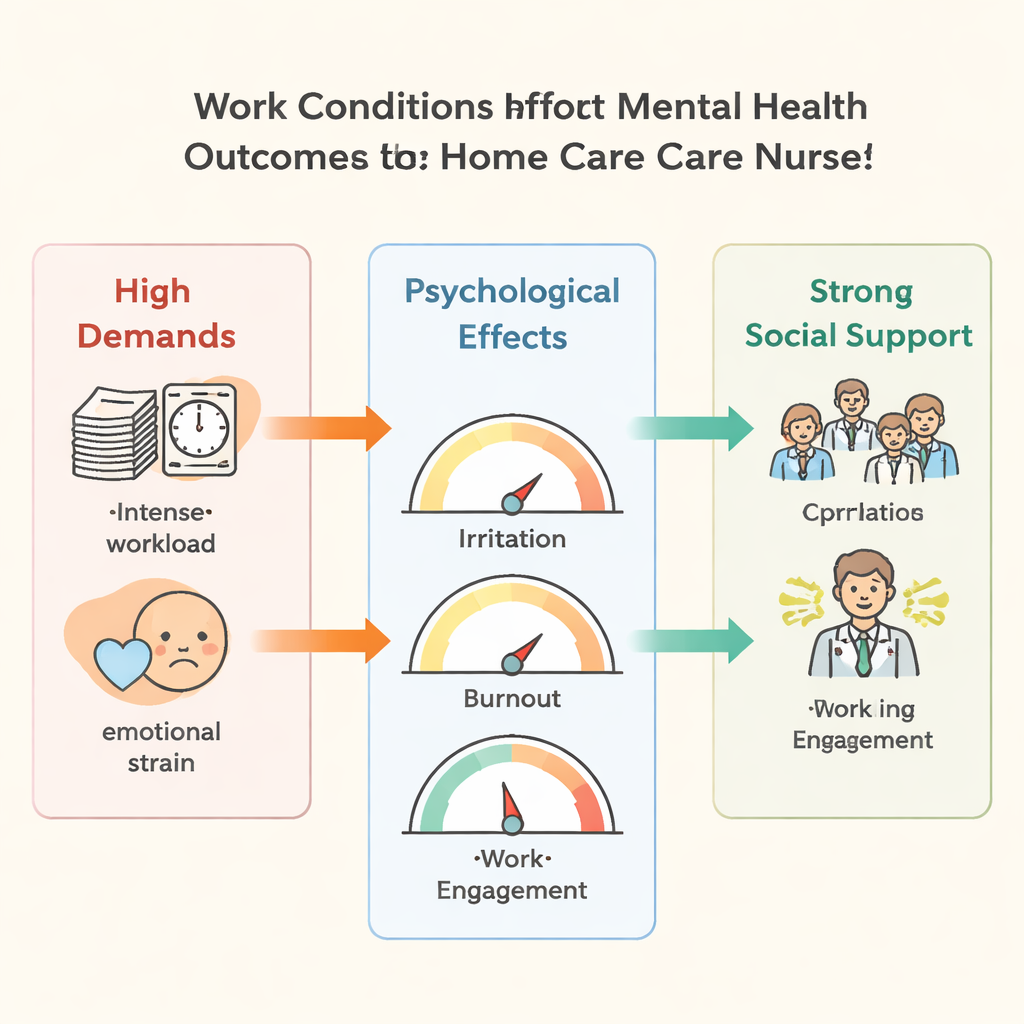
To better understand patterns within the data, the researchers grouped nurses using a statistical clustering method. Two clear subgroups emerged. One group, labeled the “healthy” subgroup, showed lower irritation and burnout and higher work engagement: these nurses still felt energetic and absorbed in their work. The other, the “unhealthy” subgroup, combined high irritation and burnout with lower enthusiasm. Apart from age — with slightly more older nurses in the healthier group — the two subgroups did not differ much in gender, family status, or years of experience. This suggests that it is the work situation itself, rather than who the nurses are, that largely shapes their mental health.
What pushes nurses toward strain — and what pulls them back
The heart of the study was to pinpoint which job factors best predicted whether nurses landed in the healthy or unhealthy subgroup. Two stood out as risks: emotional demands and work intensity. The more emotionally challenging the work felt, and the more rushed and overloaded the schedule, the more likely a nurse was to be in the unhealthy cluster. In contrast, social support acted as a powerful shield. When nurses felt they could rely on colleagues and supervisors — to listen, to offer help, to discuss difficult situations — their chances of belonging to the healthier group rose sharply. Interestingly, having more influence over tasks and schedules, often seen as a helpful resource, did not make a major difference here, possibly because autonomy is already relatively high in home care.
What needs to change
For non-specialists, the main takeaway is straightforward: the mental health of home care nurses hinges on how intensely they must work, how emotionally loaded their tasks are, and whether they feel backed by a real team, even when they spend most of their day alone in patients’ homes. The authors argue that improving working conditions is not just about kindness to staff; it is essential for safe, high-quality care. They call for targeted measures to reduce time pressure — for example, paying for the time actually needed rather than fixed task lists — and for building stronger social support, such as regular peer meetings, accessible supervisors by phone or video, and structured programs that teach nurses how to handle emotional strain. Protecting the minds of those who care for others, they emphasize, is key to keeping home care both humane and sustainable.
Citation: Petersen, J., Melzer, M. Work-related factors and mental health among home care nurses identified by two-step cluster analysis. Sci Rep 16, 6360 (2026). https://doi.org/10.1038/s41598-026-39178-z
Keywords: home care nursing, work stress, burnout, social support, mental health