Clear Sky Science · en
Two-boosting-staged single-switched ultrahigh step-up topology with continuous input current and reduced voltage stress
Turning Small Power into Big Power
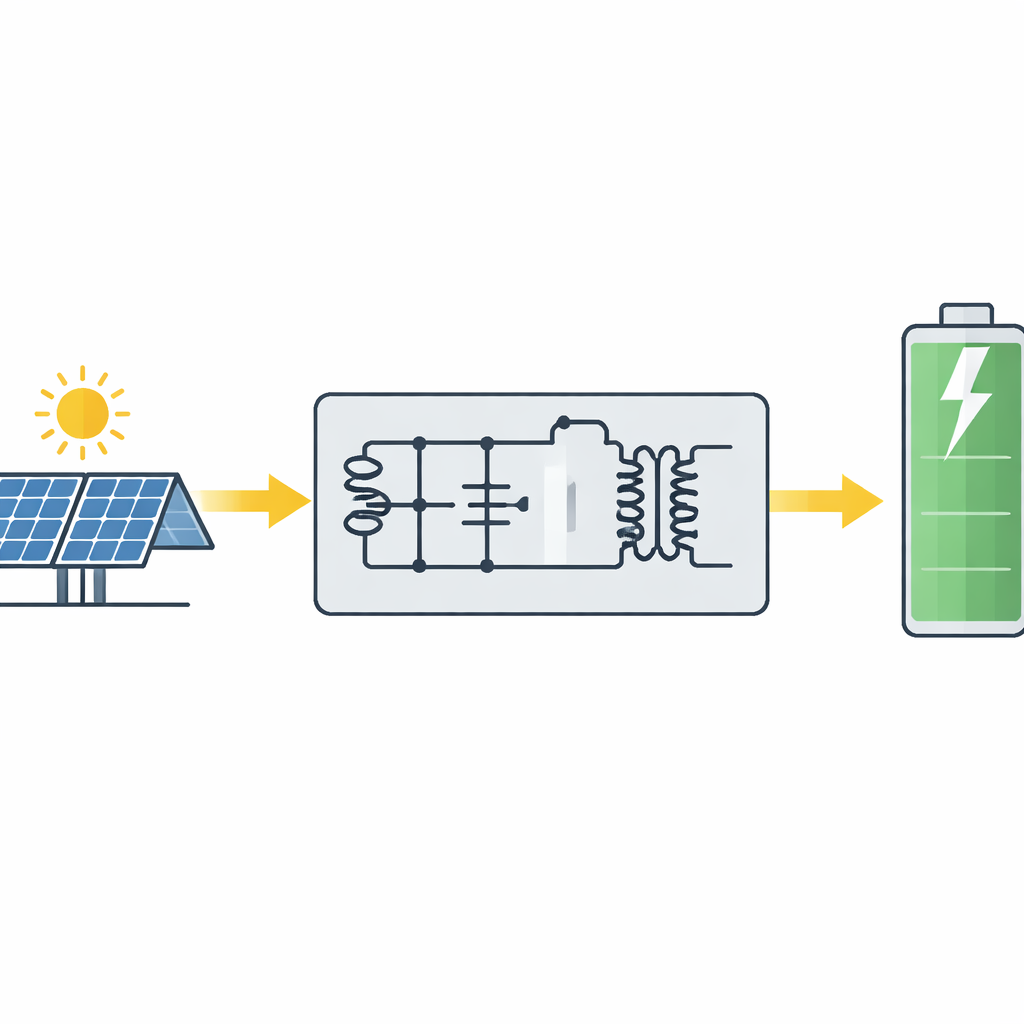
Many renewable energy sources, like rooftop solar panels or small wind turbines, produce electricity at low voltages that are not directly useful for running industrial equipment, charging electric vehicles, or feeding a high‑voltage DC grid. This paper introduces a new electronic circuit that efficiently boosts a modest DC voltage (such as 15 volts) up to nearly ten times higher (around 139 volts) in a compact and reliable way. By carefully shaping how energy moves through magnetic coils, capacitors, diodes, and a single switch, the design delivers more usable power while keeping electrical stress on its parts surprisingly low.
Why We Need Better Power Converters
As clean energy expands, more homes, buildings, and vehicles rely on power electronics to connect low‑voltage sources to higher‑voltage systems. Conventional “boost” circuits can, in theory, raise voltage a lot just by keeping the switch on longer, but in practice this runs into problems: hidden resistances in components waste energy, high voltages damage switches and diodes, and pulsing input currents disturb sensitive sources such as solar panels or fuel cells. Engineers have tried many tricks to overcome these limits—adding switched capacitors, interleaving multiple channels, or using special coupled inductors—but most existing solutions trade higher voltage gain for more parts, higher losses, or harsher electrical stress.
Two Stages Working Together
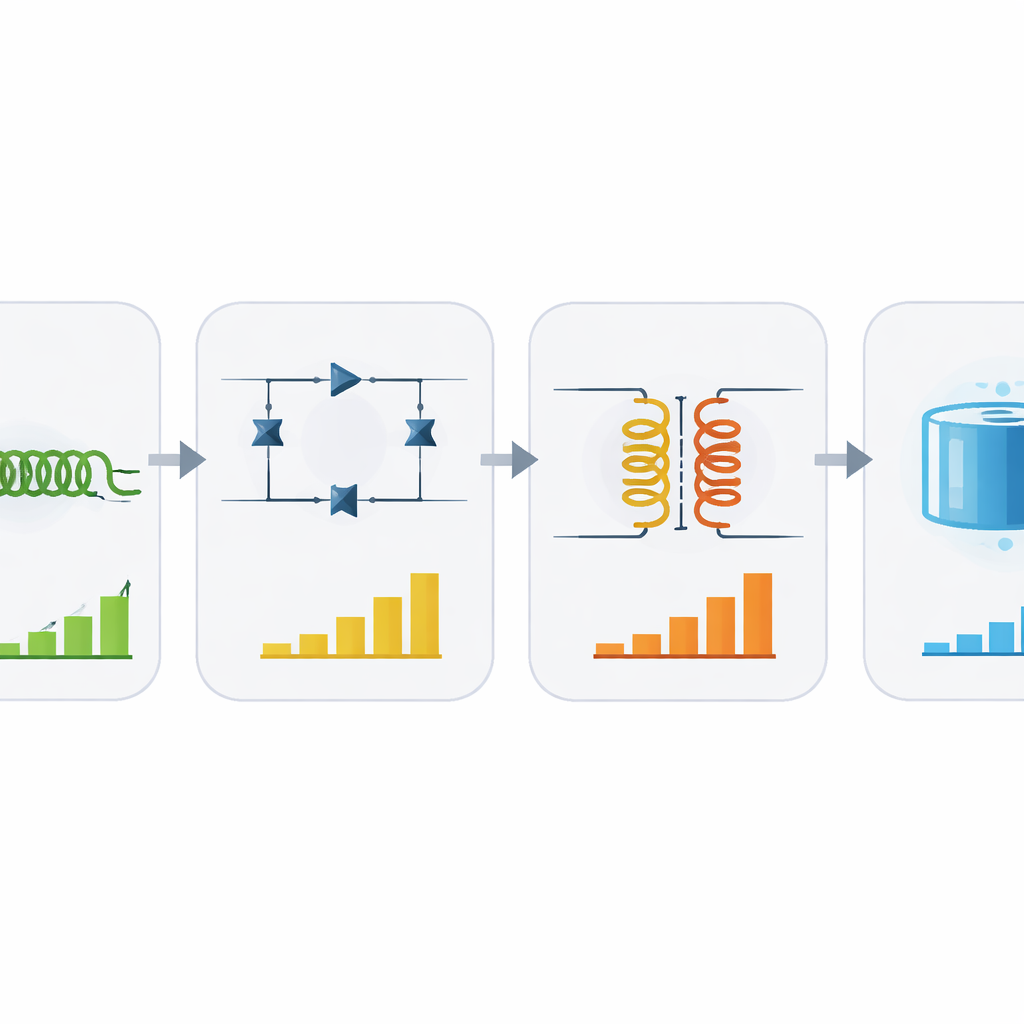
The authors propose a converter that combines two boosting stages in a single, neat structure. The first stage is related to a “quadratic boost” circuit that naturally produces a high voltage gain and, importantly, draws a smooth, continuous current from the source, which is friendly to renewables. The second stage is a special two‑winding coupled inductor that behaves like a tightly linked pair of coils, sharing energy in a controlled way between the input side and the output side. A voltage‑multiplier cell made of capacitors and diodes is woven into this arrangement so that both stages cooperate rather than fight: the capacitors stack voltages, the coupled inductor further amplifies them, and both do so without requiring extreme settings on the control signal or an impractically large winding ratio in the magnetic core.
Keeping Stress Low and Efficiency High
A key achievement of the design is that it reaches an “ultrahigh” step‑up ratio—more than tenfold at moderate settings—while electrical stress on the main switch and diodes stays well below one‑third of the output voltage. That means the circuit can use more affordable, lower‑rated semiconductor devices with smaller internal resistance, which cuts conduction losses. The layout also gives three diodes a kind of built‑in soft switching: they turn on or off when their current or voltage naturally passes through zero, so less energy is wasted heating them during transitions. The converter uses only one active switch, controlled by a simple pulse‑width modulation signal, and just one main magnetic component plus an input inductor, reducing size and complexity compared with many competing high‑gain designs.
From Equations to Real Hardware
Beyond presenting the topology, the paper walks through how it behaves in different operating modes, from continuous to discontinuous current, and derives formulas that predict voltage gain, component stresses, and efficiency. The authors then account for all the non‑ideal details that real hardware suffers from, such as resistances in windings, switches, and capacitors, and show how these reduce the ideal voltage gain. Using these models, they compare their circuit to several state‑of‑the‑art high‑step‑up converters reported in the literature. For the same operating conditions, the new design generally delivers higher voltage gain with similar or lower voltage stress and uses smaller inductors, which can save cost and space. A closed‑loop control system with a standard PI controller, tuned using a modern optimization algorithm inspired by reptile hunting behavior, keeps the output voltage stable even when the input or load changes suddenly.
Proving It in the Lab
To test whether the math holds up, the researchers built a 210‑watt laboratory prototype. With a 15‑volt input, the prototype consistently produced about 139 volts at the output, in line with theoretical predictions, while maintaining an efficiency of roughly 93% across a wide range of power levels. Measurements of voltages and currents on the switch, diodes, inductors, and capacitors matched the detailed waveforms and stress levels predicted by the analysis, and the soft‑switching behavior of the key diodes was clearly visible. When the converter was placed under feedback control, it quickly settled to the desired output voltage after disturbances, confirming that the design is not only efficient but also controllable.
What This Means for Everyday Technology
In practical terms, this work offers a robust building block for systems that must turn low‑voltage DC power into much higher voltages without sacrificing reliability or wasting energy as heat. Because it draws a smooth input current, shares a common electrical ground between source and load, and keeps stresses on its components modest, the proposed converter is well suited to solar microgrids, fuel‑cell stacks, industrial DC supplies, and fast chargers for electric vehicles. By blending two boosting stages, a cleverly used coupled inductor, and soft‑switching behavior into a single, single‑switch circuit, the design shows how careful engineering can squeeze more useful power out of the same renewable sources, helping to make clean energy systems smaller, cheaper, and more efficient.
Citation: Shayeghi, H., Mohajery, R., Sedaghati, F. et al. Two-boosting-staged single-switched ultrahigh step-up topology with continuous input current and reduced voltage stress. Sci Rep 16, 9732 (2026). https://doi.org/10.1038/s41598-026-39176-1
Keywords: high step-up DC-DC converter, renewable energy power electronics, coupled inductor design, voltage multiplier topology, soft-switching efficiency