Clear Sky Science · en
Iron oxide decorated nitrogen doped carbon derived from iron MOFs and polyaniline as binder free electrode for symmetric supercapacitors
Why faster energy storage matters
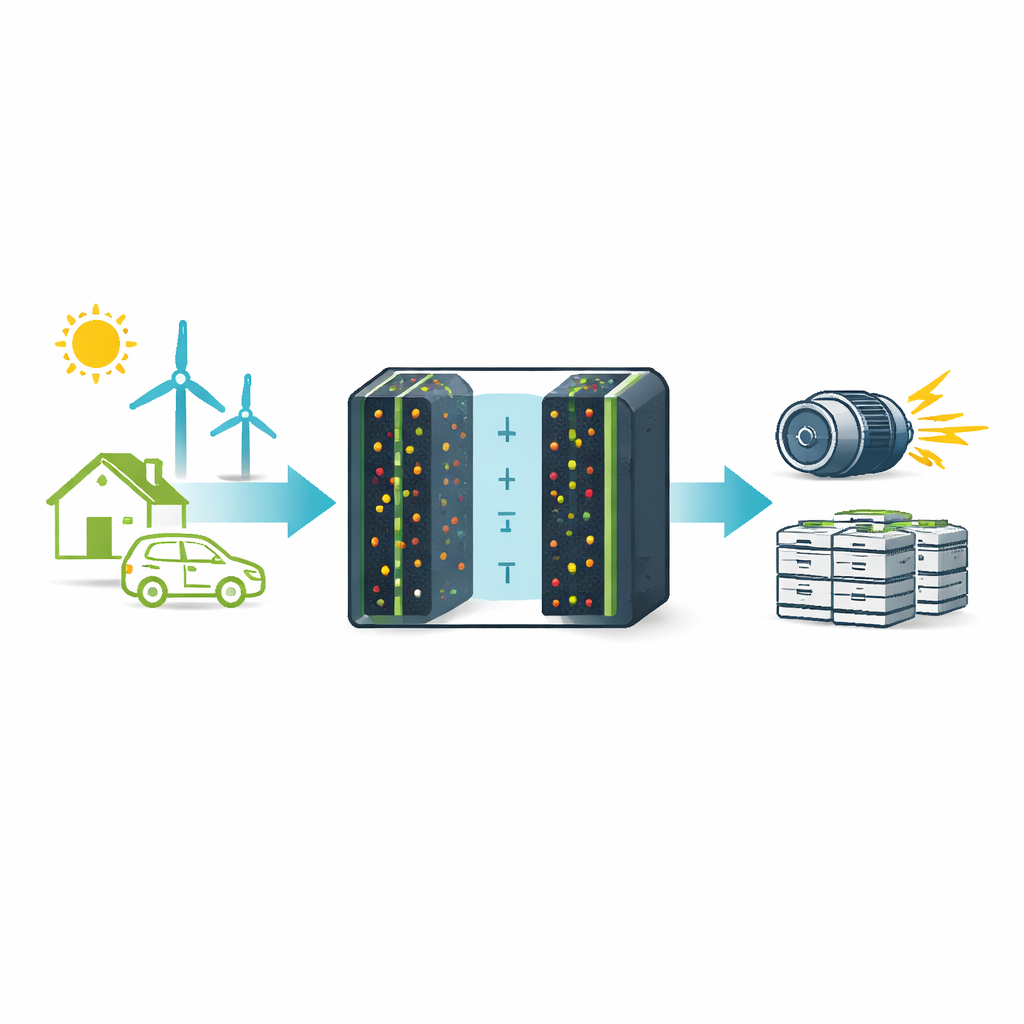
As our homes, gadgets, and electric cars increasingly rely on clean energy from the sun and wind, we need ways to store that energy quickly, safely, and for many years. Conventional batteries can hold a lot of energy, but they charge and discharge relatively slowly and wear out over time. This study explores a new kind of energy storage material for supercapacitors—devices that can charge in seconds and survive tens of thousands of cycles—aiming to bridge the gap between the speed of capacitors and the capacity of batteries.
Building a better energy sponge
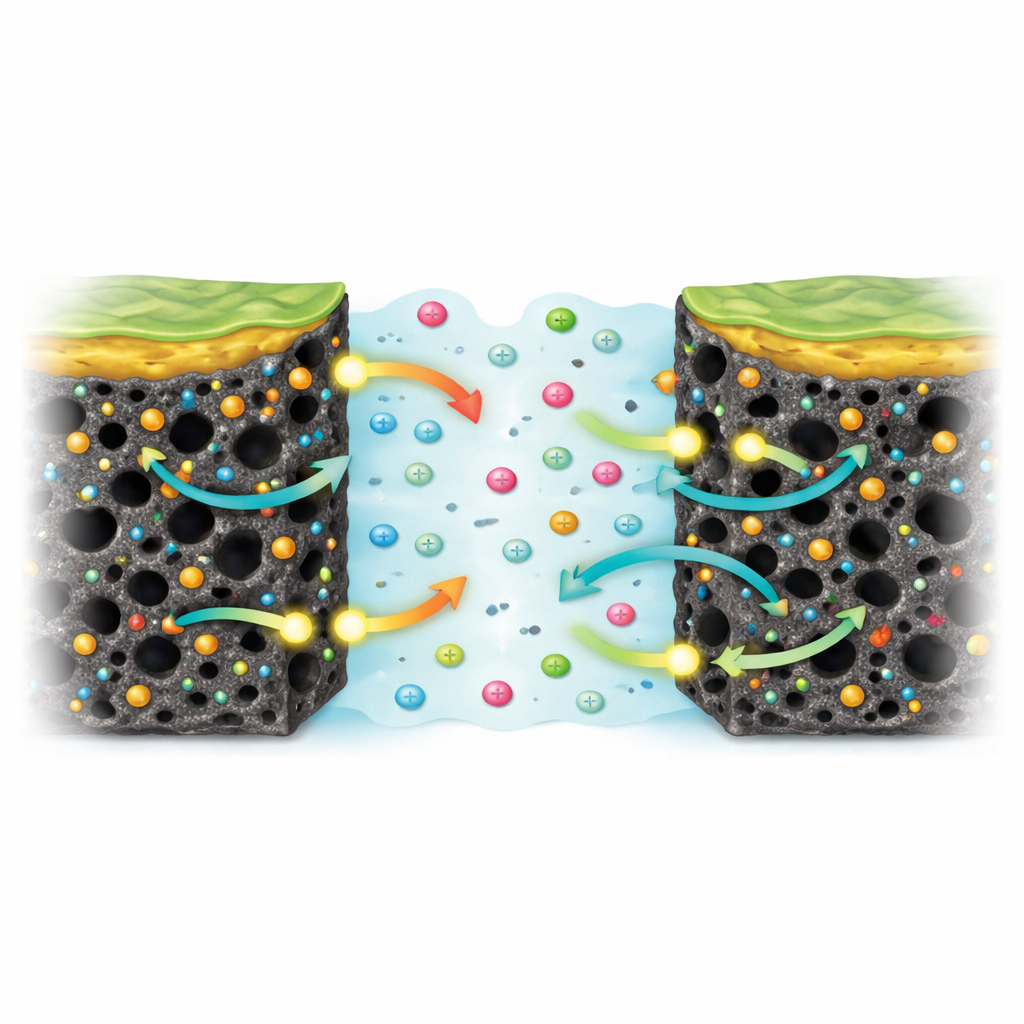
The researchers focused on designing an electrode—the part of a supercapacitor that actually stores charge—that is both highly conductive and full of tiny nooks and crannies for ions to occupy. They started from iron-based metal–organic frameworks (MOFs), which are porous crystalline materials, and from polyaniline, a well-known conducting polymer. By heating (pyrolyzing) these ingredients in nitrogen gas, they converted the MOFs into iron oxide particles supported on “nitrogen-doped” carbon, and transformed polyaniline into a porous, conductive carbon network that still carries nitrogen atoms. When these pieces are combined, the result is a composite material where iron oxide nanoparticles are evenly spread across a carbon–polymer scaffold, offering a large surface area and many active sites for charge storage.
How the new material is made
To build this composite, the team first synthesized two kinds of iron-based MOFs (MIL-101(Fe) and an amine-modified version) and separate polyaniline structures. They then bonded the amine-containing MOF to polyaniline and heated the mixture at 500 °C under nitrogen. This process decomposes the original framework and polymer into a more rugged structure: tiny iron oxide particles anchored on a carbon matrix enriched with nitrogen from both the MOF and polyaniline. By adjusting how much MOF was mixed with polyaniline (10%, 20%, or 30% by weight), they tuned the final architecture. Microscopy, X-ray diffraction, Raman spectroscopy, and surface-sensitive techniques confirmed that the 20% mixture produced a uniform nanoscale network, with iron, carbon, nitrogen, and oxygen distributed evenly throughout the material.
Turning structure into performance
The real test was how well these materials performed in water-based supercapacitors. The researchers coated graphite sheets with different versions of the composite and measured their behavior in a lithium sulfate solution. Cyclic voltammetry and charge–discharge tests showed that all of the nitrogen-containing samples behaved mainly like fast-charging electrostatic capacitors, with some extra contribution from surface reactions on iron and nitrogen sites. The standout formulation, containing 20% of the iron-based framework (called 20FNC@P-PANI), delivered a specific capacitance of about 634 farads per gram at a moderate current—a measure of how much charge it can store per unit mass. This was several times higher than electrodes made from the iron-based carbon or the polyaniline-derived carbon alone. The improvement stems from the combination of high surface area, good electrical pathways, and nitrogen “dopants” that enhance conductivity and create extra ion storage sites.
From single electrode to working device
To show real-world promise, the team built a complete symmetric supercapacitor using the same composite on both sides of the device, separated by a simple filter paper soaked in electrolyte. Even with this straightforward design, the device operated stably over a relatively wide voltage window in water and achieved energy and power densities that rival or exceed many earlier iron-oxide and polyaniline systems. It could deliver around 48 watt-hours per kilogram at a power of roughly 790 watts per kilogram, and still provided useful energy at much higher power. Most impressively, after 10,000 rapid charge–discharge cycles at high current, the device retained more than 95% of its original capacitance, indicating excellent durability.
What this means for future devices
In plain terms, this work shows that carefully combining iron-based porous crystals with a conducting polymer—then transforming them through heat into a unified carbon–iron oxide network—can produce supercapacitor electrodes that charge quickly, store a substantial amount of energy, and last for a very long time. Because the materials rely on abundant elements like iron, carbon, and nitrogen and use a water-based electrolyte, they also point toward more environmentally friendly energy storage. While more engineering is needed before such composites appear in commercial products, the study outlines a promising pathway for making fast, robust, and scalable energy storage devices to support electric vehicles, portable electronics, and the broader shift to renewable power.
Citation: El-Ashry, A.A., El-Gendy, D.M., Adly, M.S. et al. Iron oxide decorated nitrogen doped carbon derived from iron MOFs and polyaniline as binder free electrode for symmetric supercapacitors. Sci Rep 16, 8615 (2026). https://doi.org/10.1038/s41598-026-39173-4
Keywords: supercapacitors, energy storage, nanocomposites, polyaniline, metal-organic frameworks