Clear Sky Science · en
Chemical and structural analysis of a European hornet nest
A Paper House Built by Insects
Hornet nests are usually something we notice only when they are uncomfortably close to our homes. But behind the sting lies a remarkable piece of natural engineering: a lightweight, layered shelter built from recycled wood. This study takes apart a European hornet nest from an old villa near Prague, examining it from the outside in—down to its fibers and chemical bonds—to reveal how these insects quietly convert weathered wood into a strong, insulated, almost paper‑like home. The findings not only deepen our understanding of hornet biology, they also hint at ideas for greener materials and better ways to preserve such fragile natural artifacts in museums.
From Forest Scraps to Hanging Home
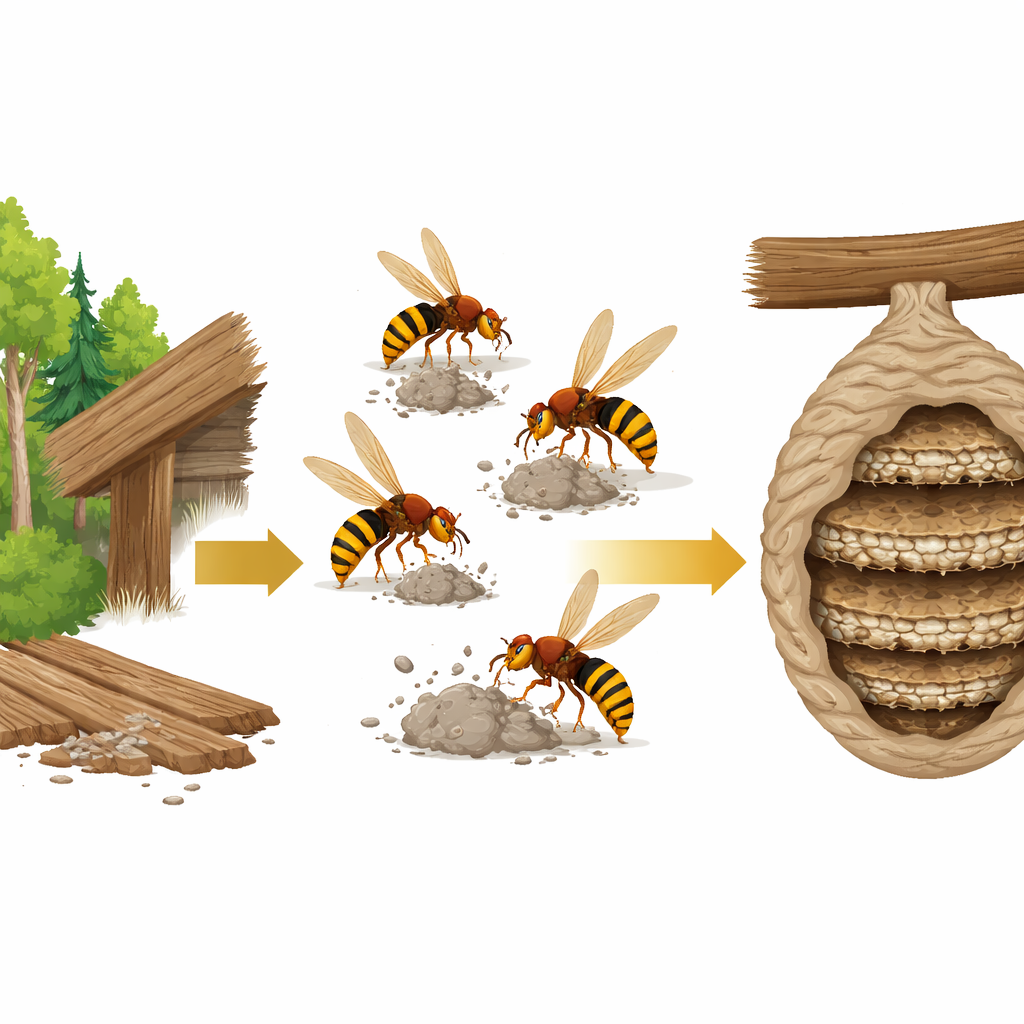
The nest examined in this research was found abandoned in a heritage attic and later destined for museum display. European hornets collect mostly rotten wood, bark, and plant fibers from nearby forests and gardens. They chew this material, mix it with saliva, and spread it in thin overlapping strips, slowly building a hanging oval shell that can reach the size of a small suitcase. Inside, they add stacked floors of hexagonal cells where larvae grow. The scientists first documented the nest with 3D scanning and medical‑grade CT imaging, creating a precise digital model that shows ten comb layers, connecting pillars, and a multi‑layered outer shell dotted with air pockets—features that together give the nest both strength and thermal comfort.
Hidden Architecture for Strength and Warmth
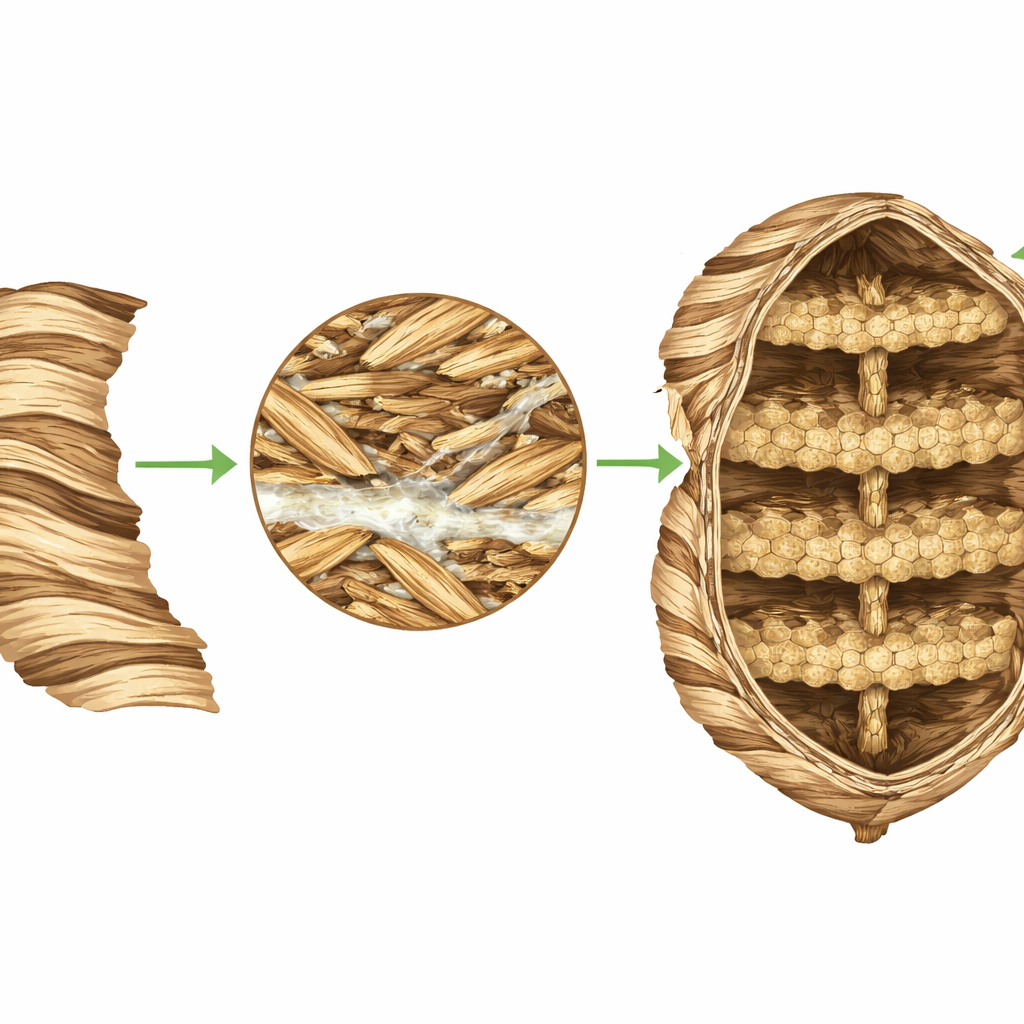
CT scans revealed that the nest is more than a random bundle of paper‑thin sheets. It is a carefully arranged structure with about 3,160 hexagonal cells organized in horizontal levels. The cells open downward to let waste fall out and to keep the brood ventilated, while solid pillars connect the floors like columns in a building. Around this core, workers stack up to six layers of shell separated by air gaps up to several centimeters thick. These empty spaces act as natural insulation, helping the colony keep its interior near a comfortable 30 °C by combining the nest’s design with their own body heat and cooling behaviors. The result is a shelter that uses very little material yet remains surprisingly robust and thermally efficient.
What the Nest Is Really Made Of
To see what the hornets were actually building with, the team examined the nest’s fibers and chemistry. Under microscopes, the "paper" turned out to be a rough mix of tiny wood chips, mostly from hardwood trees, with some softwood fragments and other plant matter. Fiber measurements showed that 82% of the fibers were shorter than a third of a millimeter—far shorter than typical wood or paper pulp fibers—making the material inherently fragile unless well glued together. Chemical tests using advanced chromatography revealed that about half the nest is made of plant sugars (polysaccharides) such as cellulose and hemicelluloses, while about one‑fifth is lignin, the stiff component that usually gives wood its hardness. The relatively low lignin content suggests hornets prefer pre‑weathered or decayed wood, which is softer and easier to chew.
Natural Glue, Color Bands, and Traces of Metal
Infrared spectroscopy showed that the nest’s alternating beige and brown stripes are more than decoration. Lighter areas contain more ordered cellulose, which tends to be stronger, while darker brown bands hold more lignin and slightly more disordered cellulose. Proteins—coming from hornet saliva and larval waste—were detected both in the outer shell and at the bottoms of brood cells. These proteins act as a natural adhesive, binding the short wood fibers into a coherent composite material. The nest also contained tiny amounts of metals such as iron and lead, likely picked up from surrounding wood, soil, or old building materials. Iron in particular may influence how the nest responds to vibrations or even play a subtle role in how the insects sense their structure, echoing findings in other hornet species.
Nature’s Blueprint for Future Materials
By treating a hornet nest as both a biological object and an engineered material, this study shows how insects act as tiny recyclers, turning decayed wood into a lightweight, insulated, and yet delicate dwelling. Understanding the nest’s layered architecture, fiber structure, and natural glues helps museum conservators stabilize and display such objects without altering their appearance. At the same time, it offers inspiration for human technologies: fiber‑based composites that rely on short recycled fibers, gentle processing, and clever geometry rather than heavy, energy‑intensive manufacturing. In short, the European hornet nest is more than a curiosity in an attic—it is a quiet example of sustainable design built one chewed wood chip at a time.
Citation: Jurczyková, T., Caranová, M., Kačík, F. et al. Chemical and structural analysis of a European hornet nest. Sci Rep 16, 9395 (2026). https://doi.org/10.1038/s41598-026-39163-6
Keywords: hornet nests, wood recycling, natural composites, biomimetic materials, museum conservation