Clear Sky Science · en
Comparison of 3D ankle kinematics between minimal inertial measurement units configuration and optical motion capture system under diverse walking conditions
Why Measuring Ankle Motion Matters
Every time you walk, your ankles quietly manage a complex balancing act that keeps you upright, stable, and moving forward. For doctors, therapists, and sports scientists, tracking this motion in three dimensions can reveal early signs of injury, help tailor rehabilitation, and fine-tune athletic training. But the most accurate tools for measuring movement are bulky, expensive lab systems, making it hard to study how people actually move in daily life. This study asks a practical question: can small wearable sensors on the leg and foot provide ankle motion data good enough to step outside the lab?
From Lab Cameras to Tiny Wearable Sensors
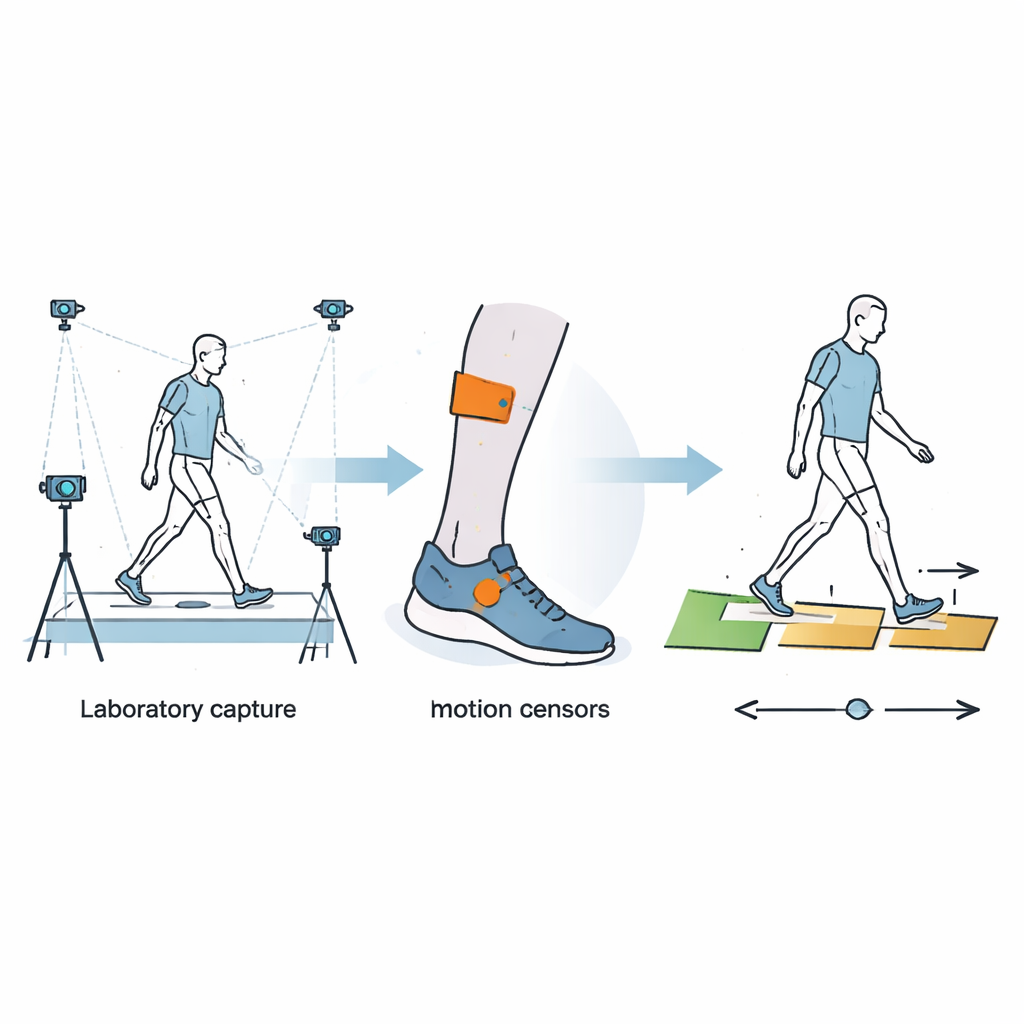
Traditional motion studies rely on optical motion capture: people walk through a lab with reflective markers on their skin while multiple cameras reconstruct their movements. This approach is extremely precise but requires many markers, trained staff, and a dedicated space. In contrast, inertial measurement units—matchbox-sized gadgets containing accelerometers, gyroscopes, and magnetometers—can be strapped directly to the body. The researchers explored a very simple setup: just two sensors, one on the shin and one on the top of the foot, to track the ankle’s three-dimensional motion while walking. Their goal was to see how closely this minimalist wearable system could match the lab’s gold-standard cameras.
Testing Ankles on Sloping Ground
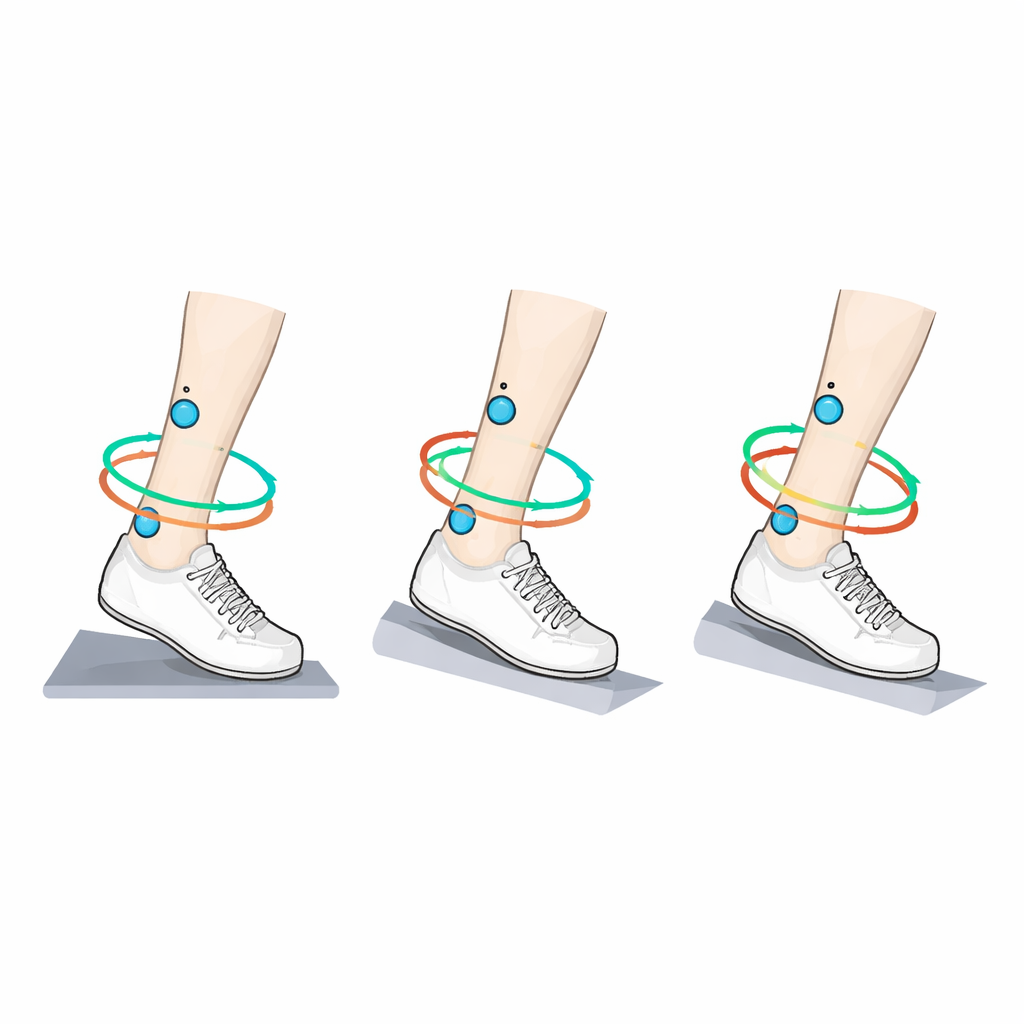
To put the sensors through their paces, the team recruited twelve healthy young adults and had them walk repeatedly along a short walkway in three ways: on a flat surface, on a sideways-tilted surface with the feet rolled slightly inward, and on a sideways-tilted surface with the feet rolled slightly outward. During every trial, both the camera system and the two wearables recorded ankle motion in three planes: up-and-down pointing of the foot (sagittal), side-to-side rolling (frontal), and twisting in or out (transverse). The researchers then synchronized the two systems in time, converted each step to a standardized gait cycle, and used several statistical tools to compare how closely the wave-like ankle motion curves from the wearables matched those from the cameras.
Where Wearables Match the Gold Standard
The results show that the small sensor setup performed surprisingly well in key aspects. When people walked on level ground, the wearable measurements closely followed the camera-based curves for the up-and-down and twisting motions of the ankle, with only small average angle differences. Even on the inward-tilted surface, these two motion directions remained in moderate to strong agreement. Importantly, the wearable system was highly repeatable: step after step, and trial after trial, it produced very consistent readings in all three planes, regardless of the surface. This consistency suggests that the sensors can reliably track changes over time, a crucial feature for monitoring recovery or performance.
Where Things Get Tricky for the Sensors
The side-to-side rolling of the ankle proved much harder to capture accurately, especially on the sloped surfaces. On the inward-tilted floor, agreement between the wearables and cameras in this direction was poor, and differences grew even larger on the outward-tilted floor. For twisting motion on the outward-tilted surface, the match dropped sharply as well. The authors point to two main reasons. First, the foot is not a single rigid block; several joints in the rearfoot and midfoot move relative to each other, especially when the sole is angled. Second, the wearable sensors use a simplified alignment based on a short standing calibration, which can misrepresent these complex, multi-part foot movements. As a result, the wearables can systematically over- or underestimate certain angles even while remaining very consistent from step to step.
What This Means for Real-World Walking
Overall, the study concludes that a minimal two-sensor wearable setup can provide functionally useful ankle motion data outside the lab, particularly for the up-and-down and twisting motions and for walking on flat or mildly altered ground. While it does not perfectly match the detailed camera system—especially for side-to-side rolling on steeply tilted surfaces—it delivers repeatable patterns that can still help clinicians and researchers track changes in how a person walks. The authors suggest that future work should refine calibration methods and data interpretation so that these small, practical devices can better handle complex foot movements, bringing high-value gait insights into clinics, homes, and everyday environments.
Citation: Kim, J., Xie, L. & Cho, S. Comparison of 3D ankle kinematics between minimal inertial measurement units configuration and optical motion capture system under diverse walking conditions. Sci Rep 16, 8307 (2026). https://doi.org/10.1038/s41598-026-39161-8
Keywords: wearable gait sensors, ankle motion, walking biomechanics, inertial measurement units, movement analysis