Clear Sky Science · en
A novel method of C-VBQ score and CT-HU as risk predictors for cage subsidence after short level ACDF
Why neck surgery needs smarter planning
Many people with worn or pinched discs in the neck eventually need an operation called anterior cervical discectomy and fusion, or ACDF, to relieve pain and weakness. While this surgery usually works well, one common problem is that the small spacer, or “cage,” placed between the neck bones can slowly sink into the softer bone, a complication known as subsidence. This study asks a practical question: can doctors spot, before surgery, which patients’ neck bones are too weak to safely hold the cage, using the scans they already get in routine care? 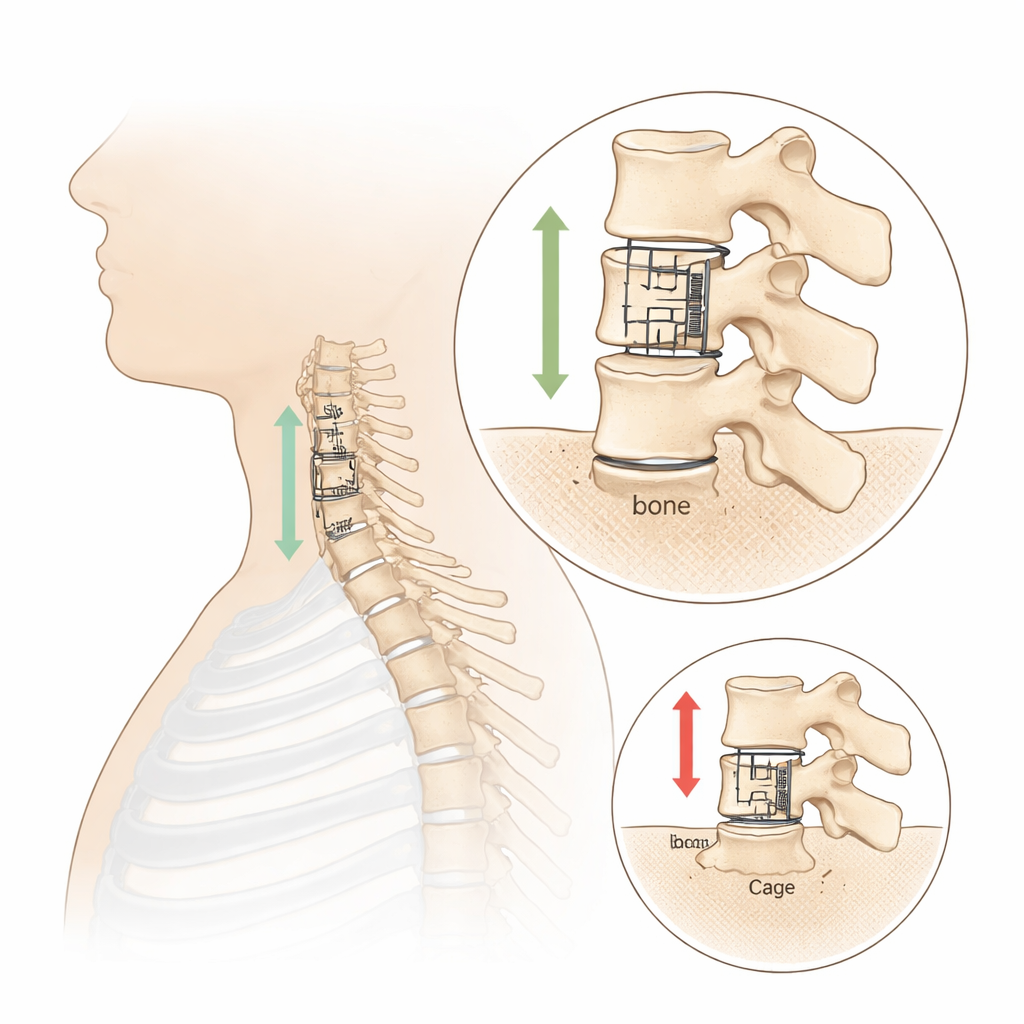
A closer look at a common neck operation
ACDF is designed to remove a damaged disc that is pressing on nerves or the spinal cord, then stabilize the spine by fusing the neighboring vertebrae together with a cage and metal plate. When the cage sinks into the bone, the neck segment can lose height, tilt into a forward curve, and possibly squeeze nerves again. This may undo the benefits of surgery and sometimes requires a second operation. Past research has shown that poor bone strength is a major driver of this problem, but standard bone tests, such as hip or lower-back bone scans, are not ideal for judging the strength of the small neck bones involved in ACDF.
Turning routine scans into bone strength indicators
The researchers focused on two measurements that can be taken from images most ACDF patients already have: MRI and CT scans of the cervical spine. From MRI, they used a “cervical vertebral bone quality” or C-VBQ score, which compares how bright the neck bones look to the fluid around the spinal cord; brighter bones in this setting tend to mean weaker, fattier bone. From CT, they measured Hounsfield units (CT-HU), a number linked to how dense the bone is. In general, higher CT-HU suggests stronger bone. By combining these image-based tools, the team hoped to build a practical way to flag patients at high risk for cage sinking. 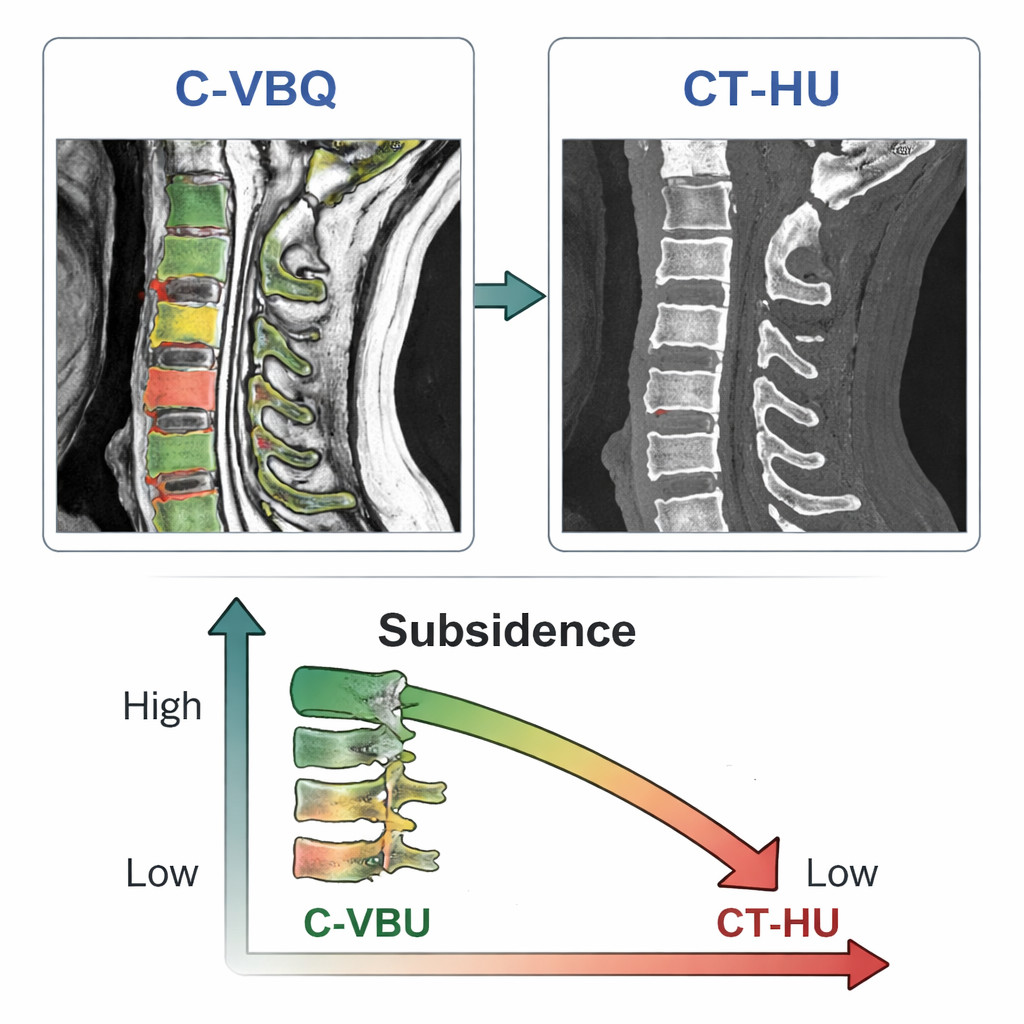
What happened in more than 100 real patients
The study followed 112 people who had one- or two-level ACDF and were monitored with X-rays and other scans for at least a year after surgery. About one in four patients developed cage subsidence. These patients tended to be older and had higher C-VBQ scores, meaning poorer bone quality on MRI, and lower CT-HU values, meaning less dense bone on CT. When the authors fed all the patient and imaging data into statistical models, only the C-VBQ score stood out as an independent predictor of whether the cage would sink. A higher C-VBQ score was linked directly to more subsidence, while CT-HU moved in the opposite direction: as C-VBQ went up, CT-HU went down.
How well did the new score work?
To test how useful C-VBQ might be in day-to-day practice, the team assessed how accurately it could separate patients who did and did not develop subsidence. They found that the score predicted cage sinking with good reliability. A cutoff value of about 2.8 on the C-VBQ scale identified nearly all patients who would go on to have subsidence, while still correctly reassuring many who would not. This pattern, together with the strong, opposing link to CT-based bone density, suggests that the MRI score is truly capturing underlying bone weakness in the neck vertebrae, not just random image noise.
What this means for patients and surgeons
For patients facing ACDF, the main message is that the quality of the neck bones matters as much as the skill of the surgeon or the type of hardware used. This study shows that a simple score derived from an MRI that is already part of most pre-surgical workups can help pinpoint who has fragile neck bones and is more likely to have the cage sink after surgery. If confirmed in larger groups, surgeons could use the C-VBQ score to adjust surgical plans, consider bone-strengthening treatments, or choose different implants, all with the goal of keeping the neck stable and avoiding repeat operations.
Citation: Zhang, Q., Zhang, Z., Ma, R. et al. A novel method of C-VBQ score and CT-HU as risk predictors for cage subsidence after short level ACDF. Sci Rep 16, 7530 (2026). https://doi.org/10.1038/s41598-026-39159-2
Keywords: cervical spine surgery, bone quality, MRI scoring, cage subsidence, spinal fusion