Clear Sky Science · en
Adaptive linear MPC for a PMSM-driven autonomous EV with a filtered third-order generalized integrator observer
Smarter Brains for Self-Driving Electric Cars
As autonomous electric cars become more common, we expect them to stay firmly in their lane, steer smoothly through curves, and make the most of every bit of battery energy. Yet under the hood, the electric motors that drive these vehicles behave in complex, sometimes unpredictable ways, especially at high speeds. This paper introduces a new control strategy that lets an electric car continuously "learn" how its motor and motion are changing on the fly, so it can keep the ride stable, efficient, and safe even in demanding driving situations.
Why Controlling an Electric Car Is So Tricky
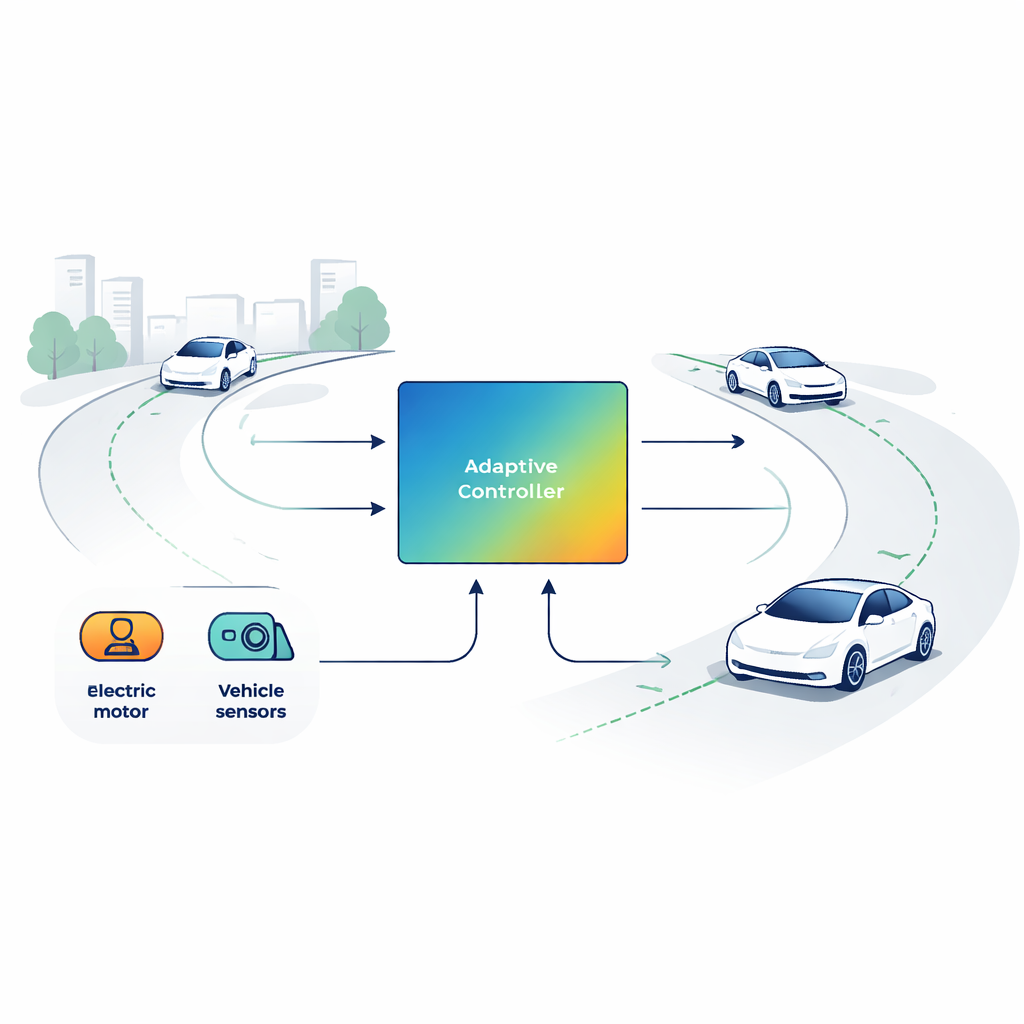
In an autonomous electric vehicle, two tasks must be coordinated at every moment: producing the right driving force at the wheels and following the desired path on the road. The motor at the heart of many modern EVs—a permanent magnet synchronous motor—does not behave like a simple, constant machine. Its internal properties change with speed and load, especially in the high-speed region where engineers deliberately weaken the magnetic field to protect the hardware. Traditional control methods often pretend the motor is simpler than it really is, or they treat it as a perfect torque source and ignore its inner workings. That can lead to steering errors, wobbly lane keeping, and wasted energy when the car speeds up, slows down, or faces disturbances such as sudden changes in road load.
A Single Control System for Motor and Motion
The researchers propose an adaptive linear model predictive control (AL-MPC) scheme that tackles motor behavior and vehicle motion together instead of in separate layers. At its core is a mathematical model that ties nine key quantities into one framework: motor currents, wheel speed, the car’s side-to-side position, and how much it is yawing, or rotating, as it turns. Rather than freezing this model at a single operating point, the controller refreshes it every sampling instant to match current conditions. This lets the car anticipate how today’s combination of speed, steering, and motor state will evolve over the next few split seconds, then choose the best steering angle and motor voltages to stay close to the planned trajectory while honoring safety limits on currents, voltages, and motion.
Listening to the Motor in Real Time
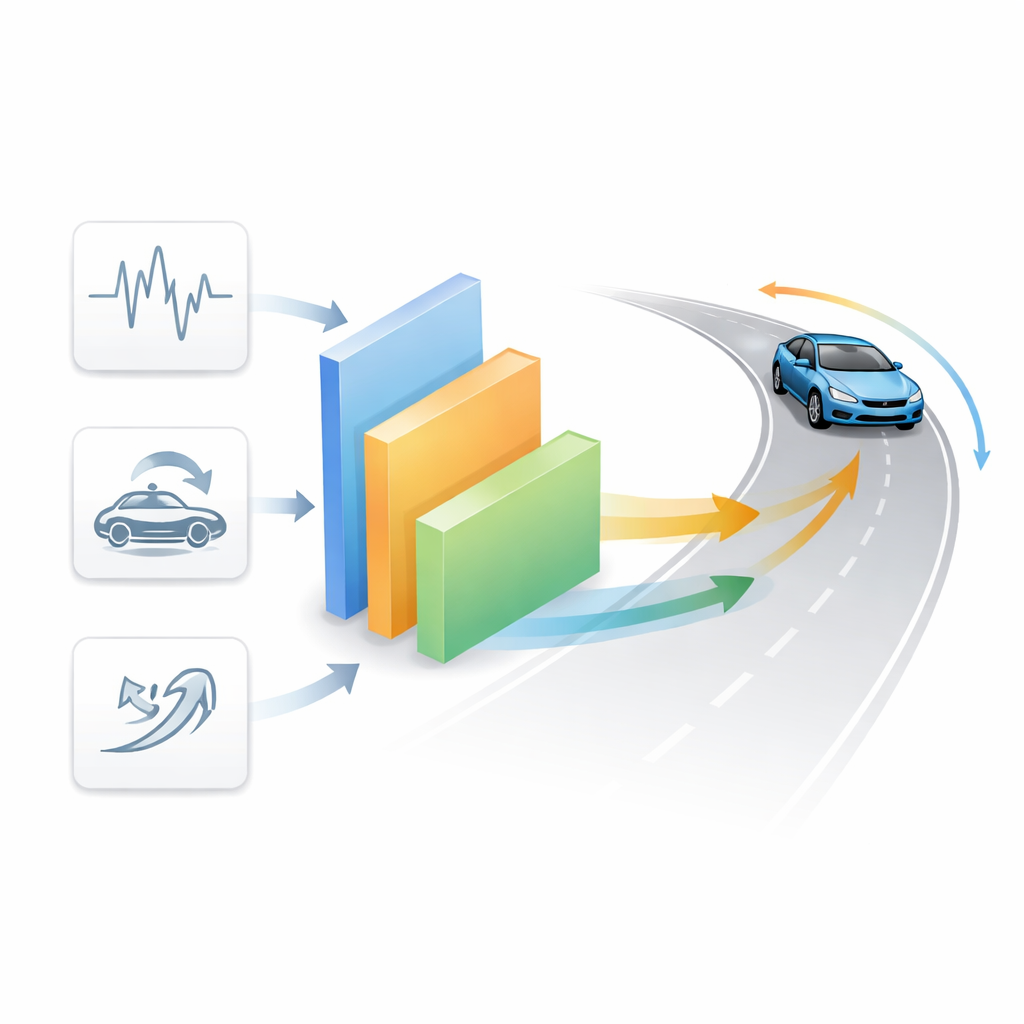
A key ingredient is a special observer—a signal-processing module—that listens to the motor’s electrical signals and reconstructs what is happening inside. Using a filtered "generalized integrator," it estimates the magnetic flux, the actual torque being produced, and how the motor’s internal reactance is changing with time. A moving average filter smooths out high-frequency noise from power electronics, so the estimates remain stable even when the inverter is switching rapidly. Because these quantities are physically meaningful, the controller can directly plug them into its predictive model, avoiding the need for large lookup tables or offline calibration. This makes the system better able to cope with changes due to temperature, aging, and different driving conditions.
Choosing the Best Action Under Limits
Once the observer and predictive model have produced their forecasts, an optimization routine steps in to decide what to do next. The authors use an "active-set" quadratic programming algorithm, which efficiently searches for the combination of steering and motor voltage commands that minimize tracking errors while keeping all constraints satisfied. These constraints include maximum wheel speed, limits on steering angle, and safe ranges for motor currents and voltages. Because the algorithm is warm-started from the previous solution, it usually needs only a few iterations, making it fast enough to run on an automotive-grade microcontroller. Hardware-in-the-loop tests confirm that the full loop—observing, predicting, and optimizing—can be completed in less than a hundredth of a second per control cycle.
How Much Better Does the Car Behave?
The team compares their approach with two established strategies: a simpler linear controller with fixed motor parameters and a more complex nonlinear controller. In computer simulations that sweep the car’s speed through a wide range, including the demanding flux-weakening region, the new method slashes yaw angle error by almost three orders of magnitude and cuts lateral position error by more than half relative to the basic linear design, while greatly smoothing the steering effort. Against the nonlinear controller, it still delivers notably smaller path deviations, dramatically reduces speed and voltage ripple, and avoids sharp torque spikes that could stress the drivetrain or unsettle passengers—all while using slightly less computation time.
What This Means for Everyday Driving
For a non-specialist, the bottom line is that this work shows how to give self-driving electric cars a more capable and efficient "brain" without overwhelming their onboard computers. By continuously estimating what is really happening inside the motor and folding that information into a unified view of the car’s motion, the proposed controller keeps the vehicle closer to its intended path, uses energy more wisely, and handles sudden changes more gracefully. Although further work is needed to extend the approach to very low speeds and more detailed tire-road interactions, this adaptive control strategy points toward electric cars that are not only cleaner, but also smoother, safer, and more comfortable for their passengers.
Citation: Ismail, M.M., Al-Dhaifallah, M., Rezk, H. et al. Adaptive linear MPC for a PMSM-driven autonomous EV with a filtered third-order generalized integrator observer. Sci Rep 16, 9349 (2026). https://doi.org/10.1038/s41598-026-39158-3
Keywords: autonomous electric vehicle control, model predictive control, permanent magnet synchronous motor, torque and steering coordination, real-time adaptive control