Clear Sky Science · en
Isolation and characterization of lytic bacteriophages with therapeutic potential against multidrug resistant Klebsiella pneumoniae from Ethiopia
Why Tiny Viruses in Dirty Water Matter to Us
Hospitals around the world are struggling with infections that no longer respond to antibiotics. One major culprit is Klebsiella pneumoniae, a bacterium that can cause life‑threatening pneumonia, blood infections, and urinary tract infections. In this study from Ethiopia, researchers went hunting for natural enemies of this germ—viruses called bacteriophages, or phages—that might be turned into living medicines when antibiotics fail. By searching hospital sewage and polluted rivers in Addis Ababa, they uncovered a rich collection of phages able to kill multidrug‑resistant Klebsiella, and began testing how well these microscopic predators might work as future therapies.
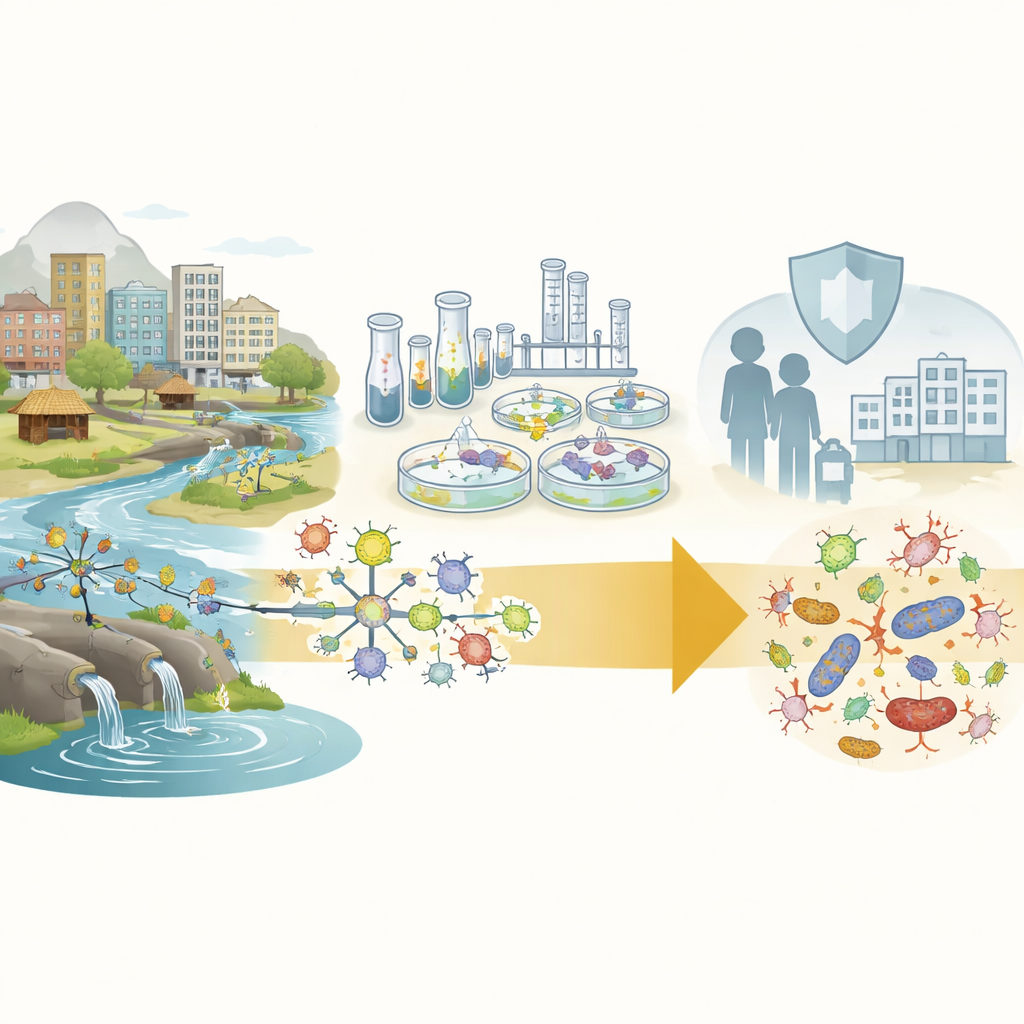
Hunting Helpful Viruses in the City
The team focused on Addis Ababa, a fast‑growing city where crowded hospitals and heavy antibiotic use create ideal conditions for resistant bacteria. Instead of looking for new drugs in factories, the scientists collected 66 samples of wastewater, hospital sewage, and soil from four major hospitals and nearby contaminated rivers. These places are teeming with bacteria and the phages that infect them. Back in the lab, they mixed each sample with ten especially hard‑to‑treat Klebsiella strains taken from patients. Clear spots that appeared on bacterial lawns signaled that a phage in the water sample had successfully attacked and destroyed its host.
Building a Library of Bacteria Killers
From 660 such tests, the researchers isolated an impressive 102 distinct phages that could kill multidrug‑resistant Klebsiella. Most came from wastewater and sewage, confirming these environments as rich hunting grounds. Each phage was checked to see how many different clinical isolates it could kill. Some were picky, attacking less than 10% of the 46 tested bacterial strains, while others wiped out more than 60%. A handful even showed the ability to infect closely related species such as other Klebsiella types, hinting that they might be useful against a broader set of hospital germs. The team also measured how quickly and efficiently each phage multiplied, how many new phage particles burst from an infected cell, and how stable they remained across different temperatures and acidity levels—conditions they would face in real‑world treatments.
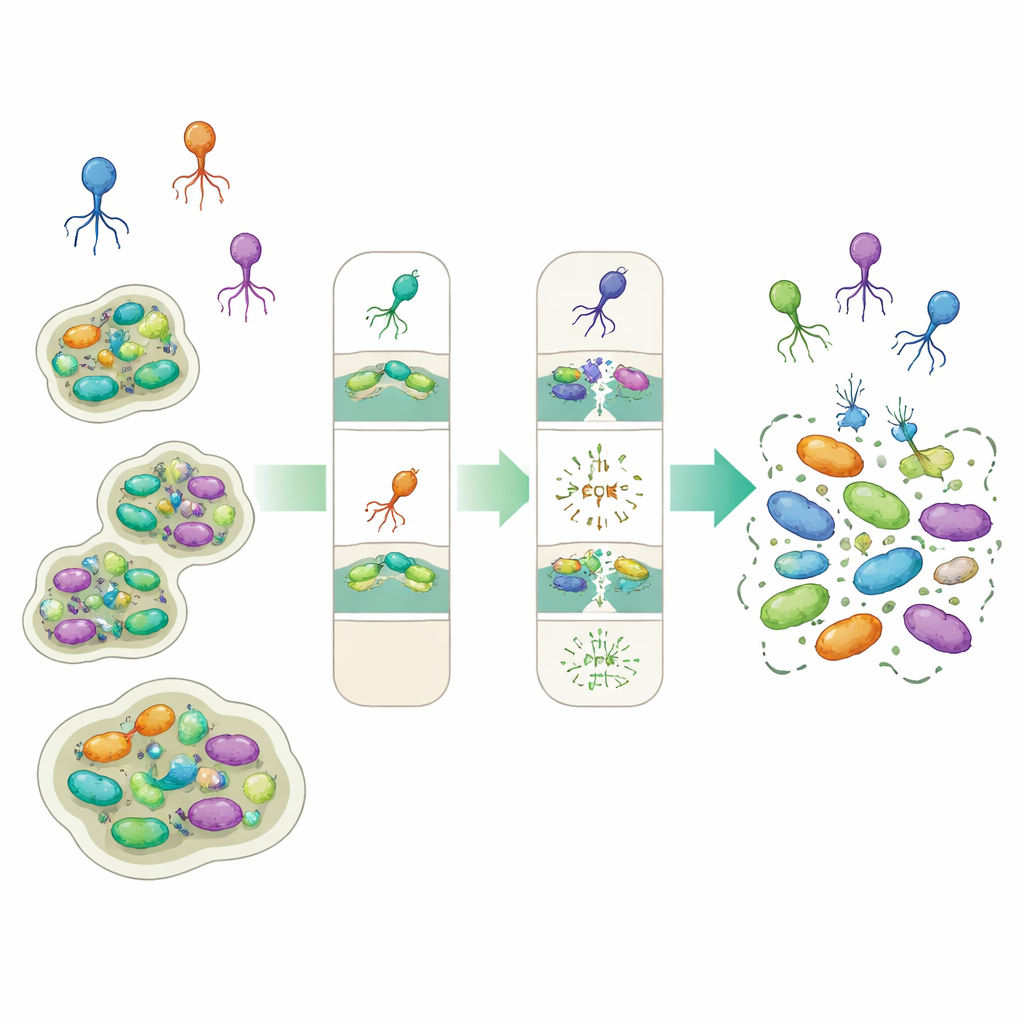
Designing a Smart Virus “Cocktail”
No single phage could eliminate every clinical strain, so the researchers turned to a cocktail strategy: combining several phages so that at least one in the mix can attack any given bacterium. Using computer tools and their lab data, they treated the problem like a puzzle—find the smallest number of phages that together cover all 42 Klebsiella isolates that were susceptible in tests. The solution was surprisingly compact: just four carefully chosen phages formed a minimal cocktail that killed every target strain. In lab experiments, higher doses of these phages sharply reduced bacterial growth, showing strong killing power even against highly resistant isolates.
Peeking Inside the Phages’ Family Tree
To understand what kinds of phages they had found, the scientists analyzed their genetic material using targeted DNA tests. Most of the 60 best‑performing phages fell into six known groups, or genera, of virulent Klebsiella‑infecting phages. One group called Taipeivirus was the most common, while others were rarer but still promising. The phages generally stayed active in mildly acidic to slightly alkaline conditions and at body‑like temperatures up to about 50 °C, though extreme heat or very harsh acidity did reduce their survival. These traits suggest that many of the phages could remain effective inside the human body and during storage if handled properly.
From Lab Bench to Bedside
Taken together, the study paints an encouraging picture: dirty water around Addis Ababa harbors a diverse, potent set of phages that can attack multidrug‑resistant Klebsiella, and a carefully selected four‑phage cocktail can cover a wide range of patient isolates in the lab. For a layperson, the key message is that nature already supplies tiny, highly targeted viruses that may help us fight back when antibiotics no longer work. Before these phages can be used routinely in hospitals, scientists still need to fully sequence their genomes, test them in animals, and run clinical trials to prove safety and effectiveness. But this work lays crucial groundwork for turning environmental phages into precise, eco‑friendly treatments for stubborn bacterial infections.
Citation: Abebe, A.A., Birhanu, A.G. & Tessema, T.S. Isolation and characterization of lytic bacteriophages with therapeutic potential against multidrug resistant Klebsiella pneumoniae from Ethiopia. Sci Rep 16, 8000 (2026). https://doi.org/10.1038/s41598-026-39153-8
Keywords: phage therapy, antibiotic resistance, Klebsiella pneumoniae, bacteriophage cocktail, wastewater virology