Clear Sky Science · en
Investigation on geoengineering properties of organic silt soil treated with chitosan nanoparticle additive
Why stronger, cleaner ground matters
From homes and roads to wind turbines, much of modern infrastructure rests on soil that was never designed to carry heavy loads. When that soil is rich in decaying plant matter, it can be weak, spongy and hard to build on safely. Engineers often strengthen such ground with cement or lime, but those materials come with a large carbon footprint. This study explores a very different option: using tiny particles made from shrimp shell waste to bind and stiffen a problematic soil, aiming for safer foundations with a smaller environmental cost. 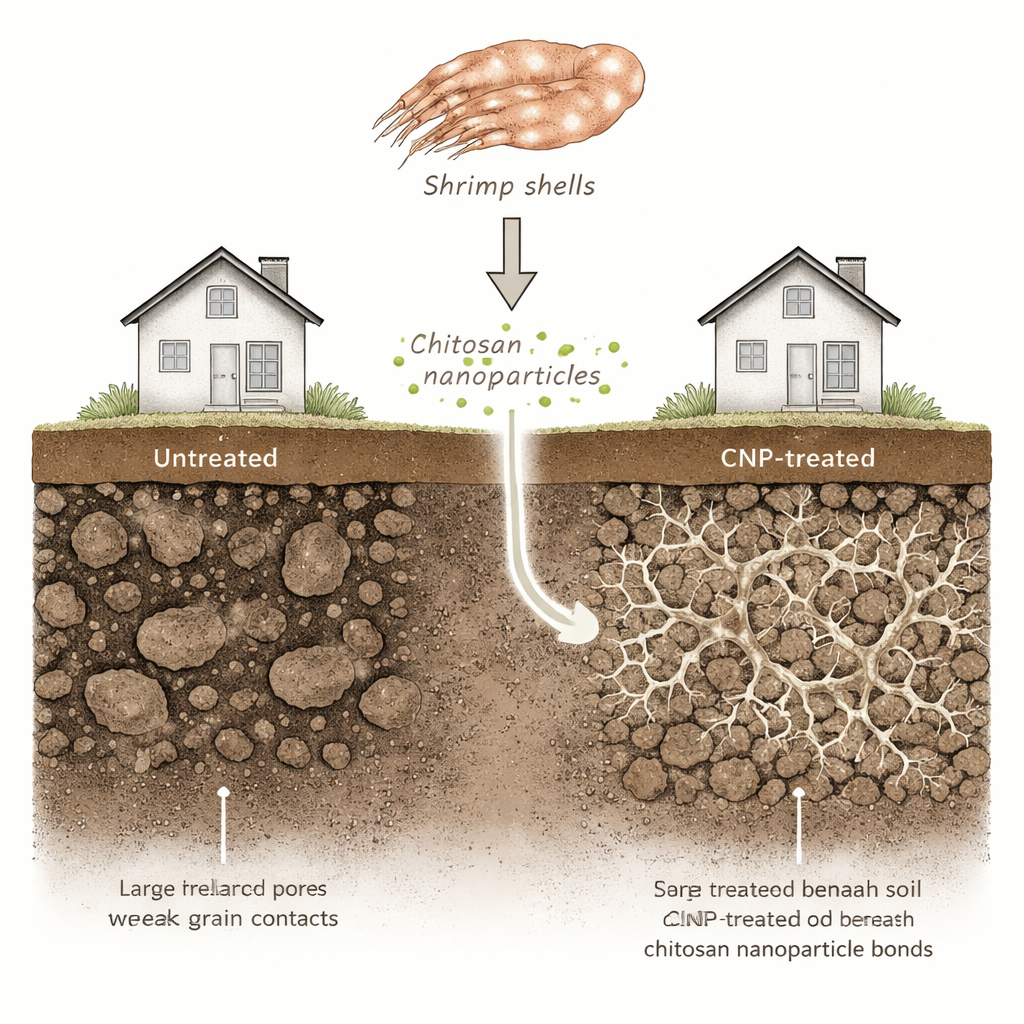
Turning shrimp shells into a soil helper
The researchers worked with a dark, organic silt from farm fields in southern India. On its own, this soil has moderate plasticity, relatively low strength and limited ability to carry load without settling. Instead of adding traditional cement, the team used chitosan nanoparticles, a powder derived from crustacean shells that is already used in areas like water treatment. By processing the material down to particles only a few dozen nanometers across, they greatly increased the surface area available to interact with soil grains. The chitosan particles carry a positive electrical charge, while many clay minerals in soil are negatively charged, setting the stage for strong attraction between them.
From loose grains to a fibrous network
To test the idea, the authors mixed dry soil with different doses of chitosan nanoparticles—between 0.5% and 2.5% of the soil’s dry weight—then added water and compacted the mixtures, mimicking what might happen in the field. They tracked how basic properties changed: how easily the soil deforms (plastic limits), how densely it can be packed (compaction), how strong it becomes in simple compression tests, how readily water flows through it, and how much it squeezes under long-term load. They also used microscopes and spectroscopy to peer into the tiny spaces between grains, searching for signs of new bonds or structures created by the additive.
Finding the sweet spot for strength
The stand-out result was that a modest 1% dose of chitosan nanoparticles performed best. After 90 days of curing, soil with this dosage more than doubled its compressive strength compared with untreated soil, while strength gains at higher dosages actually fell off. The soil’s ability to carry load increased, but its tendency to settle over time did not get worse; in fact, the compression index (a measure of how much the soil squeezes under sustained pressure) dropped by about 40%. Microscopy images showed why: the nanoparticles formed fine, fibrous threads that bridged individual soil grains, pulling them into clumps and reducing how much they could slide past each other. Importantly, X‑ray tests did not reveal new minerals, suggesting that the improvement came mainly from physical and ionic bonding, not from cement-like chemical reactions. 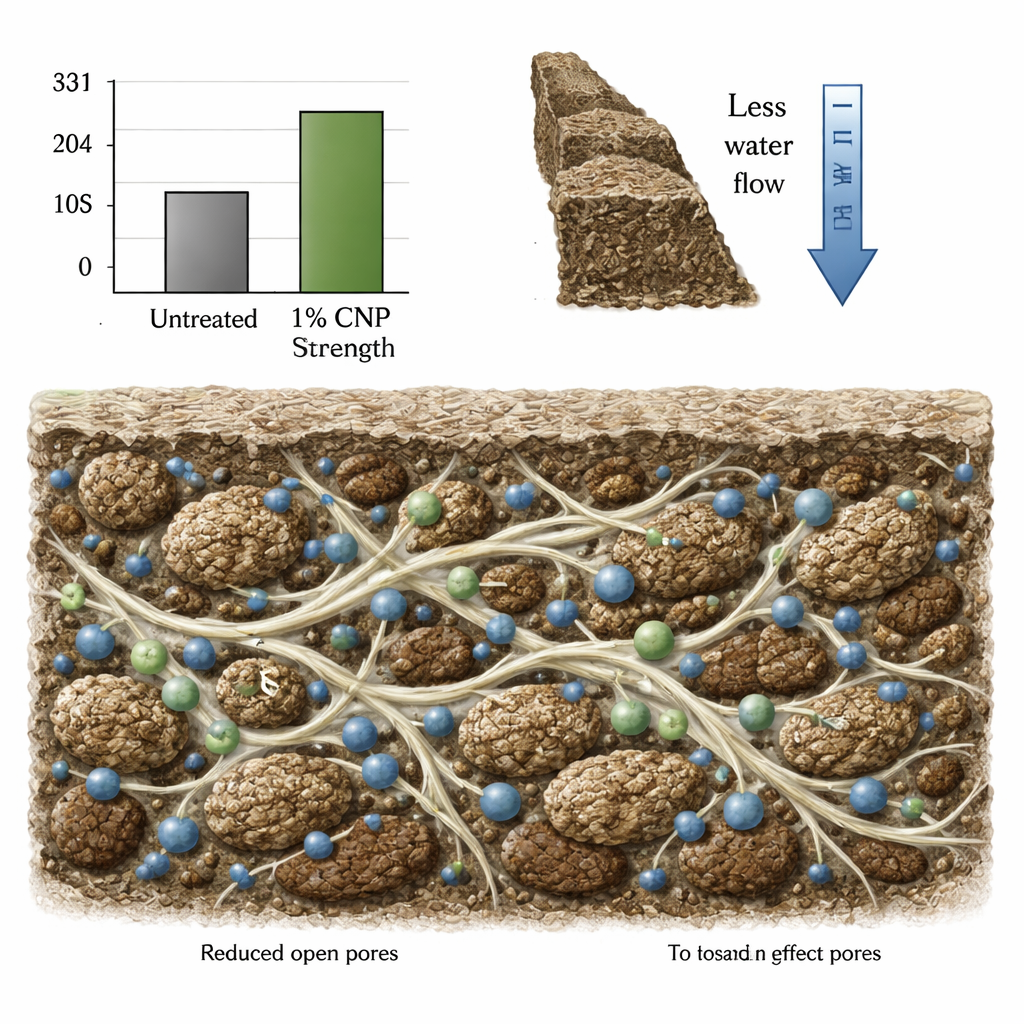
Changing how water moves through the ground
Water flow is crucial for any ground improvement method: blocking water too much can cause drainage and stability problems, but leaving pores too open can weaken soil or allow contaminants to spread. In this study, chitosan nanoparticles slightly reduced how easily water could pass through the treated soil, especially in the first two weeks. For 1% treatment, the permeability dropped by roughly three-quarters compared to the original soil, then crept up a bit with longer curing as the fibrous network rearranged pores. Overall, the treated soil still allowed some flow but resisted rapid seepage. Unlike other nano-additives previously tested on the same soil, chitosan did not create large, open channels that would increase water movement.
Promise, price, and open questions
While the technical benefits are clear, the authors also highlight serious practical hurdles. Chitosan nanoparticles currently cost far more than bulk cement or lime, even when carbon taxes on emissions are factored in, because they are produced mainly at laboratory or pharmaceutical scales. As a natural biopolymer, chitosan is also biodegradable: in real-world ground conditions, it may slowly break down, potentially eroding the strength gains seen in the lab. Ensuring that the tiny particles are evenly mixed throughout large, variable soil deposits would be another challenge on construction sites. The study therefore presents chitosan nanoparticle treatment as an encouraging proof-of-concept for greener ground improvement, rather than a ready-made replacement for conventional methods.
What this means for future building sites
For a non-specialist, the main takeaway is that waste from seafood shells can, in principle, be turned into a powerful “glue” that helps weak, organic soils safely support heavier structures while limiting extra water flow and avoiding new cement chemistry. With only about 1% of this nano-additive, the soil in the study became much stronger and less compressible without major side effects. However, until costs drop, large-scale production improves, and long-term durability in real soils is better understood, chitosan nanoparticles will likely remain a promising research tool rather than a standard ingredient in foundations and embankments.
Citation: Kannan, G., Sujatha, E.R. & O’Kelly, B.C. Investigation on geoengineering properties of organic silt soil treated with chitosan nanoparticle additive. Sci Rep 16, 7793 (2026). https://doi.org/10.1038/s41598-026-39151-w
Keywords: soil stabilization, chitosan nanoparticles, organic silt, biopolymer, ground improvement