Clear Sky Science · en
MedLedgerFL: a hybrid blockchain-federated learning framework for secure remote healthcare services
Why safer online medicine matters
As video visits and remote checkups become part of everyday life, our most intimate medical details now travel through networks and servers. This shift promises faster diagnoses and care that reaches people far from big hospitals, but it also raises a pressing question: how can doctors and researchers learn from patient data without exposing it to leaks, hacks, or misuse? This paper introduces MedLedgerFL, a framework designed to let hospitals team up on powerful diagnostic tools for lung diseases while keeping raw patient data locked safely inside each institution.
Today’s problem with sharing health data
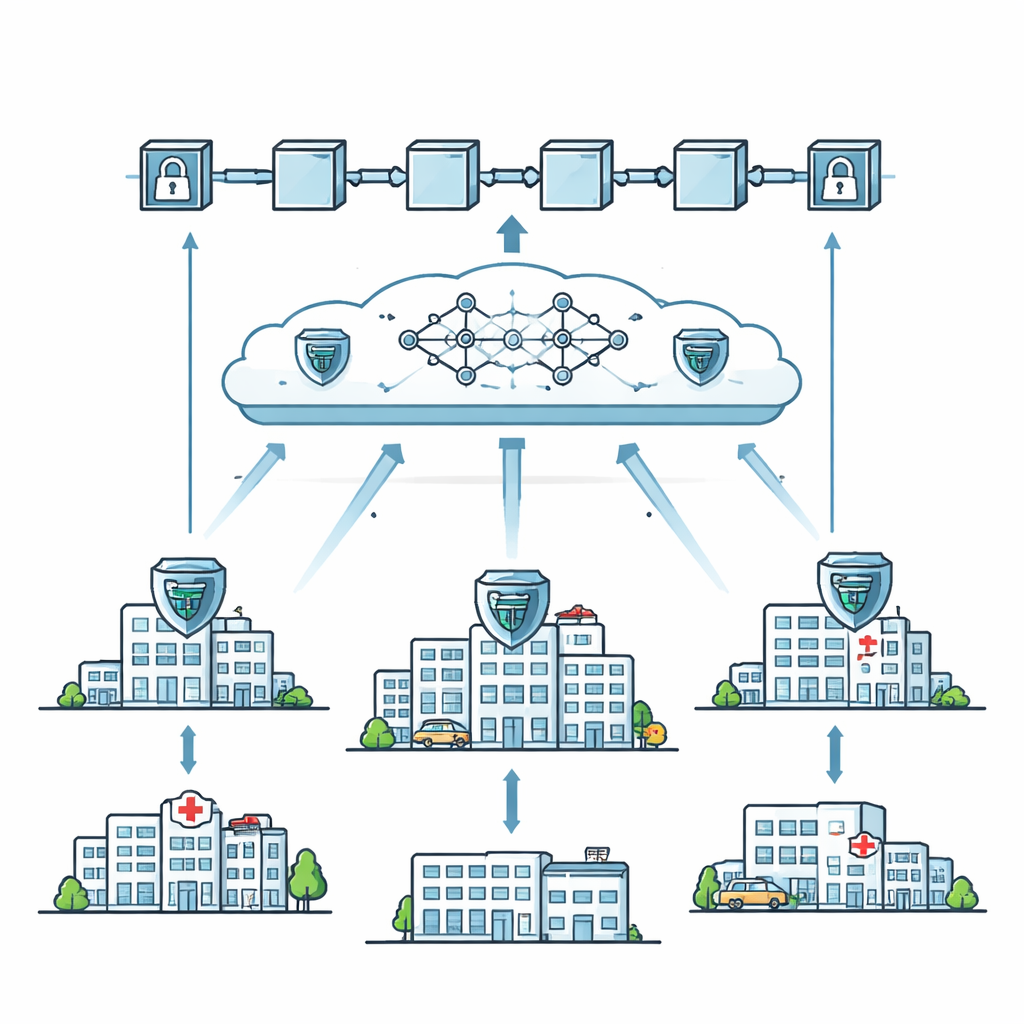
Many telemedicine systems still follow an older, centralised pattern: hospitals send copies of their patient records to a single location where predictive computer models are trained. This approach can work well for accuracy, but it creates tempting targets for cyberattacks, sparks disputes over who owns the data, and often clashes with privacy rules such as GDPR in Europe or HIPAA in the United States. Newer “federated” approaches allow each hospital to train its own copy of a model locally and share only the learned patterns, not the underlying records. Yet, these systems can falter when hospitals have very different types of patients or scanning equipment, and they usually lack a strong way to check whether the shared updates have been tampered with.
A new blend of shared learning and digital trust
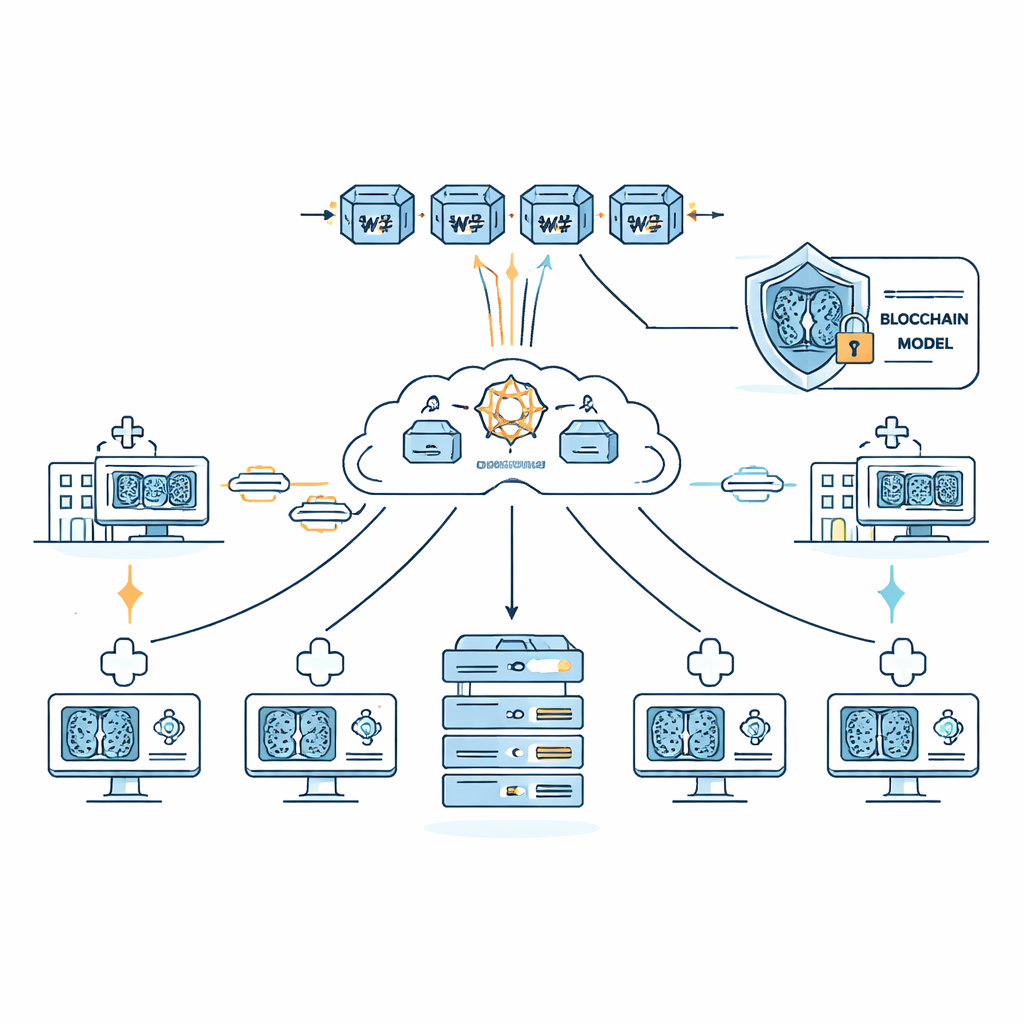
MedLedgerFL combines two ideas to tackle these gaps. First, it uses federated learning so that hospitals keep all chest X-ray images and other records on their own servers. Each site trains a model to recognise conditions such as COVID‑19, pneumonia, and tuberculosis, then sends only encrypted model updates to a central coordinator. Second, it relies on a permissioned blockchain, built on Hyperledger Fabric, to record fingerprints of these updates on a tamper‑resistant ledger that only approved hospitals can join. Smart contracts automatically verify who is allowed to participate, log every training round, and ensure that changes to the shared model can be audited later.
How the system works under the hood
Inside MedLedgerFL, a specialised training strategy called FedProx helps stabilise learning when hospitals hold uneven and dissimilar data. Instead of simply averaging updates, FedProx nudges local models to stay close to the global model, which reduces wild swings when one hospital has mostly one type of case, such as tuberculosis, while another sees more COVID‑19. To keep the blockchain fast and lightweight, the full model is stored off‑chain in an encrypted file system, while only small hashes and performance summaries are written to the ledger. Experiments with real chest X‑ray collections and a brain tumour MRI dataset show that this design speeds up transactions, cuts storage needs, and still preserves a clear, verifiable trail of how the model has evolved.
Putting the approach to the test
The authors evaluated MedLedgerFL across several deep learning models commonly used for medical images, including MobileNetV2, ResNet50, and Inception. Under challenging, realistic conditions—where each hospital holds different mixes of diseases—the system achieved higher accuracy and lower error than standard federated learning alone. MobileNetV2, for instance, performed best when paired with FedProx inside MedLedgerFL, reaching over 80% accuracy on multi‑disease chest X‑ray classification. Security tests further showed that when some participating sites behaved maliciously by flipping labels or poisoning updates, the combination of blockchain verification and FedProx kept accuracy noticeably higher than a basic federated approach. The blockchain also scaled reasonably well as more hospitals joined, maintaining acceptable delays while increasing the number of transactions it could handle per second.
What this means for future telemedicine
For patients, the promise of MedLedgerFL is that their scans and records can help improve care globally without leaving the safety of their home hospital. For healthcare providers, it offers a way to build shared diagnostic tools that respect strict privacy rules, resist data tampering, and remain transparent to regulators. By pairing privacy‑preserving learning with auditable digital trust, the framework moves telemedicine closer to a world where powerful AI support can be both widely shared and carefully protected. The authors envision next steps that add even stronger privacy techniques, more efficient coordination, and deployment in real hospital networks and connected medical devices.
Citation: Murala, D.K., Vemulapalli, L., Balagoni, Y. et al. MedLedgerFL: a hybrid blockchain-federated learning framework for secure remote healthcare services. Sci Rep 16, 8218 (2026). https://doi.org/10.1038/s41598-026-39149-4
Keywords: telemedicine security, privacy-preserving AI, healthcare blockchain, federated learning, medical imaging diagnostics