Clear Sky Science · en
A geology-constrained hybrid stacking ensemble method using well logs for TOC prediction in continental shale reservoirs
Why this matters for future oil exploration
Finding new oil in shale rocks increasingly depends on smart use of data rather than drilling ever more expensive wells. A key measure called total organic carbon (TOC) tells geologists where shale rocks are rich enough in ancient organic matter to generate oil. Directly measuring TOC from rock cores is slow and costly, so most depths in most wells remain unsampled. This study shows how a carefully designed artificial intelligence system, guided by geological knowledge, can turn routine well-logging measurements into reliable, continuous estimates of TOC in a major Chinese shale oil basin.
Reading the rocks with electronic eyes
Modern wells are routinely logged with tools that measure properties such as natural radioactivity, sound travel time, electrical resistivity, density, and neutron response. These readings form continuous curves along the borehole and are much cheaper than collecting and analyzing cores. However, the link between these log signals and organic richness is complicated. It depends on rock type, grain size, pore fluids, and the way the sediment was deposited and altered over time. Earlier empirical formulas, such as the classic ΔlogR method, work reasonably well in simple settings but struggle when the geology becomes more varied and layered, as in continental lake basins like the Songliao Basin in northeast China.
Adding geological insight to machine learning
To tackle this problem, the authors built a hybrid “stacking” ensemble model that combines four different prediction engines: gradient-boosted trees, random forests, a support-vector regression method, and an improved recurrent neural network. Rather than feeding these models raw log curves alone, they engineered a rich set of inputs that encode geological context. Rock types were translated into a continuous numerical scale that smoothly transitions across layer boundaries and reflects how TOC tends to vary from oil shale to ordinary shale, siltstone, and carbonate rocks. Reservoir intervals known from regional stratigraphy were added as categorical indicators, helping the system learn how the log–TOC relationship changes from one depth zone to another.
Extracting subtle patterns from complex logs
The team also designed new features to capture subtle combinations of well-log responses that signal tight, organic-rich shale as opposed to more permeable, cleaner rocks. They combined multiple resistivity measurements to describe how tightly fluids are trapped and mixed gamma-ray, density, and neutron readings to distinguish clay-rich backgrounds from true organic enrichment. A specialized convolutional module was introduced to handle the irregular spacing between core samples and log measurements: it treats the log curves as complex-valued signals and extracts both amplitude and phase information while accounting for uneven depth steps. Principal component analysis then distilled the many correlated log features into a smaller number of orthogonal components that summarize key rock properties.
Optimizing models and filling in data gaps
Because the number of core-based TOC measurements is limited, the researchers used heuristic optimization inspired by beluga whale behavior to select the most informative feature subsets and tune the many model settings in a data-driven way. They further applied a regression-focused data augmentation method that generates plausible synthetic TOC values at unlabeled depths, constrained to stay consistent within the same well and rock type. These steps produced more balanced training data and reduced overfitting. Finally, the four optimized base models were stacked, with their outputs combined by a higher-level learner so that individual strengths could compensate for one another’s weaknesses. 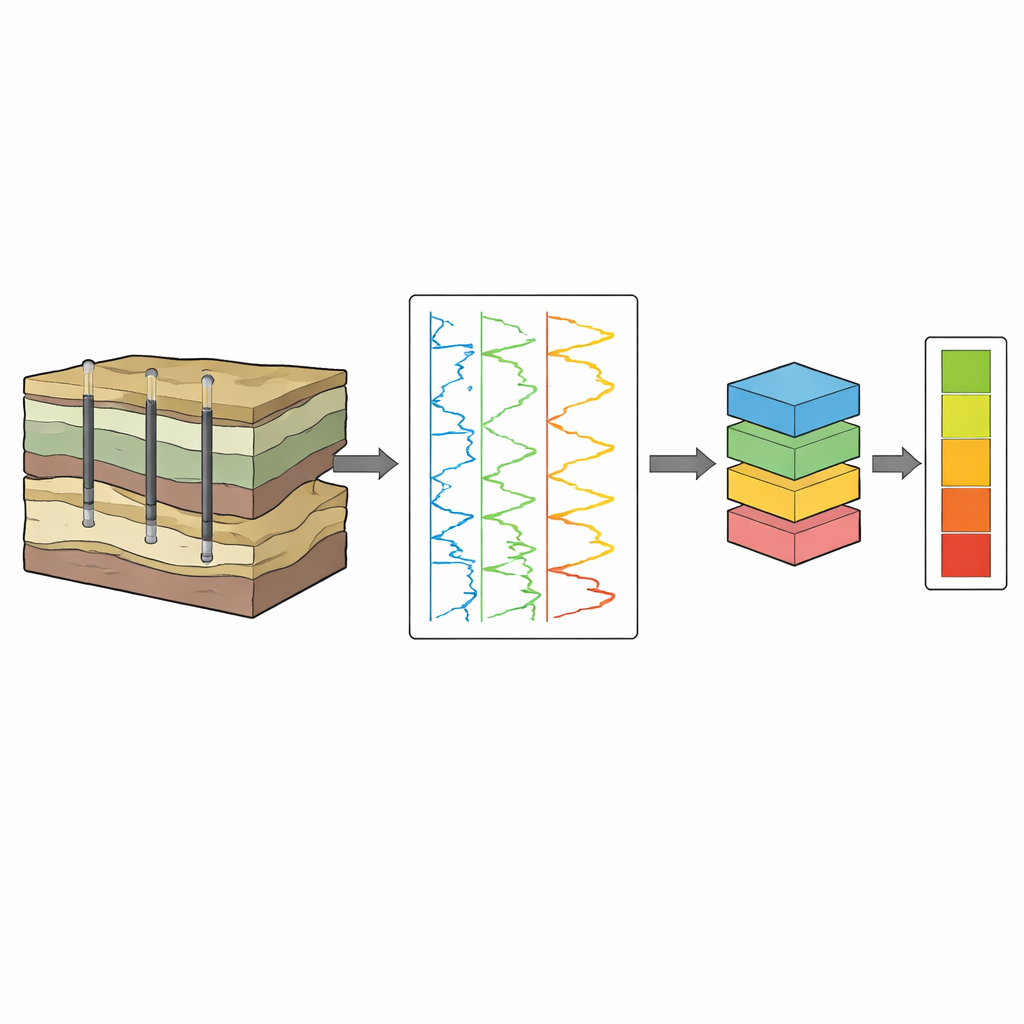
How well does it work in the real subsurface?
The approach was tested on seven wells from the Qingshankou Formation in the northern Songliao Basin, using 2,374 core samples as ground truth. Across a series of controlled experiments, every major component—geological constraints, engineered log features, advanced convolution, optimization algorithms, data augmentation, and model stacking—contributed measurable gains. The final ensemble achieved a high degree of fit within wells and, more importantly, generalized better than any single model to wells it had not seen before. Compared with traditional formulas and simpler machine-learning setups, it consistently produced lower errors and more stable performance when predicting TOC across different rock intervals and wells. 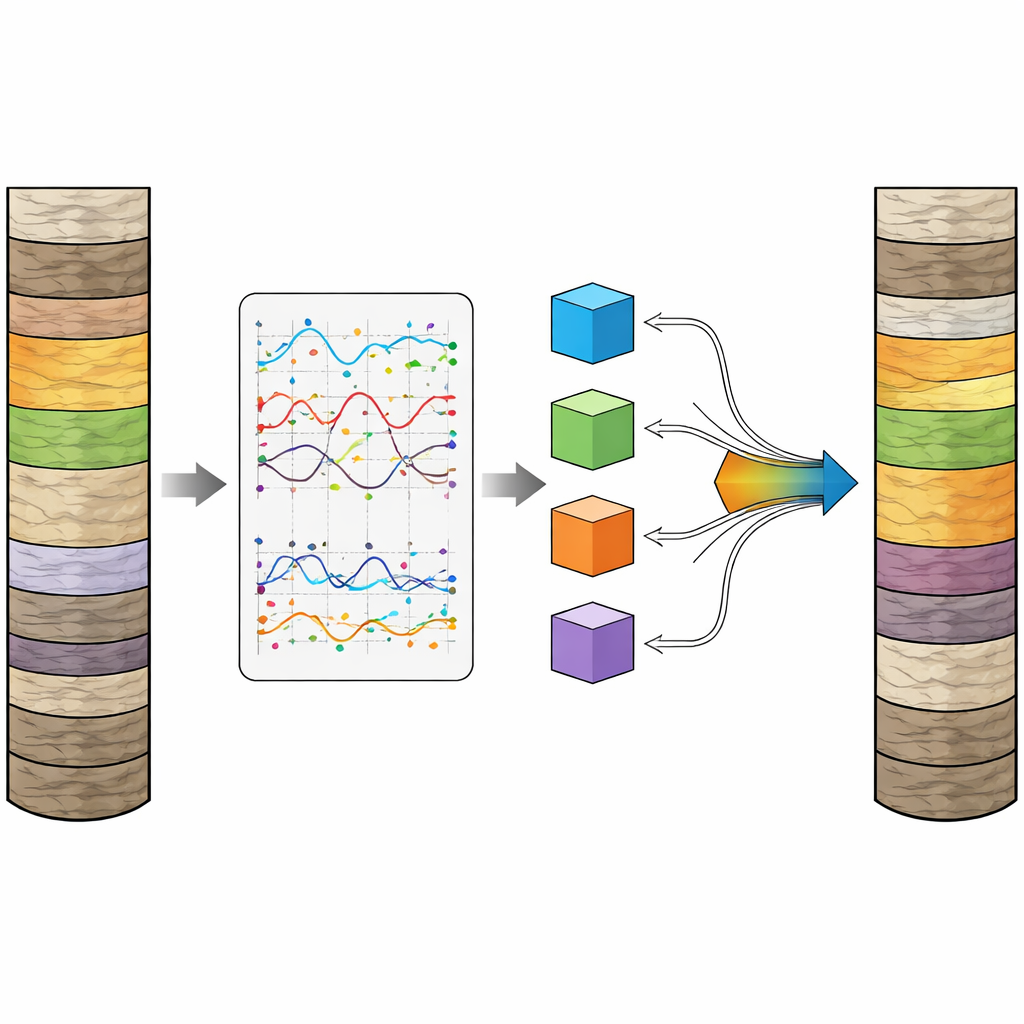
What this means for energy and geology
For non-specialists, the key message is that pairing domain knowledge with artificial intelligence can unlock more information from existing data, without extra drilling or lab work. By teaching algorithms to “think geologically” about which rock layers are likely to host organic-rich shale, and by carefully handling messy, uneven field measurements, this study delivers a practical tool for mapping sweet spots in continental shale oil reservoirs. While the method still needs to be tested in other basins with different rock types, it points toward a future where smarter models help reduce exploration risk, make better use of existing wells, and guide more targeted and efficient development of unconventional oil resources.
Citation: Lu, Y., Tian, F., Zhang, H. et al. A geology-constrained hybrid stacking ensemble method using well logs for TOC prediction in continental shale reservoirs. Sci Rep 16, 9059 (2026). https://doi.org/10.1038/s41598-026-39144-9
Keywords: shale oil, total organic carbon, well logs, machine learning, reservoir characterization