Clear Sky Science · en
Continuous flow hydroprocessing of waste plastics using ionic liquid catalyst
Turning Trash into Travel
Mountains of plastic waste are one of today’s most visible environmental problems, yet those same plastics are made from energy-rich ingredients similar to the fuels that power cars and trucks. This study explores a way to turn mixed plastic trash into a diesel-like fuel using a continuous, factory-style process that runs at much lower temperatures than usual. The goal is a practical route that could both shrink plastic pollution and supply cleaner-burning fuel that existing diesel engines can use with little modification.
From Everyday Plastics to Energy-Rich Oil
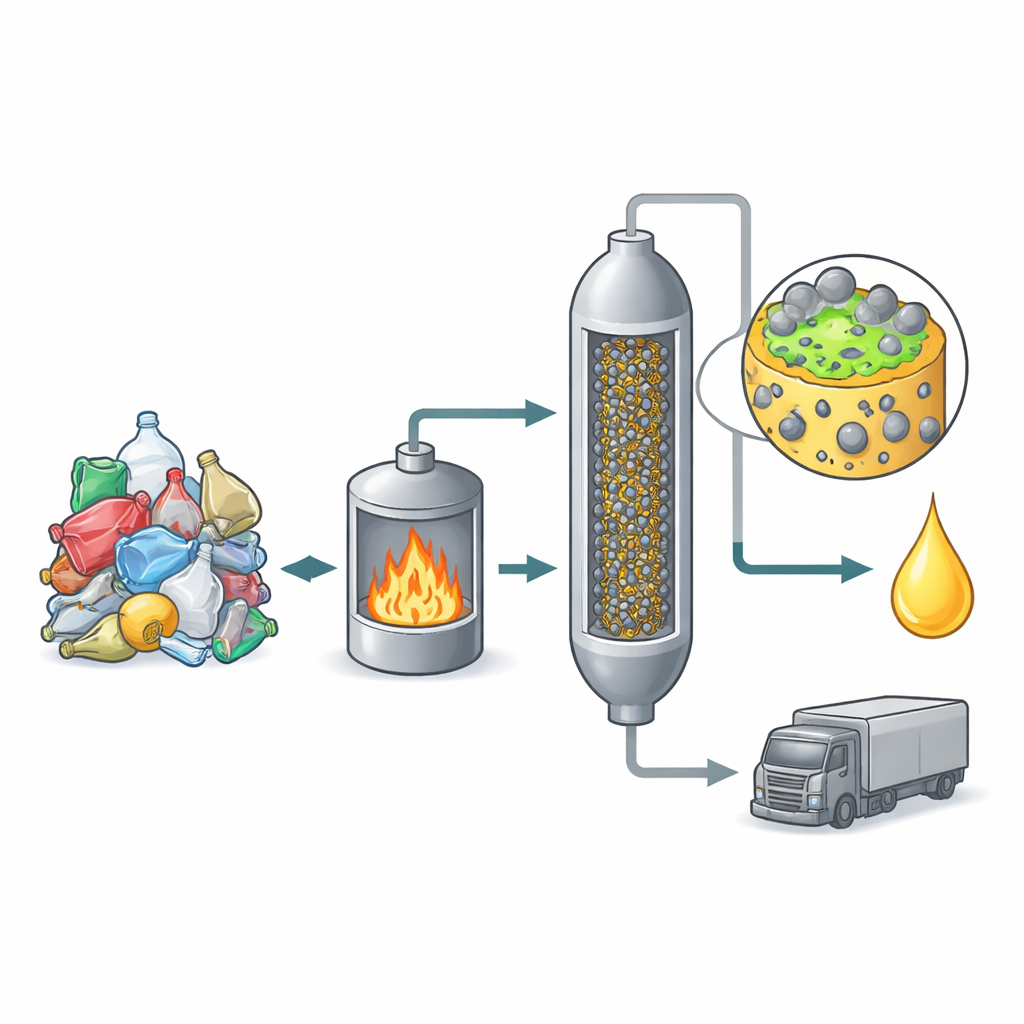
The researchers started with three common packaging plastics: low-density polyethylene, high-density polyethylene and polypropylene. Instead of dumping them, they cleaned, shredded and heated each type in the absence of oxygen, a process called pyrolysis. This step breaks long plastic chains into a thick liquid similar to crude oil. By optimizing conditions for each plastic separately, they maximized the amount of liquid obtained, then blended the three oils into a mixed plastic oil that already had an energy content close to diesel but burned too harshly and produced too many engine emissions to be used directly as fuel.
A Gentle but Powerful Catalyst
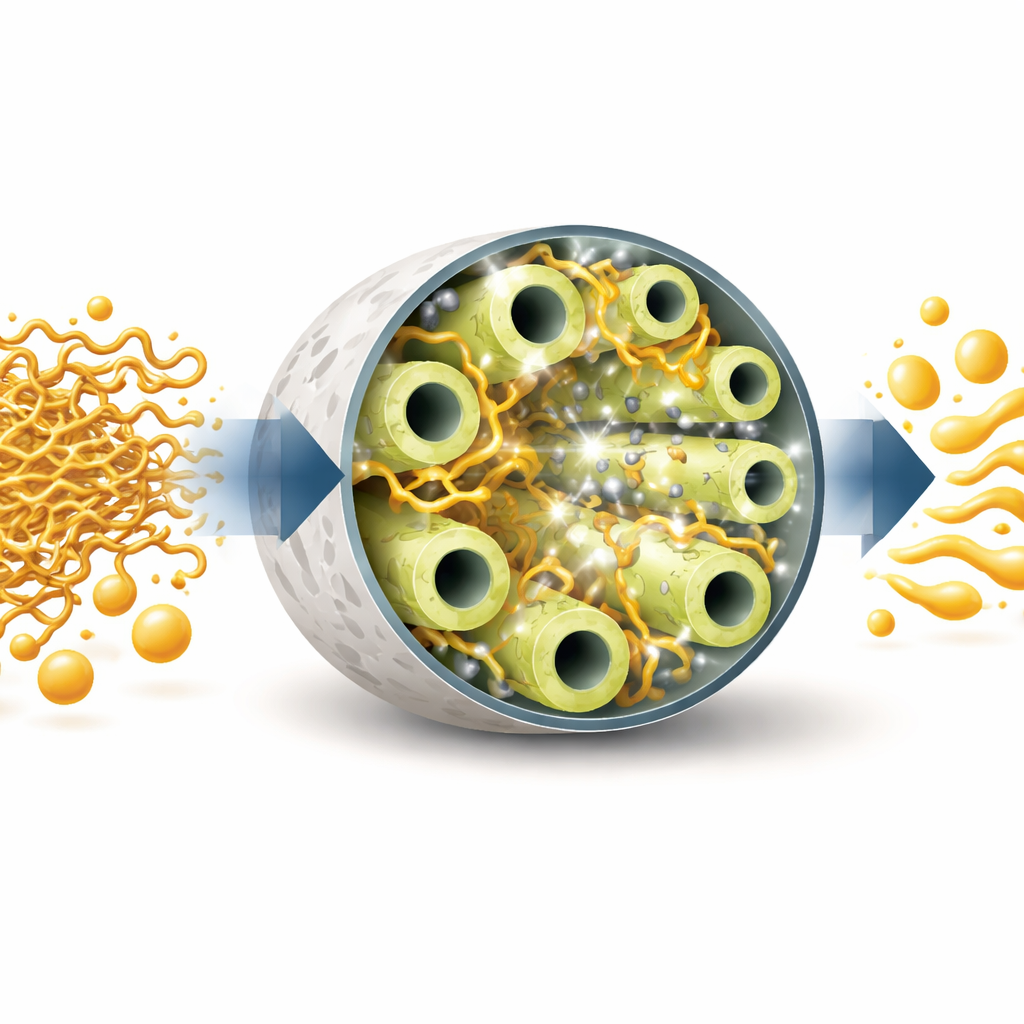
To tame this rough oil, the team designed a special solid catalyst that looks, under the microscope, like a honeycomb of tiny channels. The support is a mesoporous silica material (SBA-15) loaded with tiny particles of palladium metal, a strong helper for reactions involving hydrogen. They then coated this surface with a thin film of an ionic liquid, a salt that is liquid at room temperature. This coating helps spread the metal evenly, improves how the oil and hydrogen move through the tiny pores, and creates a microenvironment that guides reactions along easier, lower-energy pathways. As a result, the oil can be upgraded at just 180 °C, far below the 300–450 °C often needed in conventional refineries.
Running Like a Mini Refinery
The mixed plastic oil was then fed, along with high-pressure hydrogen, through a narrow, packed tube in a continuous flow, much like a small refinery unit. As the hot mixture passed over the catalyst, several reactions occurred at once: double bonds were saturated, long chains were cracked into shorter ones, some straight chains were rearranged, and some compounds were turned into ring-shaped molecules. The liquid product contained about 53% straight-chain paraffins, 22% branched paraffins and 25% aromatics—very close to commercial diesel. Laboratory tests showed that its key physical properties, including energy content, density, viscosity, ignition quality and flash point, fell within or near European diesel specifications.
Putting the New Fuel into an Engine
To find out if this upgraded plastic oil behaves like real fuel, the team blended it with regular diesel at levels from 10% to 40% and ran it in a turbocharged diesel engine. The blends delivered brake thermal efficiency and specific fuel consumption within a few percent of pure diesel, meaning the engine generated almost the same useful power from the fuel. Combustion pressures and heat release patterns were also close, indicating that the fuel burns smoothly and ignites readily, helped by a higher cetane index than commercial diesel. Emission measurements showed similar levels of carbon monoxide, carbon dioxide and nitrogen oxides, and slightly lower unburned hydrocarbon emissions, suggesting cleaner burn than many unrefined plastic-derived fuels.
Stability and Path to Real-World Use
Because any industrial process must run for long periods, the researchers operated their system continuously for 24 hours. After a short start-up phase, the reactor produced about 95% liquid product, with only a small amount of gas, and then stabilized at about 92% yield. Analyses of the used catalyst showed some pore narrowing from deposits and modest loss of the ionic liquid layer, but the overall structure remained intact. This indicates that the catalyst can function stably over long runs, and that modest regeneration or replacement strategies could keep such a system operating in an industrial setting.
Why This Matters for Everyday Life
For non-specialists, the main message is that mixed plastic waste, which is notoriously hard to recycle, can be turned into a high-quality fuel that existing diesel engines can use with minimal changes. By using a smartly designed ionic-liquid-coated catalyst and a continuous flow reactor, the process works at lower temperatures and high efficiency, bringing it closer to something that could be scaled up in real plants. While this is not a complete solution to plastic pollution or climate change, it offers a way to recover energy from plastics that are currently landfilled or burned, turning a persistent waste problem into a valuable resource.
Citation: Ramajayam, J.G., Govindarajan, M., Lakshmipathy, M.V. et al. Continuous flow hydroprocessing of waste plastics using ionic liquid catalyst. Sci Rep 16, 9261 (2026). https://doi.org/10.1038/s41598-026-39132-z
Keywords: plastic waste to fuel, diesel-like fuel, ionic liquid catalyst, continuous hydroprocessing, pyrolysis oil upgrading