Clear Sky Science · en
A foreign object detection dataset and network for electrified railway catenary systems
Why strange things on overhead wires matter
Look up above an electrified railway line and you will see a web of cables that quietly delivers power to passing trains. When foreign objects such as bird nests, plastic bags, or wind-blown kites get tangled in this web, they can trigger power failures, delays, and even safety hazards. This study tackles a practical problem for modern railways: how to teach computers to spot these dangerous intruders automatically, before they cause trouble. 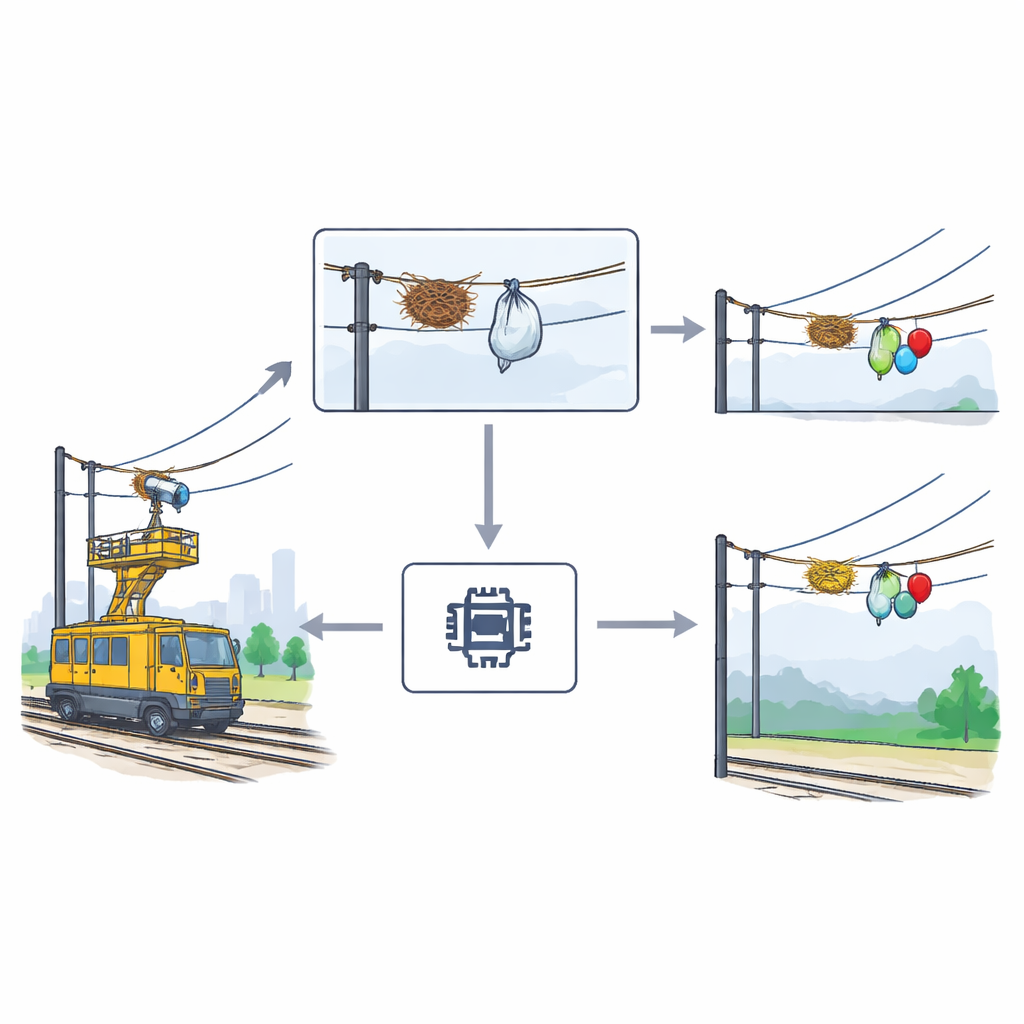
The problem of keeping overhead power lines safe
The overhead power system, called the catenary, includes poles, contact wires, and supporting cables running for hundreds of kilometers. Over time, weather and human activity introduce unexpected objects onto these lines. Nests, balloons, and plastic films can burn, short-circuit equipment, or fall onto trains and tracks. Today, many railways still rely on human patrols or workers reviewing hours of video to look for such hazards. This is slow, expensive, and easy to miss, especially when objects are small, partly hidden, or seen in poor weather.
Why ordinary computer vision falls short
Digital cameras and artificial intelligence offer a way to watch the catenary continuously, but off-the-shelf algorithms struggle in this environment. The background is complex: pylons, trees, buildings, and wires overlap in dizzying patterns, and foreign objects often appear as tiny specks or thin strips far from the camera. Classic deep-learning detectors based on convolutional neural networks are good at spotting clear, medium-sized objects, yet they have a limited “field of view” and can miss long, thin, or distant items dangling from the wires. Public training data are also scarce, because collecting and sharing real fault images from working railways is difficult.
Building a realistic picture collection
To overcome the data shortage, the authors assembled a new image collection focused specifically on foreign objects along electrified railway lines, called RailCatFOD-DS. It contains 13,866 images, with more than 14,000 labeled objects. The dataset concentrates on two major risk types: bird nests and light debris, including plastic bags, films, and kites. To mimic the harsh conditions found in the field, the team did more than simple flips and rotations. They added realistic computer-generated rain, fog-like blur, random noise, changes in brightness, and artificial occlusions, so that the model would learn to work in heavy rain, strong sun, low light, and cluttered scenes. The result is a challenging benchmark rich in small, partially hidden objects.
A network tuned to tiny, tricky targets
On top of this dataset, the researchers designed a detection system called RailCatFOD-Net. At its core is a modern vision architecture known as a Swin Transformer, which scans each image in overlapping windows and links distant regions, helping the model understand how a tiny object relates to the broader scene. Around this core, the team built two specialized add-ons. One is a multi-branch fusion feature pyramid, which blends information from fine, detailed layers with coarser, more global layers so that objects of very different sizes can be found together. The other is a regional edge-focused module that expands the area of context around each point and sharpens boundaries, particularly for long, stringy debris hanging along the wires. 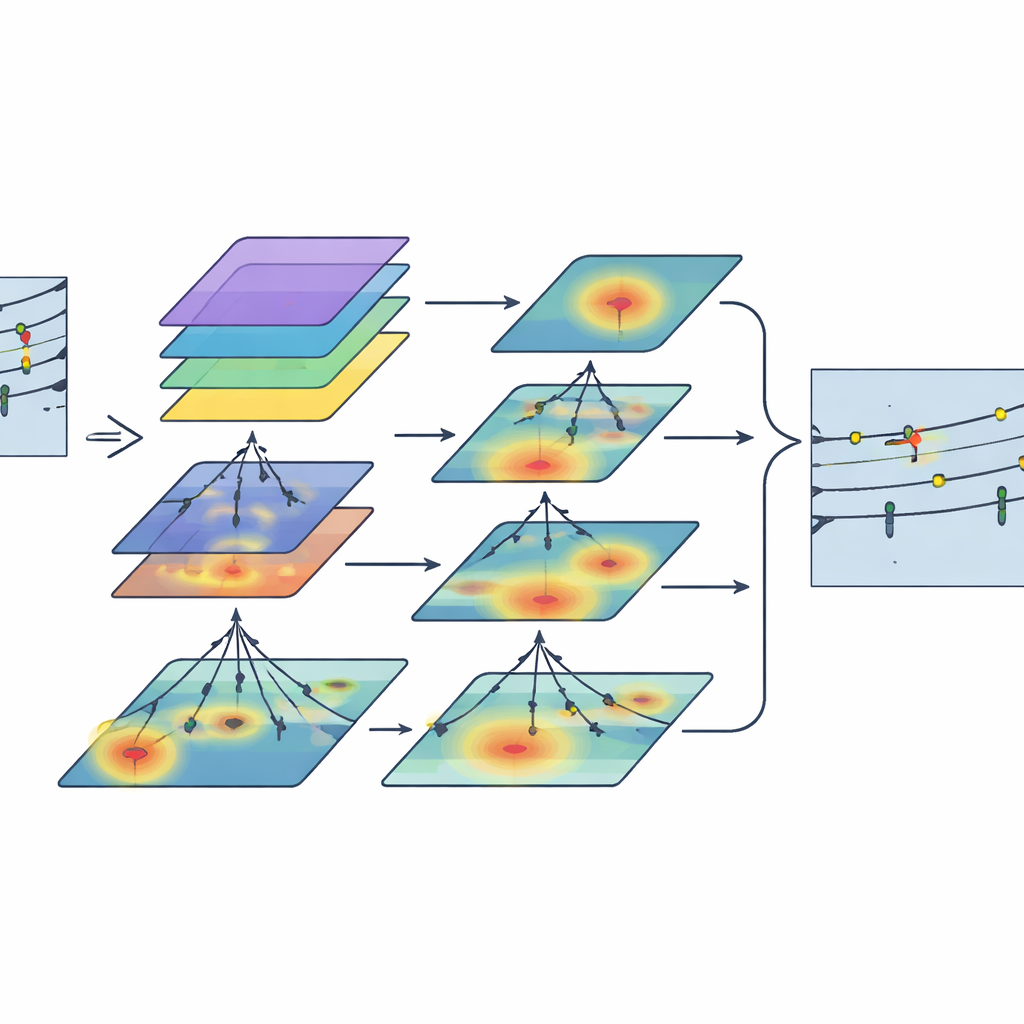
How well the new approach performs
When tested on their new dataset, RailCatFOD-Net outperformed a range of well-known detection methods, from transformer-based models to popular real-time systems like YOLO. It achieved an overall accuracy score of about 60% under a strict evaluation standard, with strong gains in finding small objects and elongated shapes compared to earlier techniques. The system also generalized well to a separate public dataset built with different image sources and synthetic foreign objects, where it again ranked at the top. Visual examples show it correctly detecting partially hidden nests, multiple objects in one scene, and debris in rain, glare, and noisy conditions where rival methods either missed them or raised false alarms.
What this means for future train travel
For non-specialists, the takeaway is straightforward: this work brings automated railway monitoring a step closer to reality. By combining a realistic, carefully prepared picture collection with a detection network tailored to the quirks of overhead power lines, the authors show that computers can reliably flag risky objects that humans might overlook. While the system is still too heavy for the smallest onboard devices and relies only on regular camera images, its success suggests that smarter, lighter versions—possibly fused with infrared or other sensors—could one day watch thousands of kilometers of track around the clock. That would mean safer journeys, fewer service interruptions, and more efficient maintenance for electrified railways worldwide.
Citation: Li, F., Cao, J., Yang, H. et al. A foreign object detection dataset and network for electrified railway catenary systems. Sci Rep 16, 9104 (2026). https://doi.org/10.1038/s41598-026-39129-8
Keywords: railway safety, computer vision, object detection, overhead power lines, transportation monitoring