Clear Sky Science · en
Carbon reduction potential and selection strategies of emerging construction-phase technologies
Why cleaner building sites matter
Buildings are responsible for a large share of the world’s climate-warming emissions, yet most public attention goes to how much energy they use once people move in. This study looks instead at a shorter but intense part of a building’s life: the construction phase. By examining 25 new construction technologies, the researchers show how smarter methods and materials can sharply cut carbon pollution on-site, and they offer practical guidance on which tools work best in different kinds of projects.
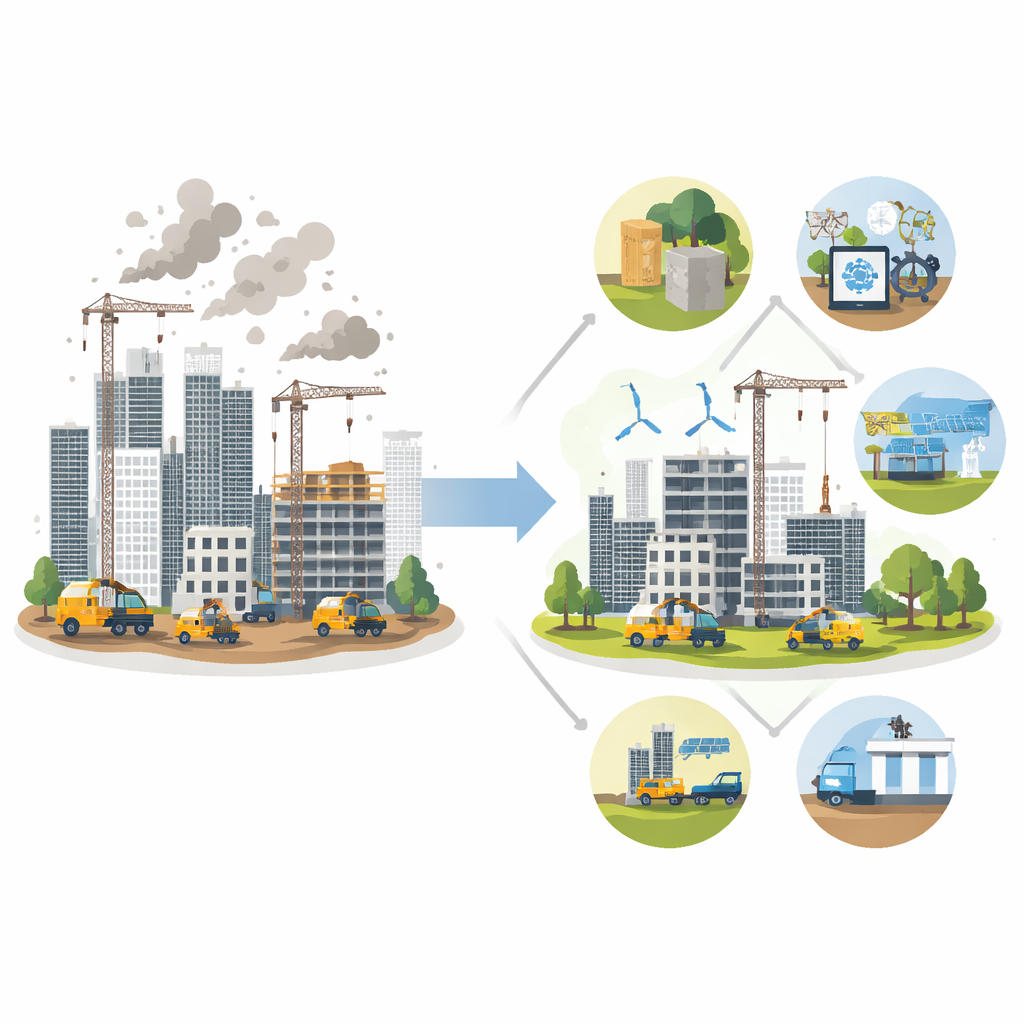
From busy work sites to hidden carbon costs
When we picture construction, we see cranes, concrete trucks, and stacks of steel. Behind that activity lie three main sources of carbon emissions on-site: the fuels and electricity that power machines and lighting, the gases and materials consumed in welding and other processes, and the transport of waste like scrap steel and discarded formwork. These emissions may occur over only a year or two, but they are highly concentrated. As cities build and rebuild at high speed, this “construction-stage carbon” becomes a major but often overlooked slice of the building sector’s climate impact.
Four families of cleaner building tools
The authors grouped the 25 emerging technologies into four easy-to-understand families. First are stronger and better-performing materials, such as high-strength concrete and steel, which allow builders to use less material for the same strength. Second are process-simplifying methods that remove or shorten messy steps on-site, like using special floor systems that do not need an extra leveling layer, or wall finishes that avoid plastering. Third are technologies that tap renewable resources and cut waste, such as rainwater collection, solar or air-source energy for site power, and systems that reduce or recycle construction debris. Finally, prefabrication technologies shift much of the work into factories, so the building site becomes mainly a place for assembly rather than heavy fabrication.
Which options cut the most carbon
Not all innovations are equal. The study finds that technologies based on renewable resources and waste reduction can, at the construction site itself, remove nearly all direct emissions linked to water supply, electricity use, and waste hauling, because they rely on clean energy and avoid trucking debris to landfills. Prefabrication comes next: for most prefabricated systems studied, on-site emissions drop by more than 90 percent compared with casting concrete and cutting steel on location. Process-simplifying methods show a wide range of benefits; some, like one-time concrete floor forming and no-plastering walls, completely eliminate certain tasks and their emissions, while others offer modest savings. High-strength and high-performance materials provide the smallest on-site reductions, generally under 30 percent, because they mostly trim quantities of material rather than the energy and waste tied to construction activities.
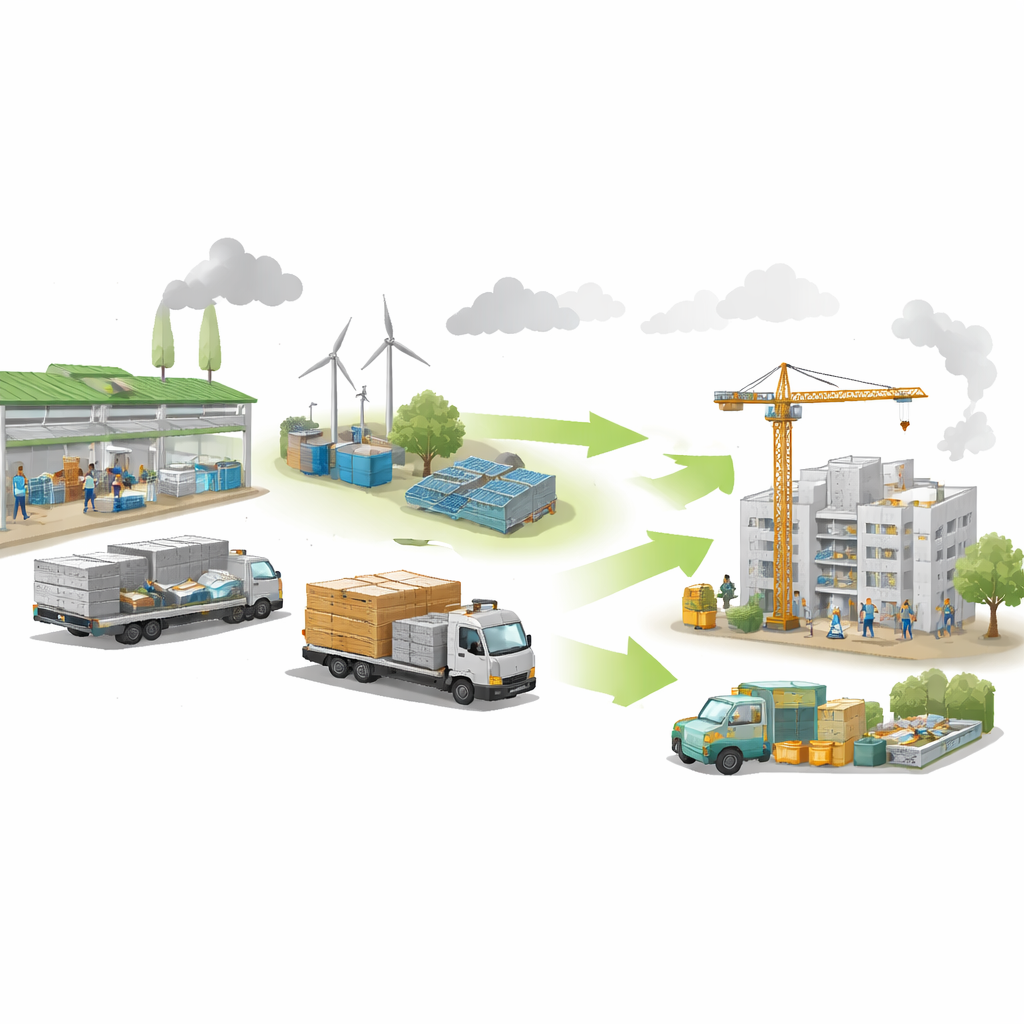
Choosing the right mix for each project
Because projects differ in height, structure, and purpose, the authors argue that no single technology is best everywhere. Instead, they propose a selection strategy based on where a building sits, what it will be used for, and local climate and policy goals. For supertall towers and long-span bridges, stronger concrete, steel, and reinforcing bars can cut material use and shorten work time. For standardized housing blocks and office parks, streamlined processes and prefabricated walls or floor slabs can slash on-site energy use and waste. Green-certified campuses, schools, and hospitals can gain most from combining solar power, rainwater systems, and strict waste reduction. To test this approach, the team applied eight of the 25 technologies to a large industrial park project in Xinyang, China. The combined package reduced on-site construction emissions by about 28 percent, a saving the authors liken to the amount of carbon a small forest of thousands of trees would absorb over the same period.
What this means for future building
The study concludes that construction sites can become far cleaner without waiting for distant breakthroughs. By understanding how each technology cuts carbon—whether by saving energy, reducing waste, or shifting work into more efficient factories—builders and policymakers can choose the right combinations for each project. While moving processes off-site does create new emissions in factories, these controlled settings are generally easier to clean up than scattered building sites. With better data, smart digital planning tools, and supportive rules and incentives, the authors argue that cities can rapidly scale up these emerging practices, turning today’s high-emitting building sites into much lower-carbon hubs of activity.
Citation: Liu, Z., Xia, Z., Li, J. et al. Carbon reduction potential and selection strategies of emerging construction-phase technologies. Sci Rep 16, 7863 (2026). https://doi.org/10.1038/s41598-026-39122-1
Keywords: construction carbon emissions, prefabricated buildings, green construction technologies, renewable energy at building sites, construction waste reduction