Clear Sky Science · en
Preliminary analysis of long-term prognosis outcomes of modified extracranial-intracranial bypass reconstruction for adult ischemic moyamoya disease
Why this brain surgery study matters
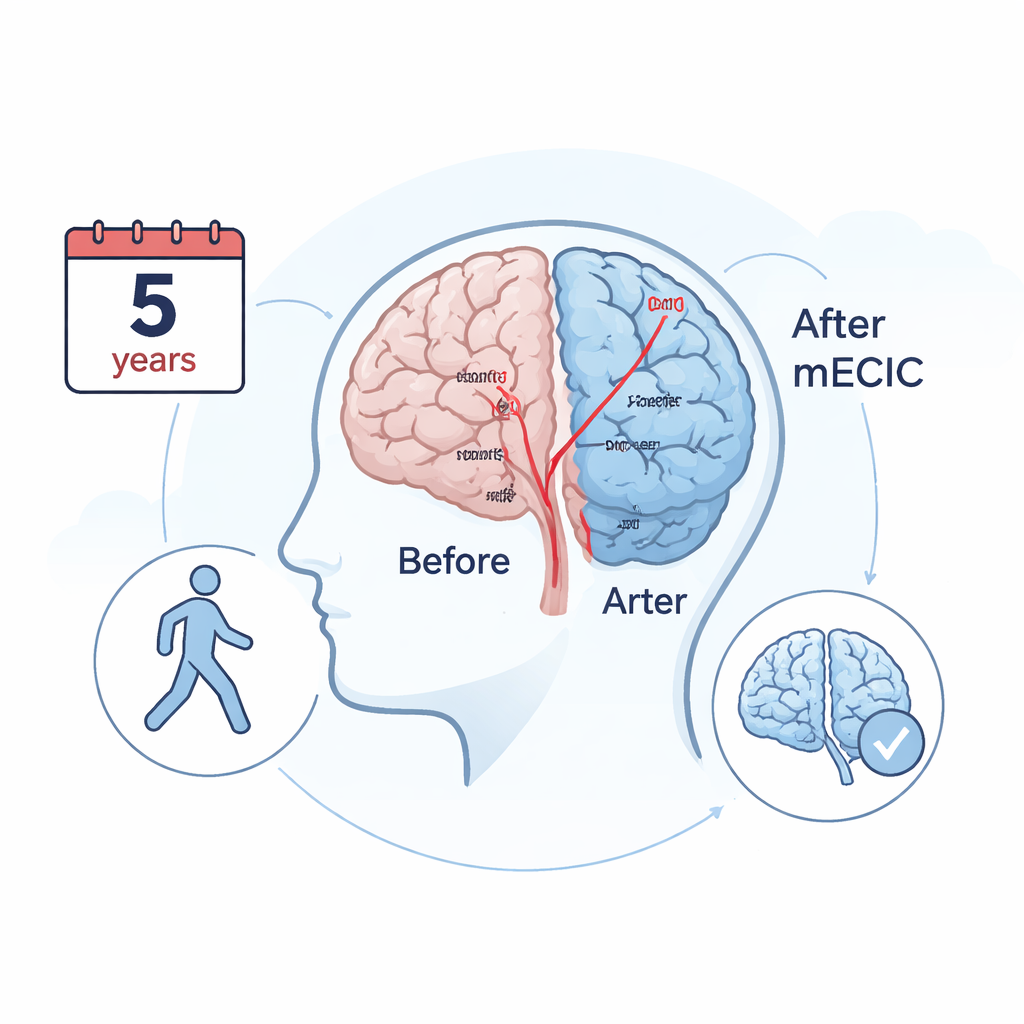
Moyamoya disease is a rare condition in which vital blood vessels at the base of the brain slowly close off, putting people at high risk of stroke and problems with thinking and memory. Doctors can try to reroute blood flow with surgery, but there is more than one way to do it, and it has been unclear which method protects the brain best over the long run. This study followed adults with an ischemic (reduced blood flow) form of moyamoya disease for five years to see whether a more complex “combined” bypass operation could keep them healthier than a simpler, indirect procedure.
The illness behind the “puff of smoke”
In moyamoya disease, the main arteries carrying blood into the brain slowly become narrowed or blocked. To compensate, the brain sprouts a tangle of tiny backup vessels that, on an angiogram, looks like a puff of smoke—the Japanese word “moyamoya.” These fragile detours often are not enough, so patients may suffer repeated brief strokes, full strokes, or bleeding in the brain. Medicines alone usually cannot restore blood flow when imaging shows clear circulation problems. Surgeons therefore try to create new routes for blood, either by stitching a scalp artery directly onto a brain artery or by laying blood-rich tissues against the brain and waiting for new vessels to grow in.
Two different detours to feed the brain
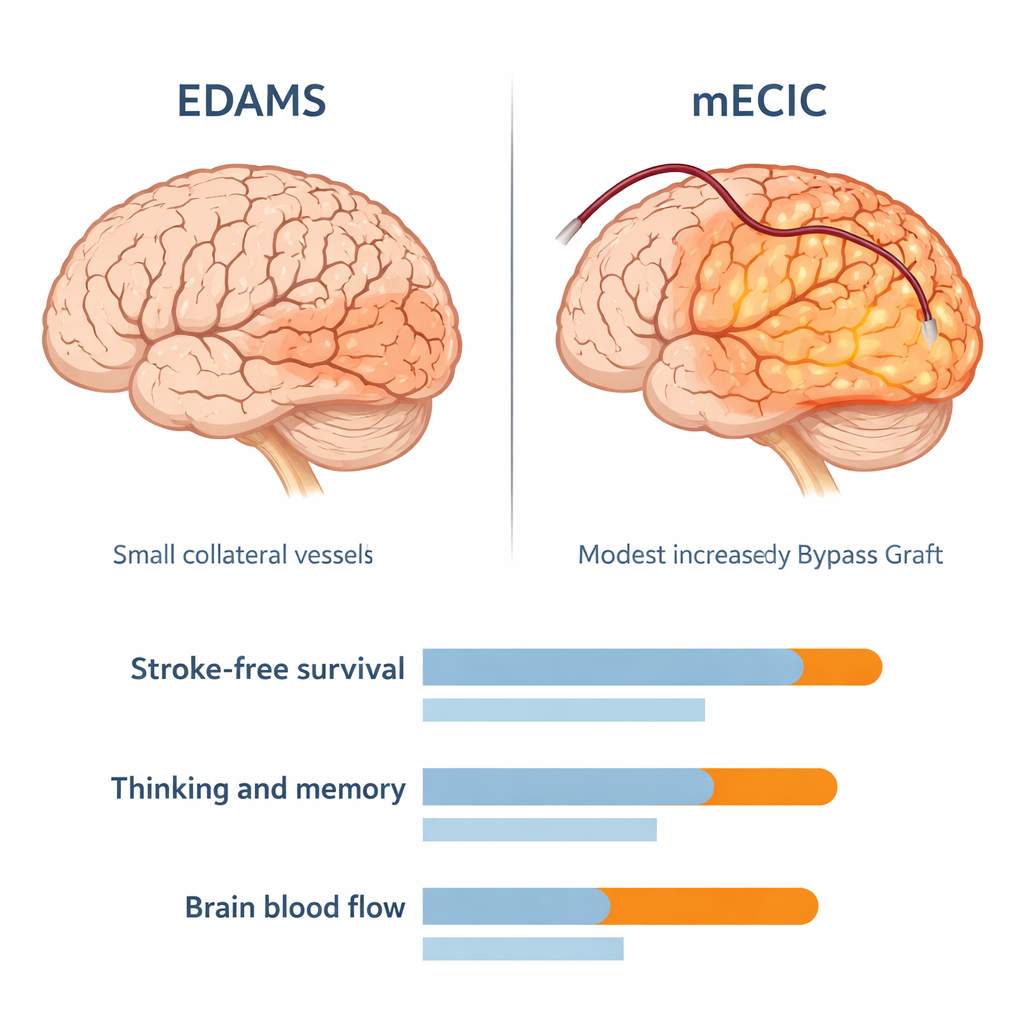
This study compared two surgical strategies in 50 adults whose main problem was too little blood flow to the brain, not bleeding. One group received a “combined” modified extracranial–intracranial bypass (mECIC), in which a healthy artery from the scalp was sewn directly onto a surface artery of the brain and, at the same time, tissues were placed over the brain to encourage extra vessel growth. The other group underwent an indirect method called EDAMS, which relies mainly on gradually growing new collateral vessels without a direct artery-to-artery connection. All patients had clear signs of reduced brain perfusion on CT scans before surgery and were followed for 60 months with clinical exams, thinking tests, and repeat imaging.
Life after surgery: strokes, independence, and thinking
Over five years of follow-up, both operations helped, but the combined bypass did more. Nearly 9 out of 10 patients in the mECIC group were living independently or with only slight disability, compared with about 6 out of 10 in the EDAMS group. Recurrent strokes and transient attacks were less frequent after mECIC, and statistical survival curves showed that patients who had the combined bypass stayed stroke-free longer. Thinking and memory, measured with a standard screening test, improved in both groups, but patients who received the combined bypass gained about three extra points on average compared with those who had the indirect procedure—evidence that restoring stronger blood flow can help the brain recover, not just survive.
How blood flow changed inside the brain
CT perfusion scans taken five years after surgery revealed why outcomes differed. Both groups showed better circulation than before surgery, but the mECIC group had clearly stronger improvement. On average, blood flow through the affected brain tissue was higher, and the time it took blood to reach and pass through that tissue was shorter, in patients with the combined bypass. In other words, their brains received more blood, more efficiently. Importantly, the rate of complications—such as new strokes, bleeding, or seizures right after surgery—was similar between the two groups, suggesting that, with careful blood pressure control and surgical technique, the more complex operation did not exact a safety penalty in this cohort.
What this could mean for patients
For adults living with ischemic moyamoya disease, this early evidence suggests that a combined direct–indirect bypass can offer a sturdier and longer-lasting detour for blood flow than an indirect method alone. Patients who underwent the mECIC procedure were more likely to avoid further strokes, stay functionally independent, and regain some thinking ability over five years. The study is relatively small and comes from a single specialized center, so larger trials are still needed. But for patients who qualify anatomically, the findings support discussing combined bypass surgery as a promising option to better protect the brain over the long term.
Citation: Zhang, W., Liu, J., Li, C. et al. Preliminary analysis of long-term prognosis outcomes of modified extracranial-intracranial bypass reconstruction for adult ischemic moyamoya disease. Sci Rep 16, 7405 (2026). https://doi.org/10.1038/s41598-026-39116-z
Keywords: moyamoya disease, brain bypass surgery, ischemic stroke, cerebral blood flow, cognitive recovery