Clear Sky Science · en
Cyclical loading, daily feeding modality and the saturation response in the developing skull
Why how we eat shapes how we grow
We usually think about diet in terms of what we eat—soft or crunchy, meat or plants. This study asks a subtler question: does the timing of our meals across the day also shape how our bones grow? Using young domestic rabbits as stand-ins for mammals in general, the researchers show that when animals eat can be just as important as what they eat for building a strong skull. Their findings challenge simple links between jaw shape and diet that are often used to reconstruct the lives of extinct animals, and they hint that our own mealtime habits could matter for bone health.
Meal patterns as a hidden force
Many mammals don’t nibble steadily from dawn to dusk. Some cram feeding into one long stretch, others into two or three distinct bouts separated by hours of rest. At the same time, chewing itself is a powerful mechanical signal that helps bones adapt and grow. Earlier work on leg bones showed that endless repetitive loading eventually stops stimulating new bone—a phenomenon called a “saturation response”—unless rest periods are built in. Strikingly, no one had tested whether something similar happens in the skull, even though chewing is one of the most repetitive daily activities in many species, including humans.
Rabbits on different daily schedules
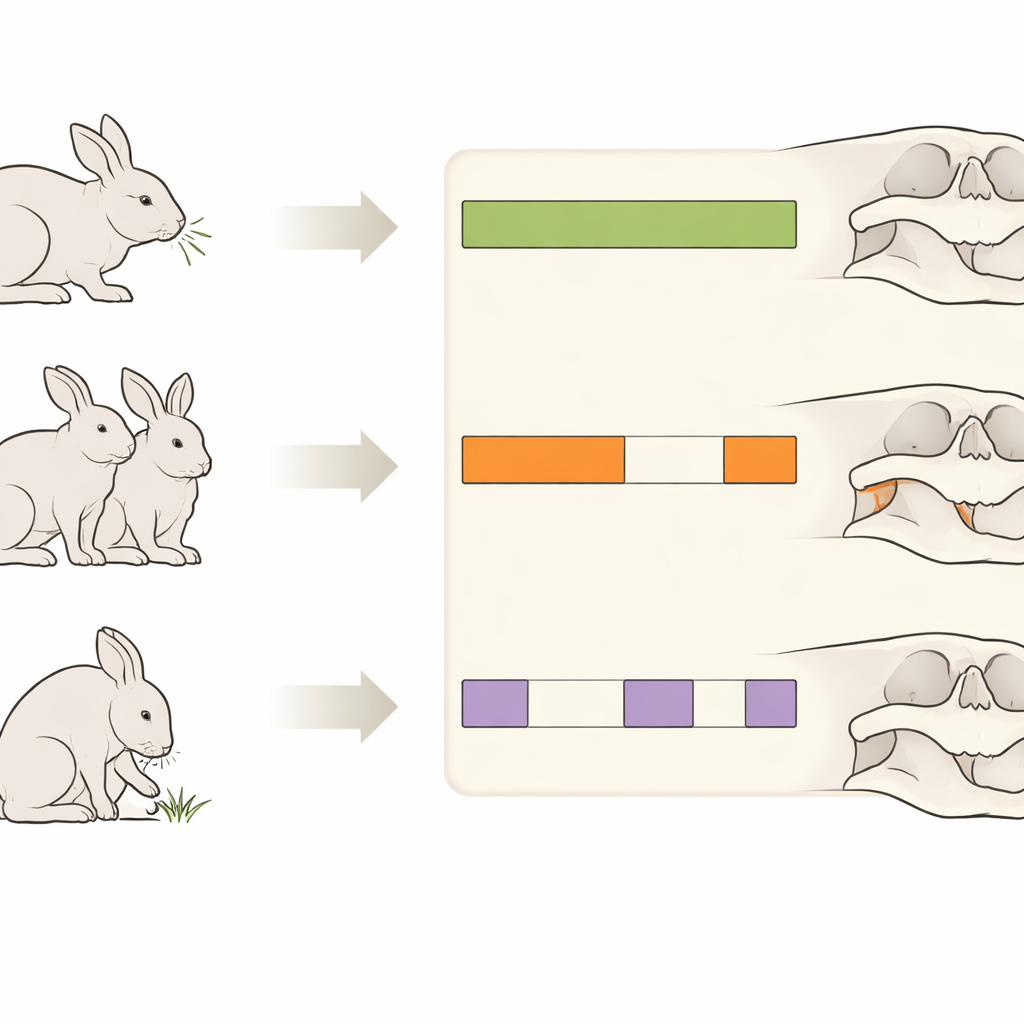
To probe this, the team raised 60 young male rabbits from shortly after weaning to adulthood on carefully controlled feeding schedules. Half received only standard pellets, while the other half got pellets plus stiff, fibrous hay that greatly increased the number of chewing cycles without increasing bite force. Within each diet, rabbits were split into three daily patterns. One group had continuous access to food during a long 9.5-hour feeding window (unimodal). A second group ate in two 2.25-hour sessions separated by a 5-hour break (bimodal). A third group ate in three 1.5-hour bouts with shorter 2.5-hour rests (trimodal). Throughout the experiment, the researchers tracked food intake and body mass, and at the end they used high-resolution microCT scans to measure the amount of cortical bone—the dense outer shell—in key regions of the jaws and palate.
Rest breaks help skull bones grow
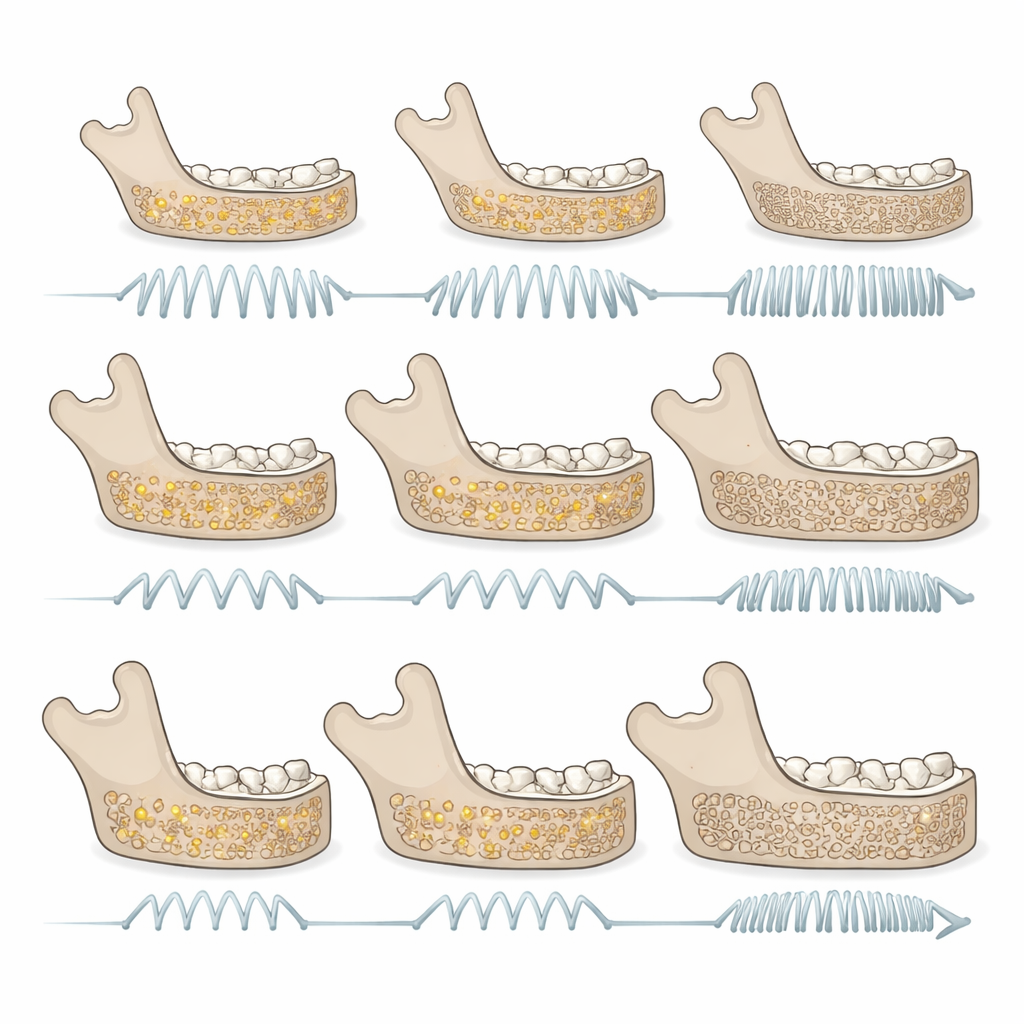
The clearest pattern emerged when comparing rabbits that ate in one long stretch versus two separated meals. In both diet groups, animals on the bimodal schedule consistently had more cortical bone in several parts of the feeding apparatus, including the main body of the lower jaw, the jaw joint, the bone between the two halves of the lower jaw, and the hard palate. By contrast, rabbits that could eat more or less continuously showed less bone in these regions, even though they often chewed more overall and tended to be heavier. This indicates that constant chewing led bone cells to stop responding to the load, while the 5-hour pause between meals in the bimodal groups allowed those cells to “reset” and keep building new tissue. Adding hay, which forced much more chewing, did not change this basic pattern, suggesting that the key factor was spacing of load over time rather than simply more cycles.
The messy middle and local quirks
The three-meal trimodal schedule told a more complicated story. With its shorter rest periods, it could have behaved like a weaker version of the bimodal pattern or like the continuous pattern, depending on how long bone cells need to recover. Instead, trimodal rabbits sometimes resembled one group, sometimes the other, and their bone outcomes closely tracked how much they actually ate. This hints that around intermediate feeding patterns, bone growth reflects a three-way interaction between the number of chewing cycles, how long each session lasts, and the duration of rest. On top of this, not all skull regions responded in the same way. One site in the upper jaw—where the tooth sockets sit—showed little change across any feeding pattern or diet, suggesting that some parts of the skull are less sensitive to repetitive chewing or respond through subtler changes that were not measured here.
Rethinking what jaw shape really means
To a non-specialist, the main message is that bone in the growing skull doesn’t just care how hard or how often an animal chews—it also “notices” when it gets to rest. Two short breaks between meals were enough to prevent the saturation of the bone-building response, producing jaws and palates with more robust cortical bone than in animals that grazed almost nonstop. Because skull shape is widely used to infer diet and behavior in fossils and living species, these results warn that similar-looking diets could produce different skulls if daily feeding patterns differ, and vice versa. More broadly, the work shows that behavior, timing, and local bone biology all intertwine to shape the skeleton, offering a richer and more nuanced picture of how form and lifestyle evolve together.
Citation: Lad, S.E., Ding, H., Alvarez, C.E. et al. Cyclical loading, daily feeding modality and the saturation response in the developing skull. Sci Rep 16, 8202 (2026). https://doi.org/10.1038/s41598-026-39109-y
Keywords: bone remodeling, feeding behavior, jaw development, diet mechanics, phenotypic plasticity