Clear Sky Science · en
EEG-based predictors of motor recovery during immersive VR-BCI rehabilitation
Rewiring Movement After Stroke
For many people who survive a stroke, weakness in an arm or hand lingers for years, quietly limiting everyday tasks like dressing, cooking, or typing. This study explores a high-tech form of rehabilitation that combines brain–computer interfaces with immersive virtual reality to help the brain relearn how to move a weakened limb. By looking closely at brain waves, the researchers asked a practical question: can early brain activity during this training tell us who is most likely to regain movement?
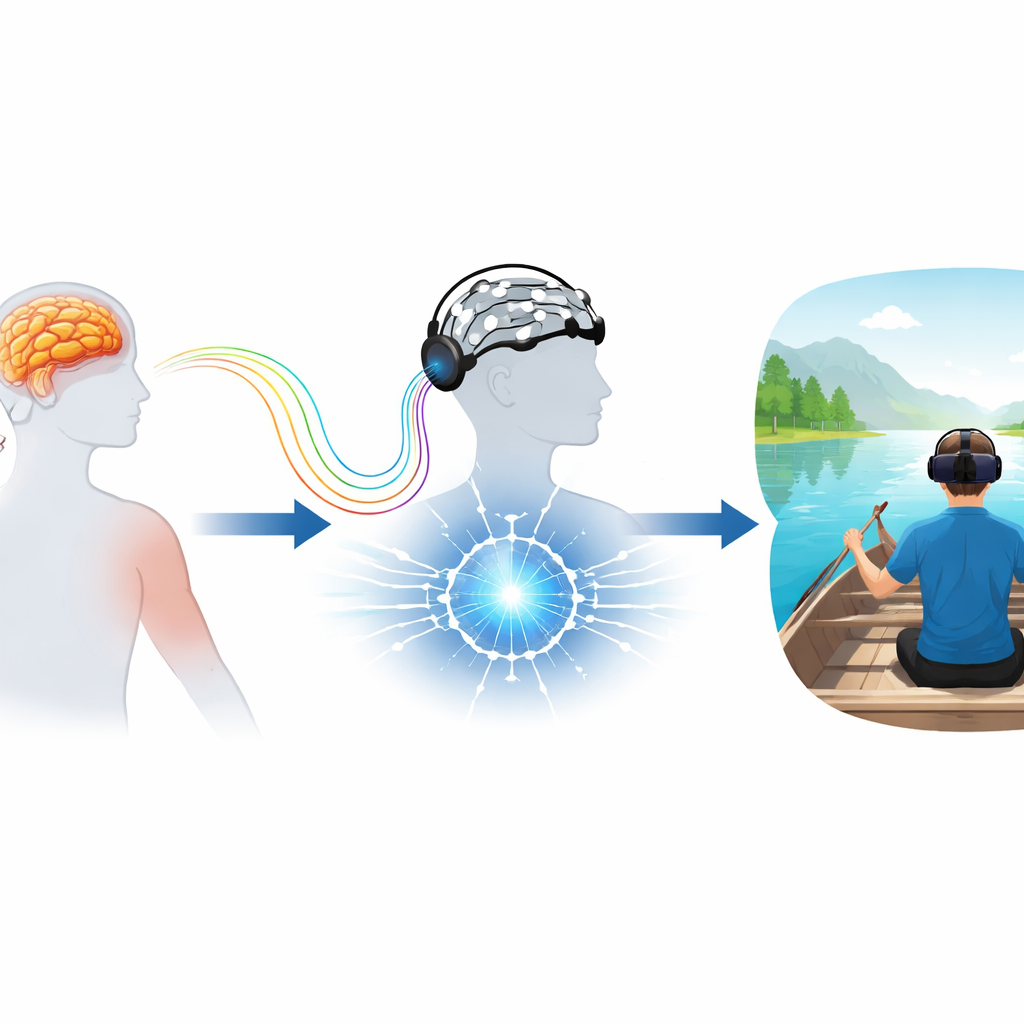
Training the Brain Inside a Virtual Boat
The team worked with adults who had chronic arm weakness after a first stroke. Over four weeks, participants in the experimental group completed up to twelve sessions in an immersive virtual reality game called NeuRow. Wearing a head-mounted display and a cap that records brain signals, they sat in a virtual boat and were asked to imagine rowing with their left or right arm while watching a virtual avatar perform the movement. When the brain activity matched the intended movement, the virtual boat advanced and small vibrations in the handheld controllers reinforced the action, creating a tight loop between mental effort and sensory feedback. A control group received extra conventional therapy instead of this VR-based training.
Listening to the Brain’s Rhythm
The researchers focused on a specific pattern in the brain’s electrical activity called event-related desynchronization, or ERD. When we plan or imagine a movement, certain rhythmic brain waves, especially over the motor areas, temporarily weaken. This drop in rhythm strength is thought to reflect the brain engaging motor networks. Using electroencephalography (EEG), the team measured how strongly these rhythms dropped when participants imagined rowing, and how this pattern was distributed across the two sides of the brain. They also built individualized frequency bands for each person to account for the fact that stroke can shift these rhythms in subtle ways.
Comparing Stroke Survivors and Uninjured Brains
To understand what “healthy” motor-related brain rhythms look like in the same VR task, the authors compared the stroke group to a reference group of 35 people without stroke who had previously completed the identical NeuRow protocol. Across key motor-related scalp locations, stroke survivors showed noticeably weaker ERD than the reference group, and the balance between the left and right sides of the brain was less stable. In other words, their brains were engaging motor networks less strongly and less consistently during imagined movement. However, within the stroke group, these ERD patterns did not change much over the 12 training sessions, and the laterality, or left–right balance, remained fairly flat over time.
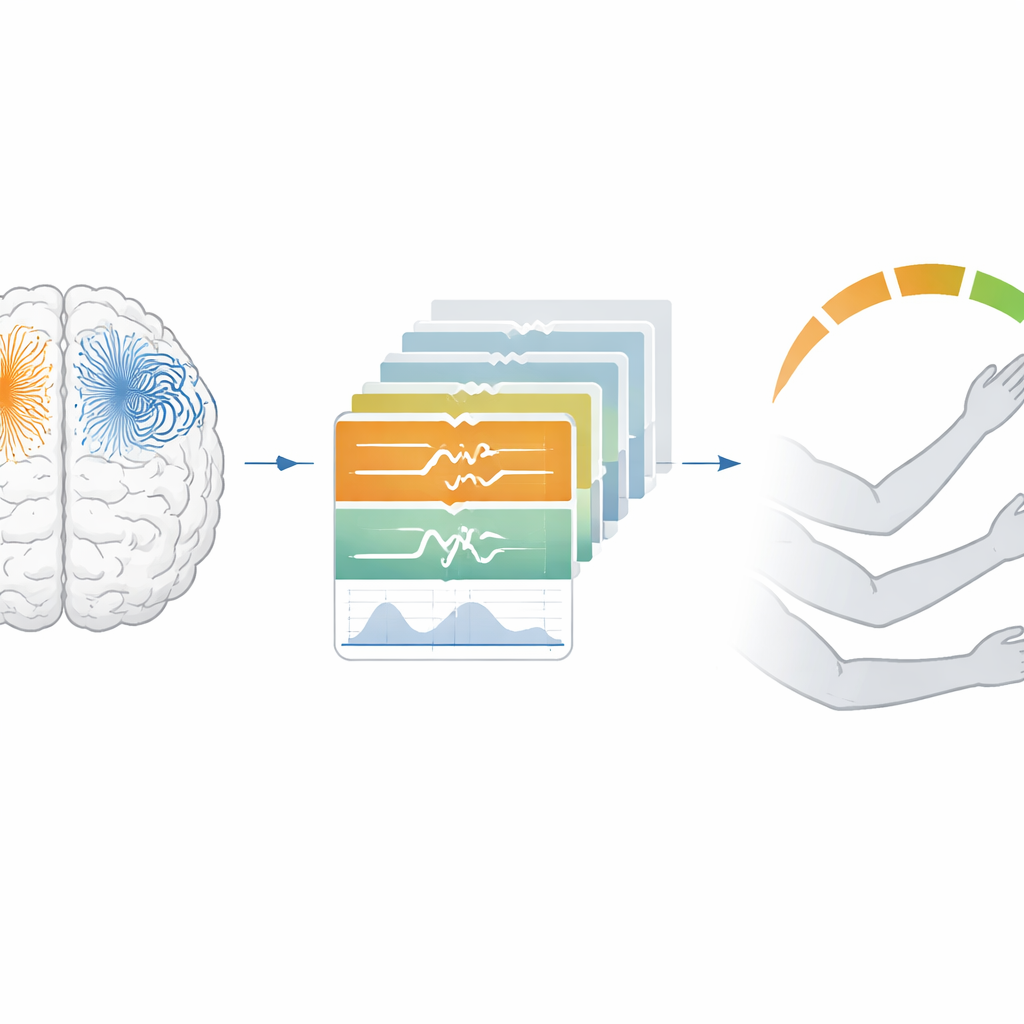
Baseline Brain Signals as a Crystal Ball
Even though the overall strength of ERD did not steadily grow with training, the level of ERD at the beginning turned out to be highly informative. Using statistical models that accounted for individual differences, the researchers found that baseline ERD in the affected motor areas predicted how much arm function, measured by the standard Fugl–Meyer test, would improve after the intervention. Participants whose brains showed a stronger motor-related drop in rhythmic activity at baseline tended to gain more movement over the month. In contrast, how ERD changed session-by-session was a much weaker predictor of recovery. The study also found hints that, especially in ischemic stroke, increased activity on the non-damaged side of the brain might play a compensatory role, with greater ipsilateral ERD linked to better outcomes.
What This Means for Future Stroke Care
For patients and clinicians, these findings suggest that a simple EEG measurement taken early in VR–BCI training may offer a powerful clue about who is likely to benefit most. Rather than waiting weeks to see whether function improves, therapists could eventually use baseline brain rhythms to personalize treatment plans, adjusting intensity or combining therapies for those whose brains show weaker engagement. The study also underscores that recovery in long-term stroke is complex: people did improve clinically, but the brain signals did not follow a simple upward trajectory. Still, by showing that pre-training brain rhythms are tied to later gains, this work moves the field closer to predictive, tailor-made neurorehabilitation that harnesses the brain’s remaining plasticity.
Citation: Valente, M., Branco, D., Bermúdez i Badia, S. et al. EEG-based predictors of motor recovery during immersive VR-BCI rehabilitation. Sci Rep 16, 7870 (2026). https://doi.org/10.1038/s41598-026-39106-1
Keywords: stroke rehabilitation, virtual reality training, brain-computer interface, EEG biomarkers, motor recovery