Clear Sky Science · en
Comparative evaluation of stability, efficacy, and sterility in five repackaged intravitreal anti-vascular endothelial growth factor medications
Why this matters for sight and savings
Millions of people rely on eye injections to prevent vision loss from conditions like diabetes and age-related macular degeneration. These medicines are highly effective but very expensive, and each vial contains more drug than a single patient needs. Hospitals often split one vial into multiple syringes to stretch supply and reduce waste, yet many doctors worry whether these repackaged doses stay safe, potent, and germ-free over time. This study takes a close, side-by-side look at five commonly used eye drugs to see how well they hold up after being divided and stored for up to two months. 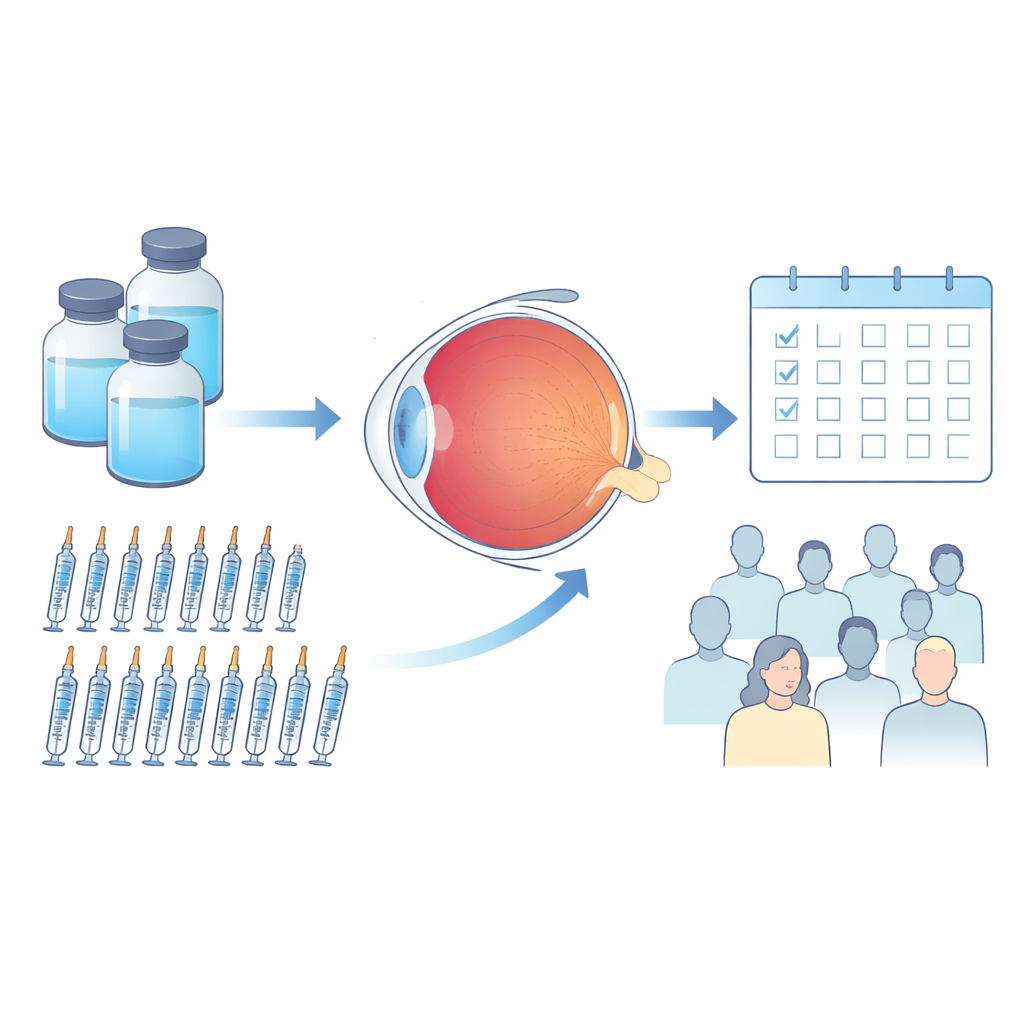
The challenge of costly eye injections
Drugs that block a molecule called VEGF have transformed treatment for serious retinal diseases, helping patients keep reading, driving, and living independently. But the price per dose and limited access, especially in lower-resource settings, mean each vial must be used wisely. Because one vial holds enough liquid for several injections, many clinics draw out multiple tiny doses into individual syringes. That practice can cut costs and increase access but raises practical questions: Do these delicate protein drugs break down? Do they clump, lose their ability to bind VEGF, or pick up harmful microbes while sitting in the refrigerator? Until now, most research examined only one or two drugs at a time, using different methods that made comparisons difficult.
A head-to-head test of five key medicines
The researchers evaluated five widely used anti-VEGF eye drugs—aflibercept, bevacizumab, brolucizumab, faricimab, and ranibizumab—under tightly controlled pharmacy conditions that follow modern sterile-compounding standards. Pharmacists drew each medicine into small plastic syringes, stored them cold, and then tested them at several time points: right after repackaging, two weeks later, one month later, and two months later. Rather than relying on a single measurement, the team assembled a toolkit of six laboratory techniques to capture different aspects of quality: how much protein remained, whether it stayed in one piece, whether it formed aggregates, whether it still grabbed VEGF effectively, and whether any bacteria or fungi grew from the samples. 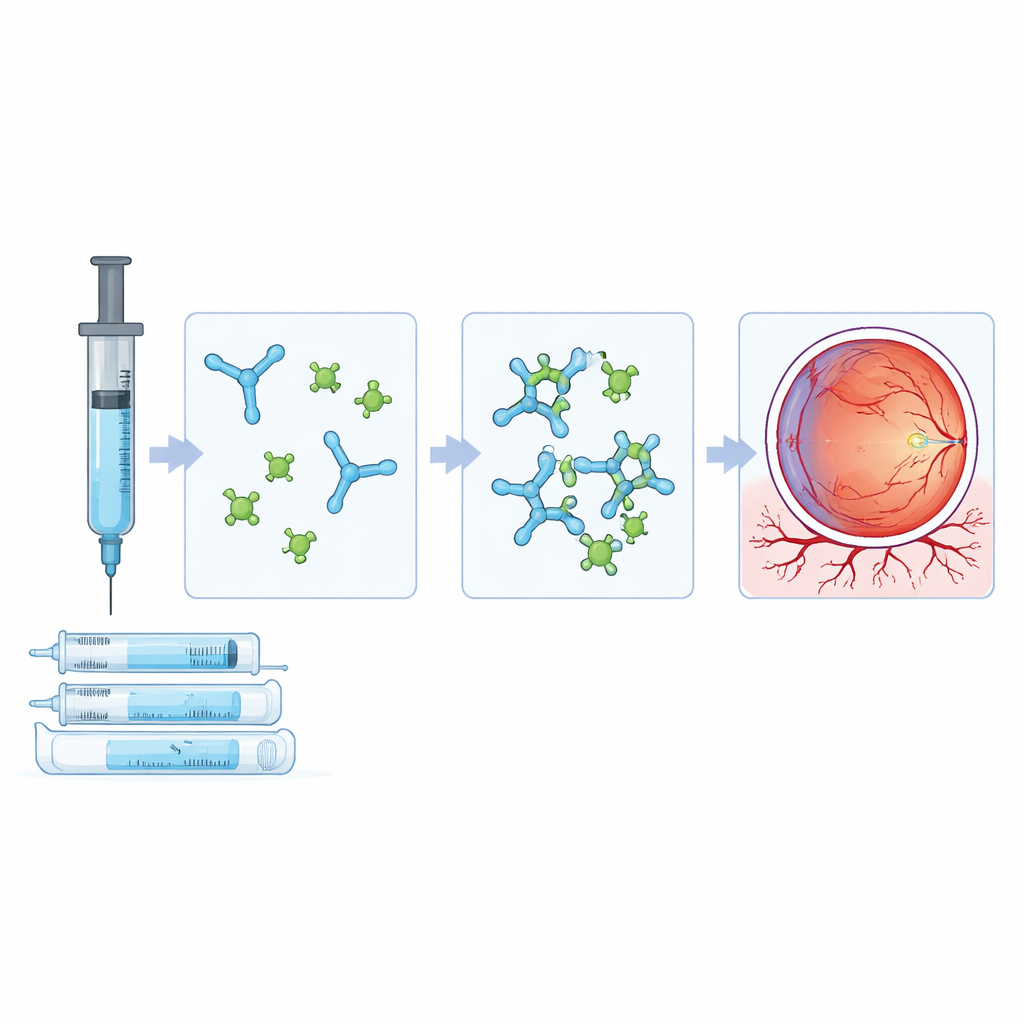
How the drugs held up over two months
Across most tests, the five drugs proved remarkably resilient. Measurements of protein amount showed that aflibercept, bevacizumab, brolucizumab, and faricimab kept nearly the same concentration over 14, 30, and 60 days. Ranibizumab showed more fluctuation, with one group of samples dropping by about one quarter at 60 days, suggesting it may be more sensitive to long storage than the others. Gel-based and chromatography methods, which reveal whether proteins break apart or clump, showed that all five medicines largely retained their expected sizes and shapes, with only minor additional peaks hinting at small amounts of aggregates or breakdown products. Crucially, a binding test designed to mimic how the drugs latch onto VEGF found that all five, including brolucizumab—which had not been thoroughly studied in this way before—maintained their ability to bind the target molecule even after 60 days in the syringe.
Keeping germs out of shared medicines
Because infection inside the eye can be devastating, sterility was a central concern. The team tested for microbial contamination using culture plates that can support growth of both bacteria and fungi, and they added an enrichment step to catch even very low numbers of stressed or slow-growing microbes. Samples from all five drugs, at all storage times up to 60 days, showed no detectable growth. While no culture method can absolutely guarantee the absence of every living organism, these results strongly suggest that, when prepared and stored under clean-room conditions by trained staff, repackaged anti-VEGF syringes can remain free of culturable microbes for at least two months.
What this means for patients and clinics
Overall, the study indicates that five leading eye-injection drugs can be safely repackaged into small syringes and stored in the refrigerator for up to 60 days without major loss of structure, function, or sterility—provided strict sterile techniques and proper storage are used. One exception is that ranibizumab may deserve extra caution at the longest storage time because of signs of physical instability, even though its ability to bind VEGF remained intact in the lab. The authors stress that their findings come from a single, well-equipped center and laboratory tests, not direct patient outcomes, so clinics should still monitor their own procedures carefully. Even so, this work offers reassuring evidence that thoughtful repackaging can stretch each vial further, potentially lowering costs and expanding access to sight-saving treatments around the world.
Citation: Thunwiriya, P., Phetruen, T., Chaiwijit, P. et al. Comparative evaluation of stability, efficacy, and sterility in five repackaged intravitreal anti-vascular endothelial growth factor medications. Sci Rep 16, 9306 (2026). https://doi.org/10.1038/s41598-026-39102-5
Keywords: anti-VEGF eye injections, intravitreal drug repackaging, retinal disease treatment, biologic drug stability, ophthalmology pharmacy