Clear Sky Science · en
Enhancing chalk formation integrity by diammonium phosphate treatment
Why hardening chalk rock matters
Much of the oil and gas produced from the North Sea comes from chalk, a soft, fine-grained rock that behaves a bit like compacted powder. When fluids are pumped out, tiny particles can break loose and flow with the oil, clogging pathways, damaging wells, and making production less efficient. This study tests a chemical treatment designed to toughen chalk from real North Sea reservoirs, aiming to reduce this particle shedding while keeping the rock’s ability to let fluids flow.
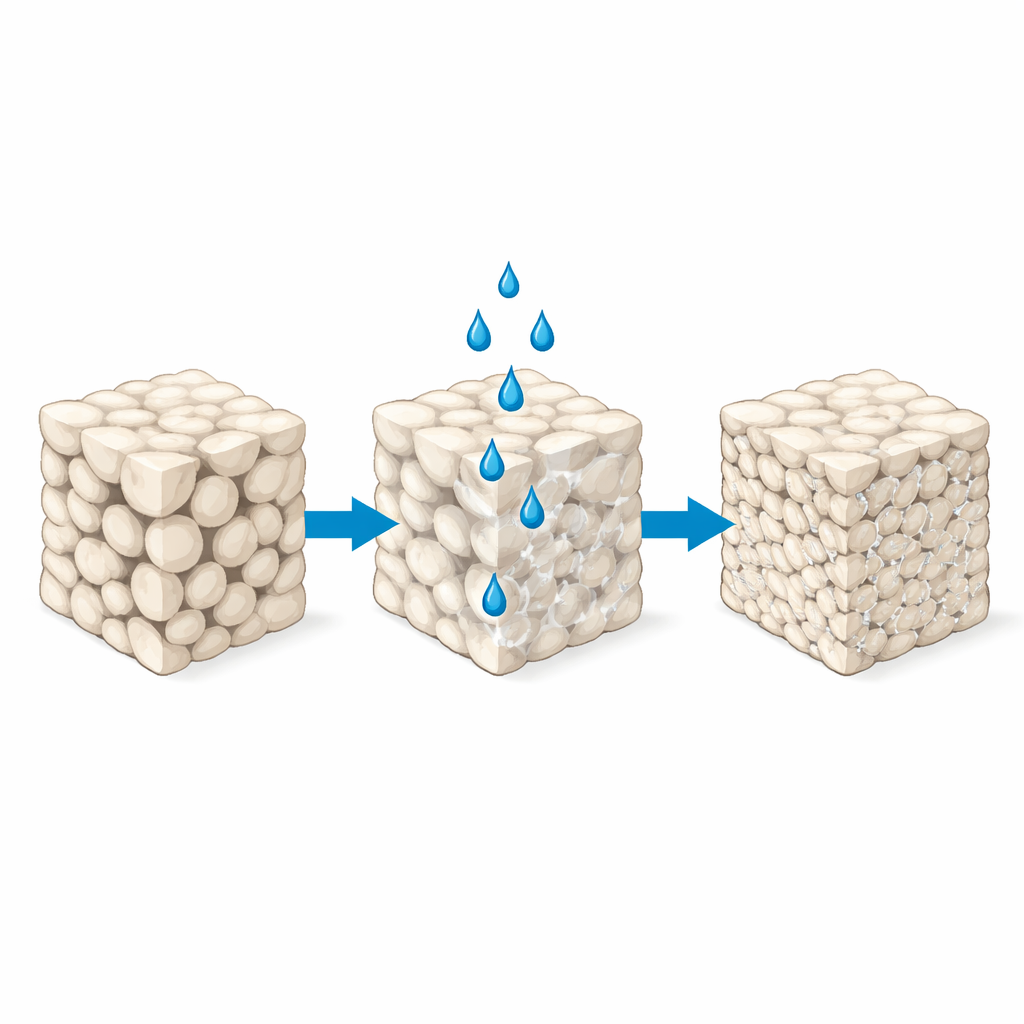
A chemical that turns soft chalk into tougher stone
The researchers focused on a compound called diammonium phosphate, already known in art and architecture conservation for strengthening fragile stone. When this solution meets calcite, the main mineral in chalk, it can transform part of it into hydroxyapatite, a harder mineral also found in human bones and teeth. The team wanted to know whether this reaction, previously tested mostly on outcrop chalk from Texas, would also work deep underground on real reservoir cores from the Danish sector of the North Sea, where conditions of pressure and temperature are closer to those in producing fields.
Testing real rocks from the field
They studied two sets of chalk: widely used Austin Chalk outcrop samples from Texas and four cylindrical cores taken from a producing North Sea reservoir. Each plug was soaked in a concentrated diammonium phosphate solution, sealed in a steel cell, and exposed to elevated temperature and pressure for three days to mimic downhole conditions. Before and after treatment, they measured how easily fluids could pass through the rock, how much empty space (porosity) it contained, and how stiff it was using a non-destructive impulse hammer test. They also ran separate experiments on small chips and powders from the same rocks to track how the minerals and microstructure changed during the reaction.
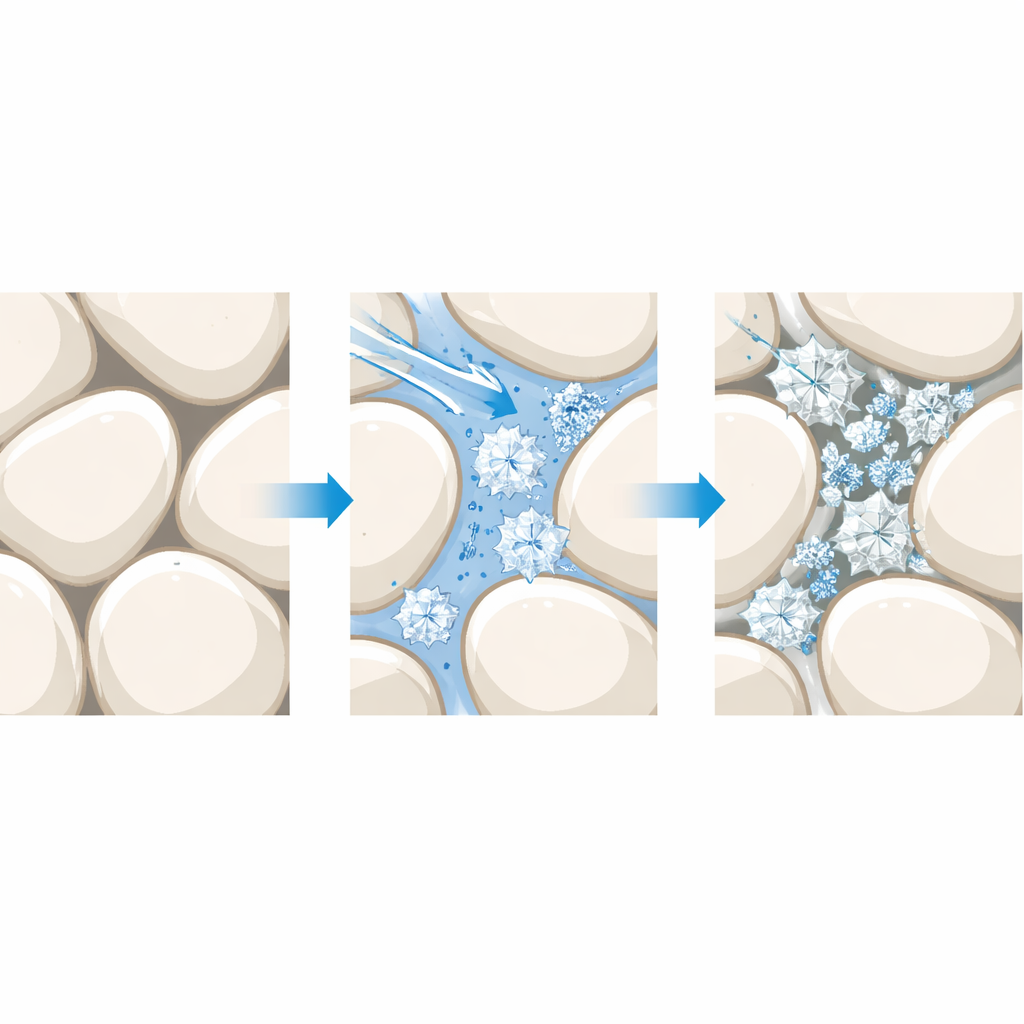
Seeing new mineral bridges between grains
Microscope and X-ray methods revealed what was happening inside the chalk. Before treatment, the chalk grains were mostly clean calcite particles touching at points, with little natural cement between them. After treatment, new, tiny crystals with rosette-like shapes appeared on grain surfaces and in the spaces between grains. Their chemical fingerprints showed they were made of calcium, phosphorus, and oxygen, consistent with hydroxyapatite. These new crystals acted like bridges, tying neighboring grains together and turning loose contacts into solid bonds. Powder experiments showed that when the chalk is finely ground and fully exposed to the solution, most of the calcite can be converted into hydroxyapatite, confirming that the reaction can be very aggressive if surfaces are accessible.
Stronger rock, fewer fines, but less flow
Mechanically, the chalk became much stiffer after treatment. The outcrop samples roughly doubled or tripled in stiffness, while the reservoir cores showed increases of about 40–50 percent. At the same time, the amount of pore space remained nearly the same, but the ease with which fluids flowed through the rock dropped: high-permeability outcrop samples lost up to 60 percent of their flow capacity, while the already tight reservoir samples lost about 30 percent. This suggests the new mineral bridges partially narrow the pathways between pores. From a production standpoint, this is a trade-off: the rock becomes more resistant to collapse and less likely to release troublesome particles, but it also becomes less permeable, which can reduce flow unless treatments are carefully targeted.
What this means for future energy production
To a non-specialist, the main message is that the authors have found a way to "bone-coat" soft chalk from the inside, making it more durable by transforming some of its mineral skeleton into a tougher form. Done in the right place—especially near wells that suffer from collapsing chalk and migrating fines—this could stabilize the rock, protect equipment, and sustain production. However, because the same mineral glue that prevents particle movement also tightens the flow paths, the treatment is best used as a precise tool around the wellbore rather than across an entire field. Future work will focus on how to open up pathways before treatment, how to control where and how much new mineral forms, and how to balance rock strengthening with the need to keep oil and water moving efficiently through the reservoir.
Citation: Desouky, M., Aljawad, M., Amao, A. et al. Enhancing chalk formation integrity by diammonium phosphate treatment. Sci Rep 16, 9932 (2026). https://doi.org/10.1038/s41598-026-39100-7
Keywords: chalk reservoirs, rock strengthening, diammonium phosphate, fines migration, hydroxyapatite