Clear Sky Science · en
Experimental investigation on solar air heating system using evacuated tube collector with coaxial tube
Why hotter air from the sun matters
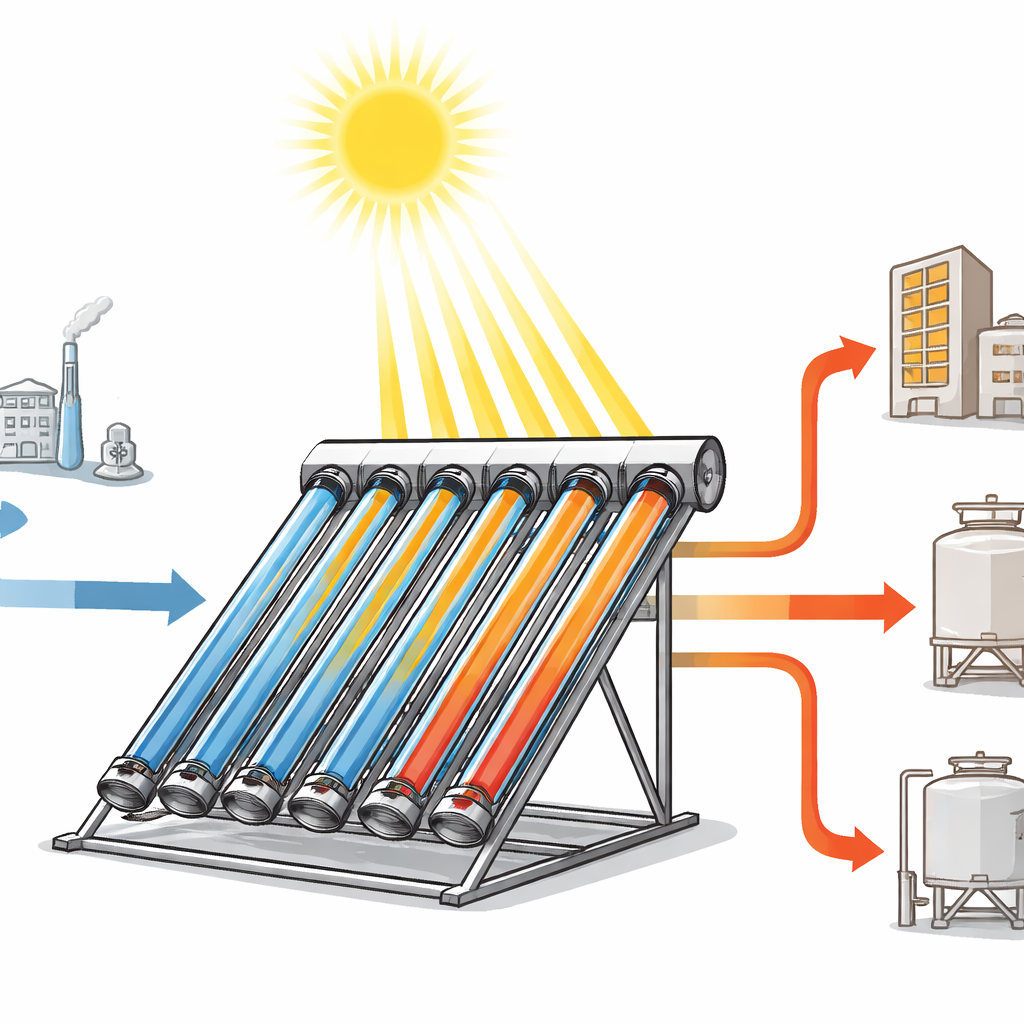
From drying food and timber to warming factories, many everyday processes need steady streams of hot air. Burning fossil fuels to supply this heat adds to costs and carbon emissions. This study explores a way to tap sunlight instead, using a special kind of glass tube collector to turn outdoor air into reliably hot air—reaching temperatures close to boiling water—without complex machinery or exotic materials.
Turning sunlight into hot moving air
The researchers focus on a device called a solar air heater, which captures the sun’s energy and passes it into flowing air. Instead of the flat, box-like panels often seen on roofs, they use rows of rounded glass tubes known as evacuated tubes. Each tube has a vacuum layer that acts like a high-end thermos, sharply cutting heat loss to the outside. Sunlight warms a dark inner surface, and air is forced past this surface with the help of a small blower, picking up heat along the way.
A twist inside the tube
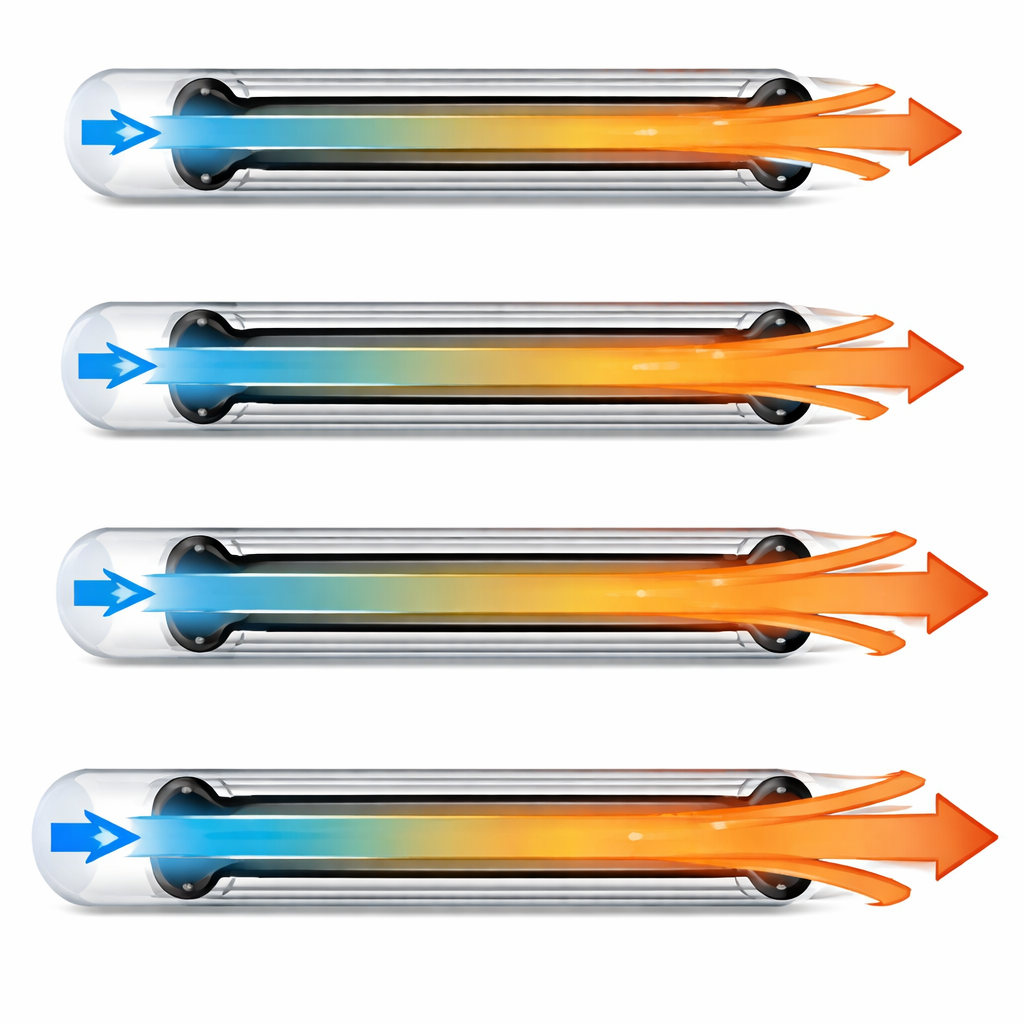
The main innovation lies in how the air moves inside each tube. Rather than letting air drift through a single open space, the team inserts a smaller metal tube along the center, creating a narrow ring-shaped passage between the metal tube and the heated inner glass. This “tube within a tube” layout makes the air stay in close contact with the hot surface for longer, improving heat transfer. By carefully routing the air in this confined path, the system squeezes more useful warmth out of the same sunlight without adding complex moving parts.
Testing different tube lengths and air speeds
The experiments took place outdoors in sunny Coimbatore, India, using 20 evacuated tubes connected to a common air inlet and outlet. The team varied two simple settings: how quickly the air flowed (50 or 100 kilograms per hour) and how long the inner metal tube was (either 1.5 meters or half that length, 0.75 meters). They tracked sunlight intensity, air temperatures at many points, and how much extra power the blower consumed to push air through the system.
How hot did the air get?
For the longer 1.5-meter inner tubes at the lower air flow, the system heated incoming air up to 94 °C—more than 50–60 degrees above a warm tropical afternoon. With the same tube length but higher flow, the top temperature fell to about 74 °C because the air rushed through more quickly and had less time to warm. Shorter 0.75-meter tubes produced cooler air overall, peaking around 78 °C at low flow and 69 °C at high flow. In simple terms, longer paths and slower movement gave hotter air, while faster flow improved the fraction of sunlight converted into useful heat but reduced the final temperature.
Balancing useful heat and effort
Beyond temperature, the researchers judged performance by efficiency: how much of the incoming sunlight became usable heat after subtracting the energy needed to run the blower. With the 1.5-meter tubes at 50 kg/h, the system reached around 26% effective efficiency; the shorter tubes performed similarly, slightly above 28%, because they caused less resistance to the air flow. Higher flow rates raised the basic thermal efficiency but also increased the blower power, trimming the effective gain. This trade-off shows that designers must balance “how hot” against “how hard to push” when sizing real-world systems.
What this means for real-world use
Overall, the study shows that a relatively simple change—adding a central tube to guide the air inside standard evacuated glass collectors—can reliably produce hot air in the 70–95 °C range. Those temperatures are well suited to drying crops and timber, low-temperature industrial processes, and space heating, especially for small and mid-sized businesses in sunny regions. By fine-tuning tube length and airflow, operators can choose between hotter air or higher efficiency, helping solar air heaters become a practical, low-carbon replacement for fuel-fired hot air systems.
Citation: Ravichandran, V., Kumar, P.M., Adaikalasamy, V. et al. Experimental investigation on solar air heating system using evacuated tube collector with coaxial tube. Sci Rep 16, 7923 (2026). https://doi.org/10.1038/s41598-026-39094-2
Keywords: solar air heater, evacuated tube collector, industrial drying, renewable heat, coaxial tube design