Clear Sky Science · en
Proton-pump inhibitors and palbociclib or abemaciclib in endocrine-sensitive breast cancer treatment
Why heartburn medicine might matter in breast cancer care
Many people with cancer also take common heartburn drugs, known as proton‑pump inhibitors (PPIs), to ease stomach trouble. At the same time, newer targeted medicines such as palbociclib and abemaciclib have transformed treatment for a frequent kind of breast cancer that responds to hormones. This study asked a simple but important question: could everyday heartburn pills quietly weaken the benefits of one of these cancer drugs? The answer, at least for palbociclib, appears to be yes.
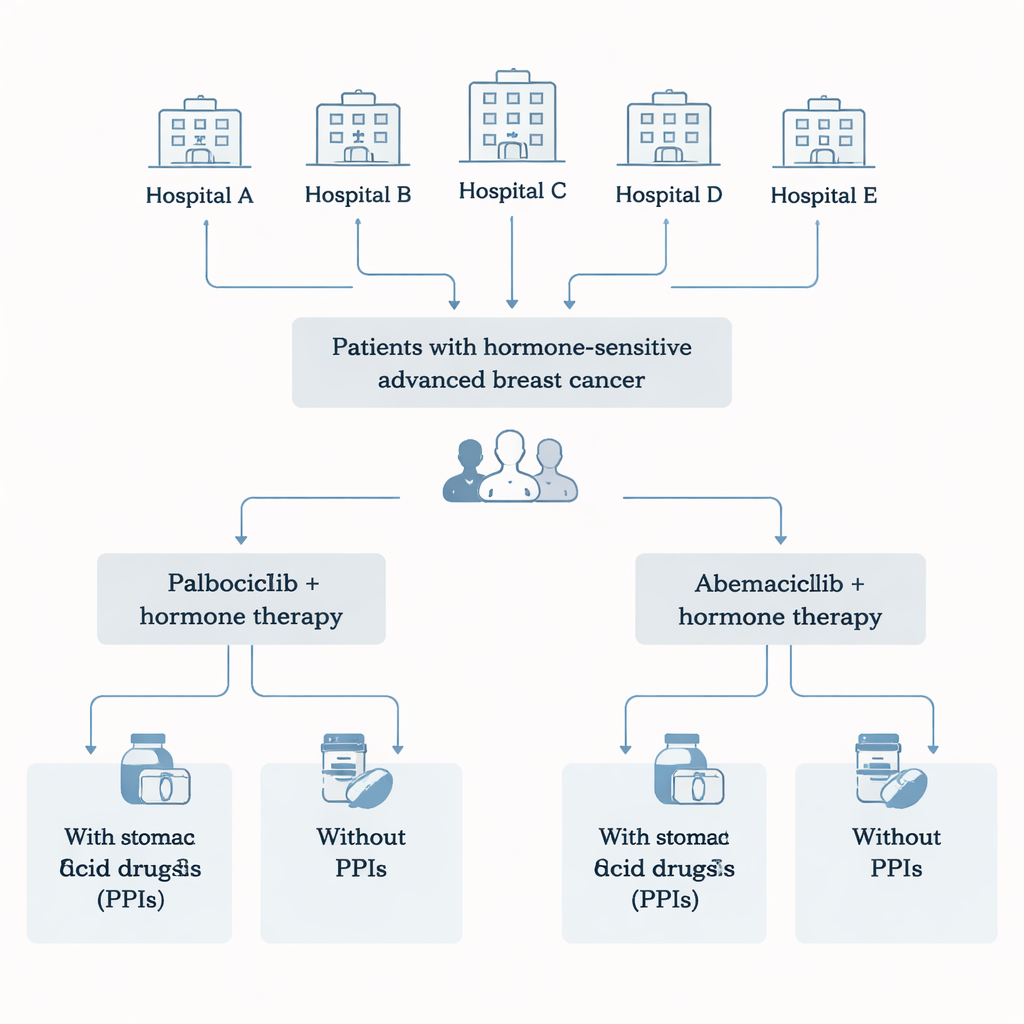
Two cancer drugs, one common concern
The researchers focused on women in Japan with advanced or returning breast cancer that is driven by hormones but lacks the HER2 growth signal. For these patients, standard care now pairs hormone‑blocking medicine with one of several drugs that slow down cell division, including palbociclib and abemaciclib. Because PPIs are widely prescribed to control acid reflux and protect the stomach, many patients end up taking them alongside cancer treatment. Earlier reports hinted that PPIs might reduce how well palbociclib works, but the findings were mixed and often did not separate people by how sensitive their cancer still was to hormone therapy.
How the study was done in real hospitals
This team reviewed medical records from five major cancer centers and university hospitals across Japan. They identified 202 adults whose breast cancer was still considered responsive to hormone treatment and who were receiving their first round of therapy that combined hormones with either palbociclib or abemaciclib. Everyone had advanced or recurrent disease but had not yet needed chemotherapy for it. The researchers compared people who used PPIs for most of their time on these drugs with those who rarely or never used PPIs, tracking how long it took before the cancer worsened and how long patients lived overall.
Palbociclib appears more vulnerable to stomach‑acid changes
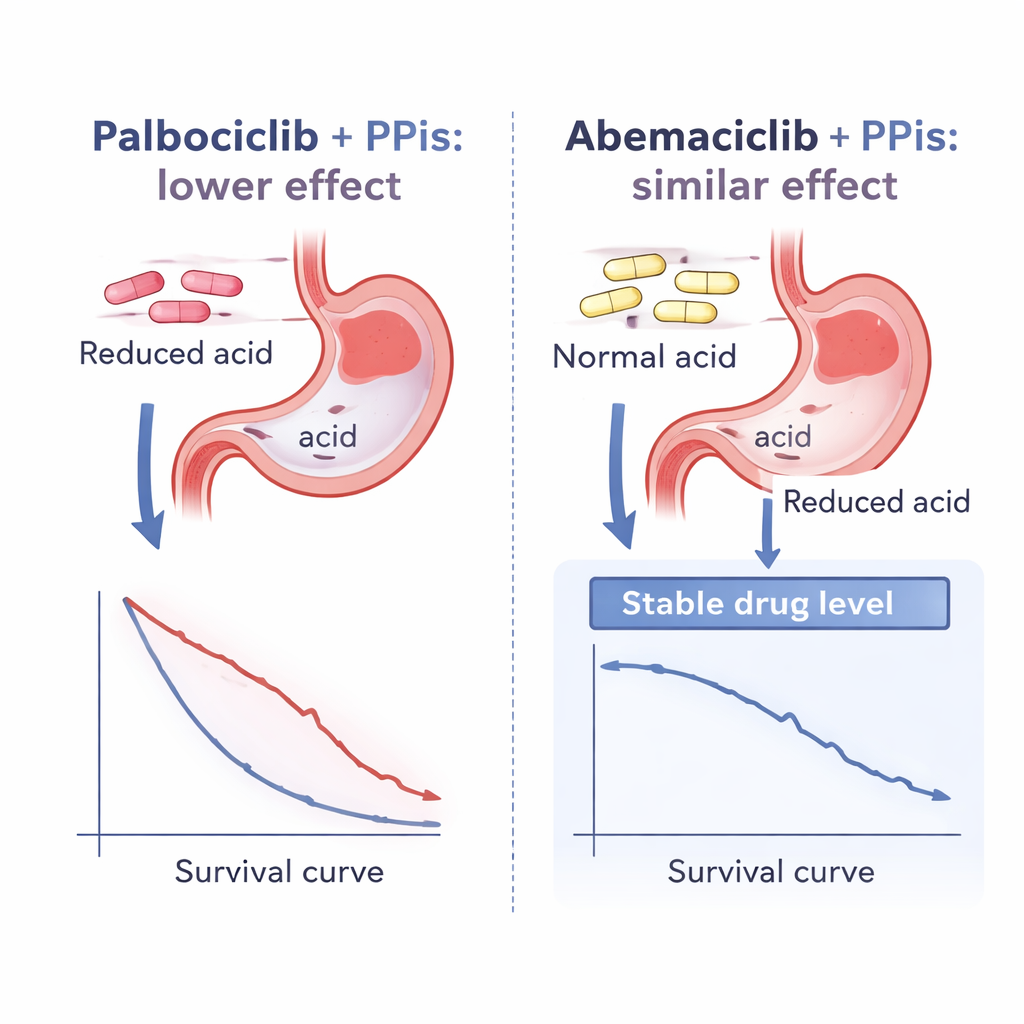
Among the 123 people treated with palbociclib, those who also took PPIs tended to see their cancer progress sooner and, more strikingly, had shorter overall survival than those who did not use PPIs. After taking into account age, spread of cancer, and general health, PPI users on palbociclib were more than three times as likely to die during the study period as non‑users. This pattern held whether palbociclib was given as a capsule or a newer tablet, suggesting that changing the pill design did not fully solve the problem. The likely reason is chemical: palbociclib dissolves and is absorbed best in an acidic stomach, and PPIs raise stomach pH, potentially lowering how much drug gets into the bloodstream.
Abemaciclib seems more forgiving
Results were different for the 79 patients who received abemaciclib. In this group, people taking PPIs did just as well as those who were not, both in how long their disease stayed under control and in overall survival during follow‑up. Abemaciclib is absorbed more steadily across a range of stomach acid levels and is taken continuously rather than in cycles with breaks, which may help maintain effective drug levels even if acid is reduced. Side effects such as low blood counts with palbociclib and liver‑related problems with abemaciclib occurred at similar rates regardless of PPI use, suggesting that safety was not the main issue—effectiveness was.
What this means for patients and doctors
For people with this common form of breast cancer, the study’s message is practical and easy to grasp: a routine heartburn pill may blunt the benefit of palbociclib but does not seem to do the same for abemaciclib. The work does not prove cause and effect and was limited to Japanese patients, but it adds to growing evidence that drug combinations matter. In everyday terms, patients taking palbociclib should let their doctors and pharmacists know about any acid‑reducing medicines they use, so the care team can reconsider whether a PPI is truly needed or whether another cancer drug, such as abemaciclib, might be a better fit. Careful attention to these seemingly small details could translate into longer, better‑controlled lives for many people living with hormone‑sensitive breast cancer.
Citation: Takada, S., Takahashi, K., Uozumi, R. et al. Proton-pump inhibitors and palbociclib or abemaciclib in endocrine-sensitive breast cancer treatment. Sci Rep 16, 7551 (2026). https://doi.org/10.1038/s41598-026-39093-3
Keywords: breast cancer, palbociclib, abemaciclib, proton pump inhibitors, drug interactions