Clear Sky Science · en
Foreign object detection on photovoltaic panels based on DHLNet
Why keeping solar panels clean really matters
Solar panels work best when every cell can see the sun clearly. In the real world, however, panels quickly get covered by bird droppings, dust, leaves, snow, and even small cracks or burn marks. These unwanted visitors do more than just make panels look dirty—they block light, cause hot spots, age the hardware faster, and quietly drain power from entire solar farms. This paper introduces a new computer-vision model called DHLNet that can automatically spot such foreign objects on photovoltaic (PV) panels, even when they are tiny, faint, or partly hidden, helping keep solar power safe, efficient, and affordable.
The growing challenge of watching over solar farms
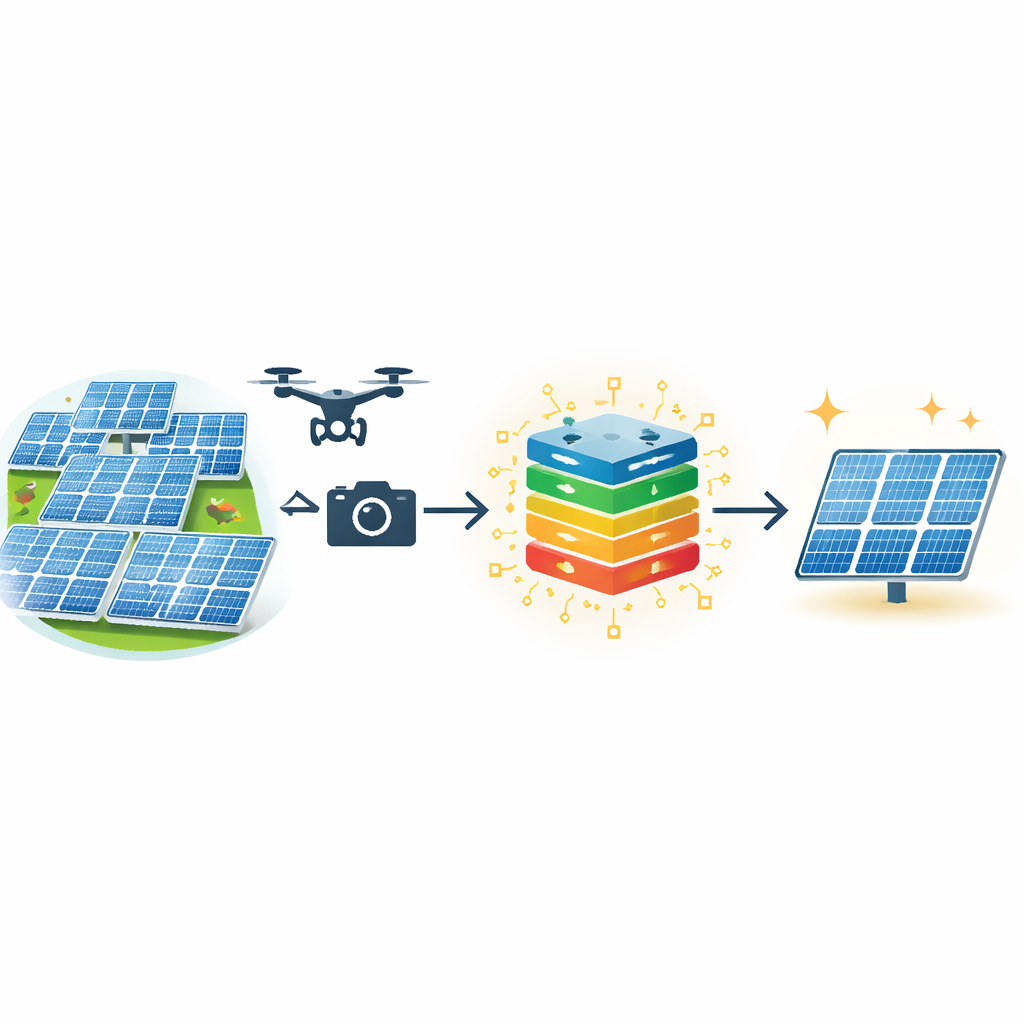
As solar power spreads from rooftop systems to vast utility-scale plants, checking panels by hand has become slow, expensive, and easy to get wrong. Traditional methods often listen to electrical signals from a panel string and look for odd patterns. While these approaches are simple and fast, they struggle to say exactly where a problem sits on a panel or what caused it. In recent years, engineers have turned to cameras—sometimes mounted on drones—to take pictures or thermal images of panels. Deep learning models can then be trained to recognize patterns linked to faults. Yet existing tools still miss many small or low-contrast defects, especially under changing sunlight, shadows, and cluttered backgrounds common in outdoor sites.
How the new detection model sees more in the same image
DHLNet builds on the popular YOLO family of real-time object detectors but rewires key parts so it can better pick out subtle flaws on solar panels. First, the authors redesign how information flows through the middle "neck" of the network. Their Dual-Flow Feature Pyramid Network sends signals both from coarse, high-level layers down to finer layers and from fine layers back up, while also adding cross-links between different scales. This crisscross traffic lets the model keep sharp details—like the outline of a small blob—while still understanding the broader scene, which is crucial when defects are much smaller than the panel tiles that contain them.
Sharper eyes for blurred edges and tricky textures
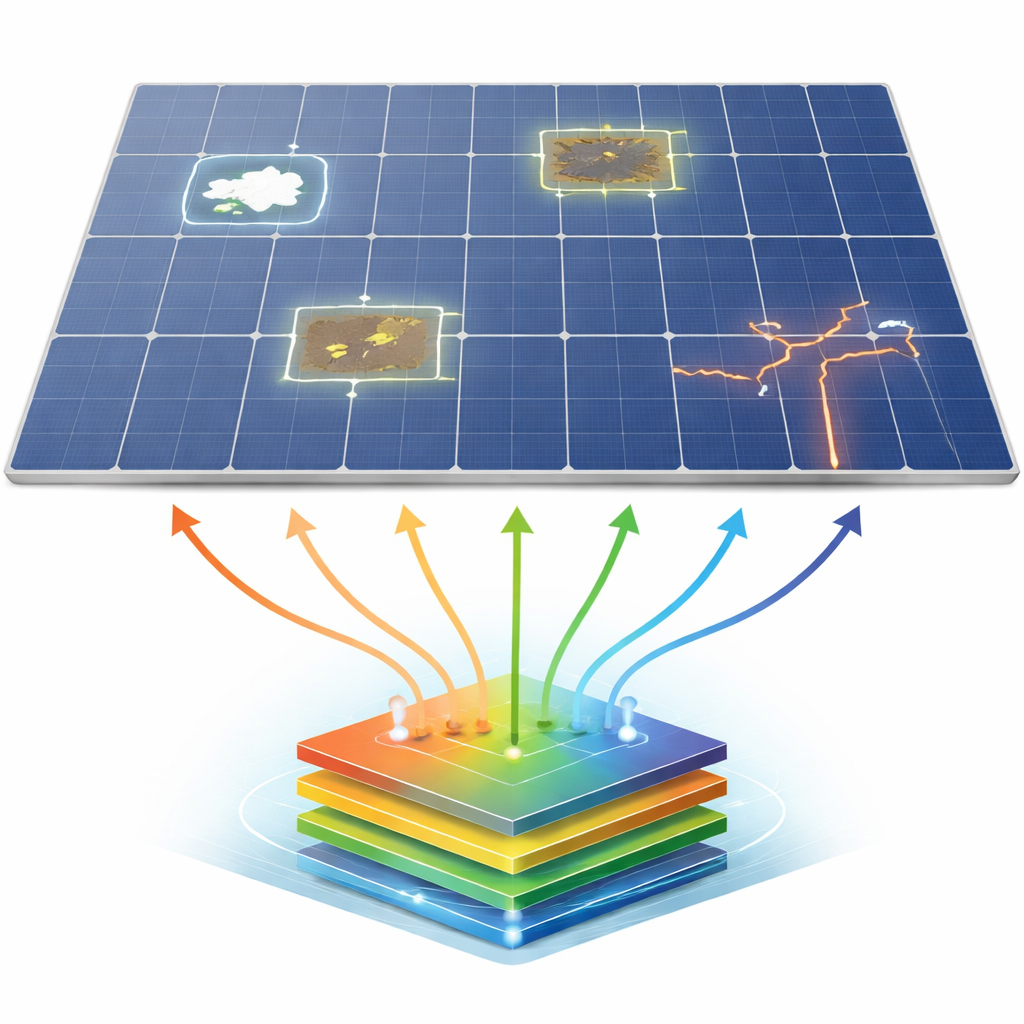
Many foreign objects on panels are hard to distinguish from the background: dust appears as gentle smudges, bird droppings blend into reflections, and snow can soften edges. To handle these cases, DHLNet adds a high-frequency enhancement block that splits features into two streams. One focuses on very local edges and textures, while the other looks at high-frequency patterns across a larger area. These are then recombined with a shortcut connection that preserves the original scene context. On top of that, the network includes a special attention module that uses large, separable filters to gather information from a wide field of view at once. This helps the model notice faint or oddly shaped defects that span several cells, such as cracks or irregular patches, without losing track of fine details.
Putting the model to the test in real conditions
The researchers assembled a diverse image dataset from multiple solar plants and online sources, covering different seasons, lighting conditions, and weather. Each image was resized to a standard format and carefully labeled with the exact location and type of foreign object or defect, including snow, dust, bird droppings, physical damage, and intact panels. They compared DHLNet with a broad set of modern detectors, from classic two-stage models like Faster R-CNN to lightweight one-stage versions of YOLO and Transformer-based designs. DHLNet achieved higher scores in both common accuracy measures and tougher tests that reward precise bounding and correct classification across many overlap thresholds, all while remaining small and fast enough for real-time use on a single high-end GPU.
What this means for future solar power upkeep
To a non-specialist, the key message is simple: DHLNet helps solar operators see more of the small problems that quietly erode performance, without slowing down inspections. By combining sharper edge sensing, smarter attention to context, and better mixing of information across scales, the model improves how reliably foreign objects are spotted on panels, especially when they are tiny, faint, or partially hidden. Because it runs in real time and uses modest computing resources, it can be paired with drones or fixed cameras for continuous monitoring. In the long run, such tools can cut inspection costs, reduce the risk of permanent panel damage, and keep solar farms producing as much clean energy as possible.
Citation: Jin, H., Li, M., Lv, X. et al. Foreign object detection on photovoltaic panels based on DHLNet. Sci Rep 16, 8145 (2026). https://doi.org/10.1038/s41598-026-39074-6
Keywords: solar panel inspection, computer vision, foreign object detection, deep learning, photovoltaic maintenance