Clear Sky Science · en
Ninja optimization algorithm based ultra wideband antenna electromagnetic band gap modeling via a generative adversarial network
Smarter Antennas for a Wireless, Low-Carbon Future
Our homes, cars, factories, and even solar farms are filling up with wireless devices that must talk to each other reliably while wasting as little energy as possible. Ultra-wideband antennas—tiny metal shapes that send and receive very short radio pulses across a broad range of frequencies—are a key part of this puzzle. This paper explores how combining modern artificial intelligence with a nature-inspired "ninja" search strategy can make the design of these antennas faster, cheaper, and more efficient, helping to support next-generation communication and renewable energy systems. 
Why These Antennas Matter
Ultra-wideband antennas are special because they can carry huge amounts of data using very low power, and they can pinpoint locations with high accuracy. They are used in short-range communication, smart sensors, and emerging smart-grid and renewable energy applications, where devices must continuously monitor how much energy is produced, stored, and consumed. To work well in crowded airwaves, many of these antennas are paired with electromagnetic band-gap structures—carefully patterned surfaces that act like filters, blocking unwanted interference from other services such as WiMAX, Wi‑Fi, and radar bands. Designing such antenna–filter combinations is difficult: small changes in shape, material, or pattern can drastically alter how well the antenna radiates, how much power it wastes, and how strongly it rejects interference.
Turning Design Data into a Learning Problem
Instead of relying only on slow trial-and-error simulations, the authors build a rich dataset of 1000 antenna designs that combine ultra-wideband radiators with different band-gap patterns. For each design, they record practical quantities that engineers care about: operating frequency, how much signal is reflected back into the circuit, how wide a range of frequencies the antenna can handle, how strongly it radiates in a given direction, how well it is matched to the electronics, and how efficiently it converts input power into radio waves. They also tag designs by their band-gap type and which interference bands they deliberately "notch out." The central task is to predict antenna efficiency from all these inputs. If this link can be learned accurately, designers can explore new shapes and settings in milliseconds instead of running expensive electromagnetic simulations every time.
Teaching an AI to Imitate Physics
The study tests several deep-learning approaches and settles on a generative adversarial network as the most promising. This kind of model uses two cooperating rivals: one network proposes synthetic examples of antenna behavior, while another tries to tell fake from real. Over time, the generator becomes very good at mimicking the patterns hidden in the data. Here, that adversarial setup helps capture the messy, highly nonlinear relationships between geometric details, material choices, and performance. To keep the model focused on the most informative inputs, the authors introduce a feature-selection step based on a “Binary Ninja Optimization Algorithm,” which searches for the smallest subset of variables that still predicts efficiency well. Compared with nine other bio-inspired selection methods, this ninja-inspired variant removes more redundancy without hurting accuracy, trimming the problem down to a compact set of key descriptors.
Letting Virtual Ninjas Tune the Model
Even a good model can underperform if its internal settings—such as learning rates, layer sizes, and batch sizes—are poorly chosen. Rather than hand-tuning them, the authors unleash the continuous version of their Ninja Optimization Algorithm to explore this setting space. In the metaphor of the paper, each "ninja" is an agent that roams the landscape of possible configurations, sometimes wandering widely to avoid getting stuck, sometimes making small, precise moves around promising regions. Phases of exploration, mutation, and exploitation are carefully alternated so the search neither freezes too early nor wastes time in unproductive regions. When used to tune the generative adversarial network, the ninja strategy delivers extremely low prediction errors and a coefficient of determination (R²) of about 0.99, substantially outperforming other popular optimizers such as particle swarm, bat, whale, and differential evolution algorithms. 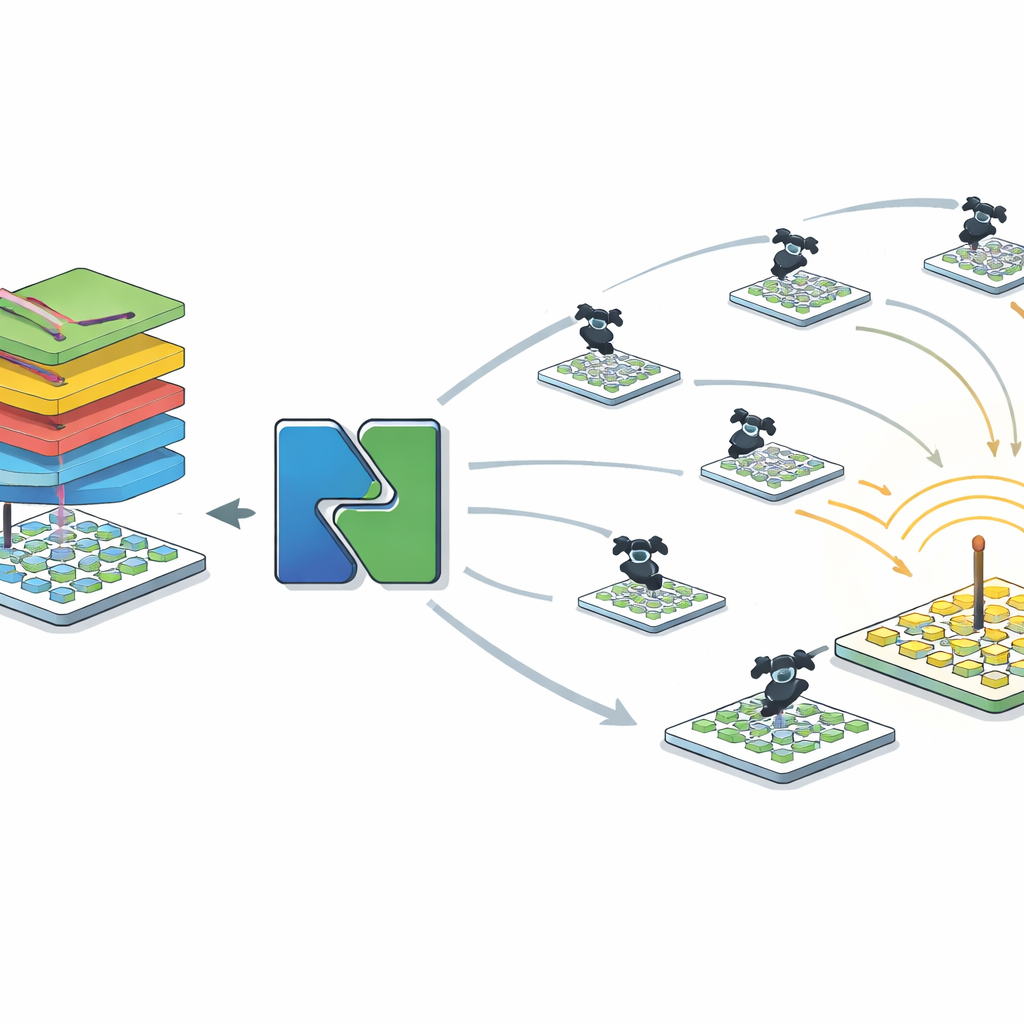
More Accurate, Faster, and Tougher to Disturb
Beyond raw accuracy, the authors test how robust their framework is under more realistic conditions. They deliberately inject noise into the input data and shrink the amount of training data to mimic scarce or imperfect measurements. The ninja-tuned model maintains very small prediction errors even when noise levels and data shortages increase, while competing methods degrade more noticeably. The approach is also computationally frugal: among all optimization–AI combinations tested, the ninja‑guided model reaches its high accuracy with the lowest average run time and moderate memory and processor use. This combination of precision, speed, and robustness suggests that the method can serve as a practical design assistant rather than a laboratory curiosity.
What This Means for Everyday Technology
In plain terms, this work shows how an intelligent, search-based learning system can take over much of the heavy lifting in ultra-wideband antenna design. Instead of spending days running full electromagnetic simulations for each new idea, engineers can use the trained model to rapidly screen thousands of possibilities and focus only on the most promising ones. That can lead to antennas that radiate more efficiently, shrug off interference more gracefully, and better fit into compact, low-power devices used in smart homes, wearable gadgets, electric vehicles, and renewable energy installations. By marrying generative AI with a nimble optimization scheme, the study points toward a future in which wireless hardware is co-designed with data-driven tools that are as agile and precise as the digital systems they support.
Citation: Alhussan, A.A., Khafaga, D.S., El-kenawy, ES.M. et al. Ninja optimization algorithm based ultra wideband antenna electromagnetic band gap modeling via a generative adversarial network. Sci Rep 16, 7908 (2026). https://doi.org/10.1038/s41598-026-39068-4
Keywords: ultra wideband antennas, electromagnetic band gap structures, machine learning optimization, generative adversarial networks, wireless energy systems