Clear Sky Science · en
Foliar 15N-urea absorption and translocation in wheat with contrasting senescence patterns at late growth stage
Why greener wheat matters for our food
Wheat plants don’t all age the same way. Some stay green for longer while others yellow and wither sooner. That difference in “stay‑green” behavior can quietly shape how much grain we harvest and how much protein ends up in our bread. This study follows nitrogen—the key nutrient behind leaf color and grain protein—through two types of wheat that age at different speeds, revealing how timing of nitrogen uptake and leaf life span combine to influence both yield and grain quality.
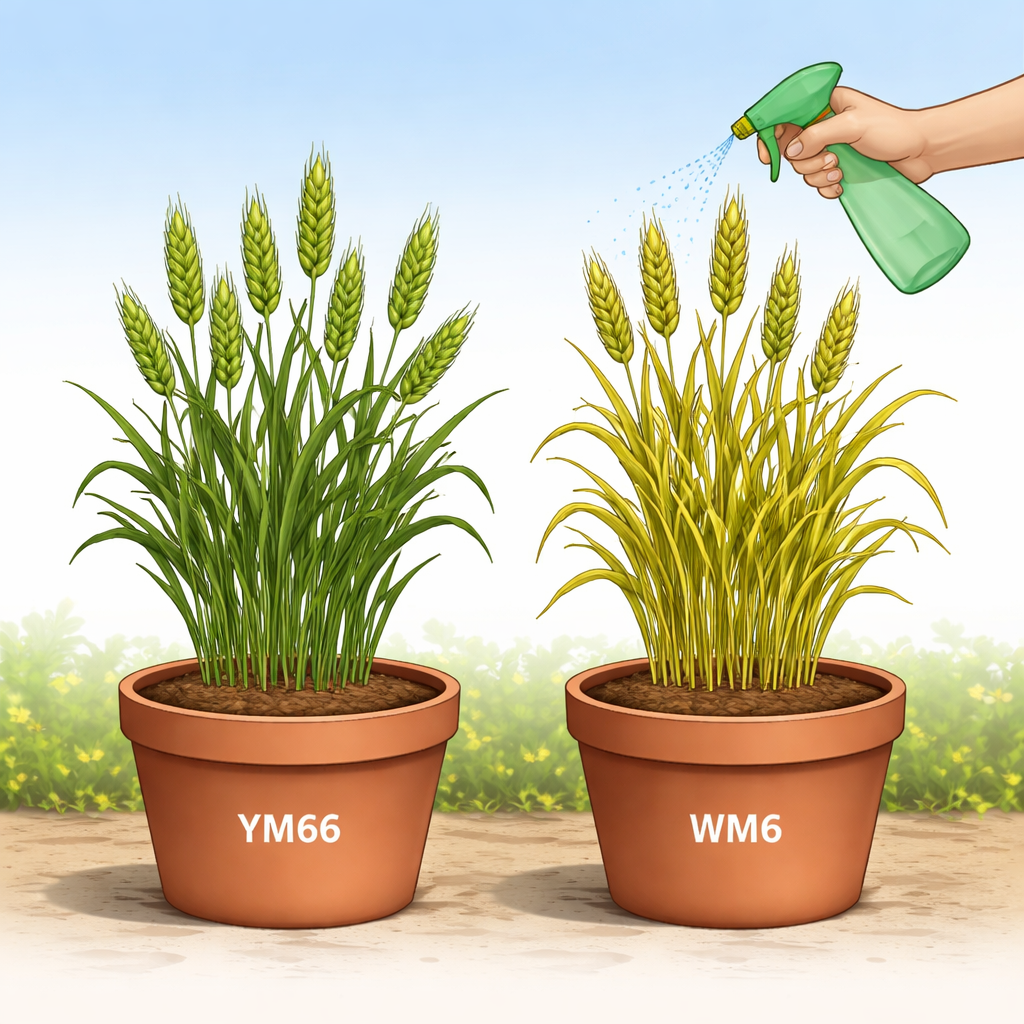
Two kinds of wheat growing side by side
The researchers compared a stay‑green wheat variety called YM66 with an early‑senescent variety named WM6. In stay‑green plants, the top leaves and stems remain green even when the grains are nearly mature, supporting photosynthesis and grain filling for longer. In carefully controlled pots, both wheats were grown under the same soil, water, and fertilizer conditions so that the only major difference was how quickly their leaves aged. Throughout the late growth period, the team measured how much green leaf area remained, how much chlorophyll (the green pigment) the leaves carried, and how much nitrogen was present in leaves, stems, and grain.
Painting nitrogen onto leaves to track its journey
Rather than fertilizing the soil, the scientists “painted” a special nitrogen fertilizer onto the flag leaf—the top leaf that plays a central role in feeding the developing grain. They used urea enriched with the rare isotope 15N, which acts like a chemical tracking tag. This foliar feeding was done either a few days before flowering or about ten days afterward. By following where the 15N appeared over time in leaves, stems, and grains, they could see when and how each plant type absorbed nitrogen, where it was temporarily stored, and how much ended up in the harvested kernels.
Greener plants took up more nitrogen for longer
YM66, the stay‑green wheat, kept more green leaf area and higher chlorophyll levels during grain filling than WM6. That visual difference reflected a deeper one: YM66 absorbed more total nitrogen and kept doing so for a longer period after flowering. While WM6 added only a modest amount of nitrogen after flowering, YM66 continued to build its nitrogen reserves for nearly three weeks. In both wheats, nitrogen already stored in leaves and stems before flowering was gradually moved into the grain. But YM66 held higher nitrogen levels in its stems and leaves for longer, acting as a stronger reservoir that could feed the grain steadily.
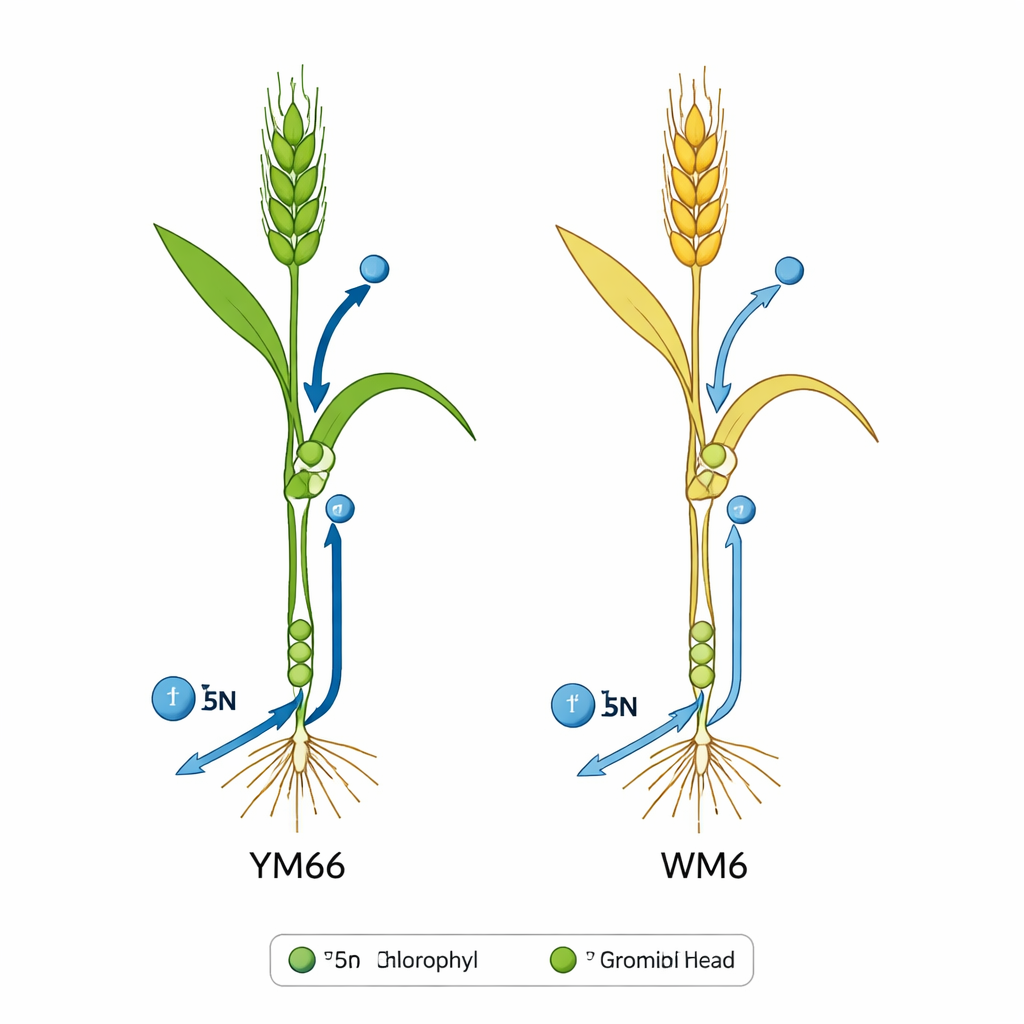
Most grain nitrogen came early—but was moved with different skill
The isotope tracing showed that, in both wheat types, most of the nitrogen found in mature grain originally came from what the plants had absorbed before flowering. Over half of the 15N applied before flowering was later recovered in the grain, compared with about forty to just under fifty percent of 15N applied after flowering. However, YM66 proved better at both absorbing labeled nitrogen through its leaves and remobilizing it to the kernels. Before flowering, more of the tagged nitrogen in YM66 shifted from leaves into the stems and then into the grain, while WM6 left a larger share behind in vegetative tissues. After flowering, YM66 again moved a bigger fraction of newly absorbed nitrogen into grain, whereas WM6 tended to hold onto it in the leaves, especially as those leaves aged and lost vigor.
Greener leaves, stronger crops, and better use of fertilizer
These differences in nitrogen handling had tangible payoffs. YM66 produced more kernels per head, heavier grains, greater total plant mass, and a higher share of biomass in the grain than WM6. The study suggests that stay‑green wheat uses nitrogen more efficiently by combining strong early uptake, sustained leaf function, and effective transfer of stored nitrogen into developing grains. For farmers and breeders, this means that varieties whose leaves stay green longer—and that can skillfully move nitrogen from leaves and stems into the grain—may deliver higher yields and better grain protein from the same amount of fertilizer. Understanding and improving this hidden nitrogen economy could help produce more nutritious wheat while reducing wasted fertilizer in the field.
Citation: Gong, YH., Zhu, YM., Li, T. et al. Foliar 15N-urea absorption and translocation in wheat with contrasting senescence patterns at late growth stage. Sci Rep 16, 7174 (2026). https://doi.org/10.1038/s41598-026-39067-5
Keywords: wheat, nitrogen use efficiency, stay-green, foliar fertilization, grain protein