Clear Sky Science · en
Influence of impeller configuration and operating parameters on granular mixing: a DEM investigation
Why mixing grains matters
From breakfast cereal to pills and building materials, many everyday products start as mixtures of dry grains or powders. Getting those grains to mix evenly is surprisingly hard: some clump, some separate, and some break. This study looks inside one common type of industrial mixer to ask a practical question with big economic impact: how should we shape and run the rotating blades so that solid particles mix quickly, gently, and efficiently?
How a vertical grain mixer works
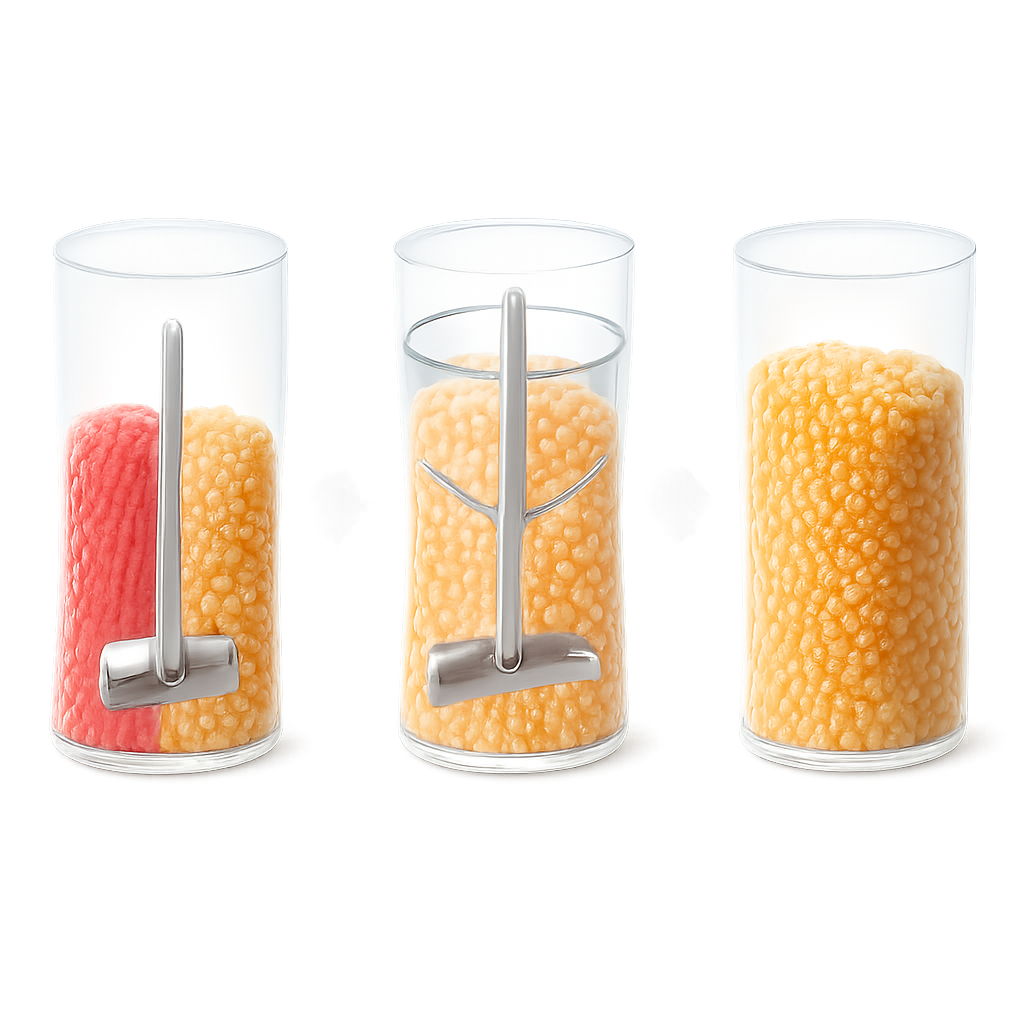
The mixer explored here is a tall, clear cylinder with a rotating shaft at its center and metal blades near the bottom that sweep through thousands of glass beads. As the shaft turns, these blades scoop particles up, push others down, and send them swirling around the vessel. The authors combined laboratory tests with detailed computer simulations that track every single bead. This approach, called the Discrete Element Method, follows how particles collide, bounce, and rub against each other and the walls, revealing motion that is almost impossible to measure directly in a real machine.
Testing blade shapes and operating conditions
The team focused on three knobs an engineer can tune: the number of blades (two or three), the tilt of those blades (the “rake angle”), and how fast and how full the mixer is run. They built mixers with interchangeable blades that could lean forward, backward, or stand upright, and tested speeds from slow rotation to relatively rapid spinning. In the simulations, they quantified how well the two colors of glass beads mixed using a standard “mixing index,” and also tracked measures linked to particle activity: how jostled the grains are (granular temperature), how quickly they spread (diffusion), how fast they circulate around the tank, and how much empty space exists between them (void percentage).
What blade tilt does to the grains
The shape and tilt of the blades turned out to strongly steer particle motion. When the blades were tilted so that their effective angle was 90 degrees or more, mixing became faster and more thorough: the mixing index, granular temperature, and diffusion all rose. Particles moved more randomly and spread through the vessel more easily, though their average speed around the tank dropped. Two-bladed designs worked best with strongly tilted blades (around the equivalent of 135 to 150 degrees), while three-bladed designs reached their sweet spot at somewhat smaller tilts (about 120 to 135 degrees). Steeper angles also created more empty space within the bed, as particles were lifted and loosened rather than compressed. Overall, the study shows that blade tilt mainly changes how quickly a uniform mixture is reached, rather than the final degree of uniformity itself.
Speed, filling level, and particle liveliness
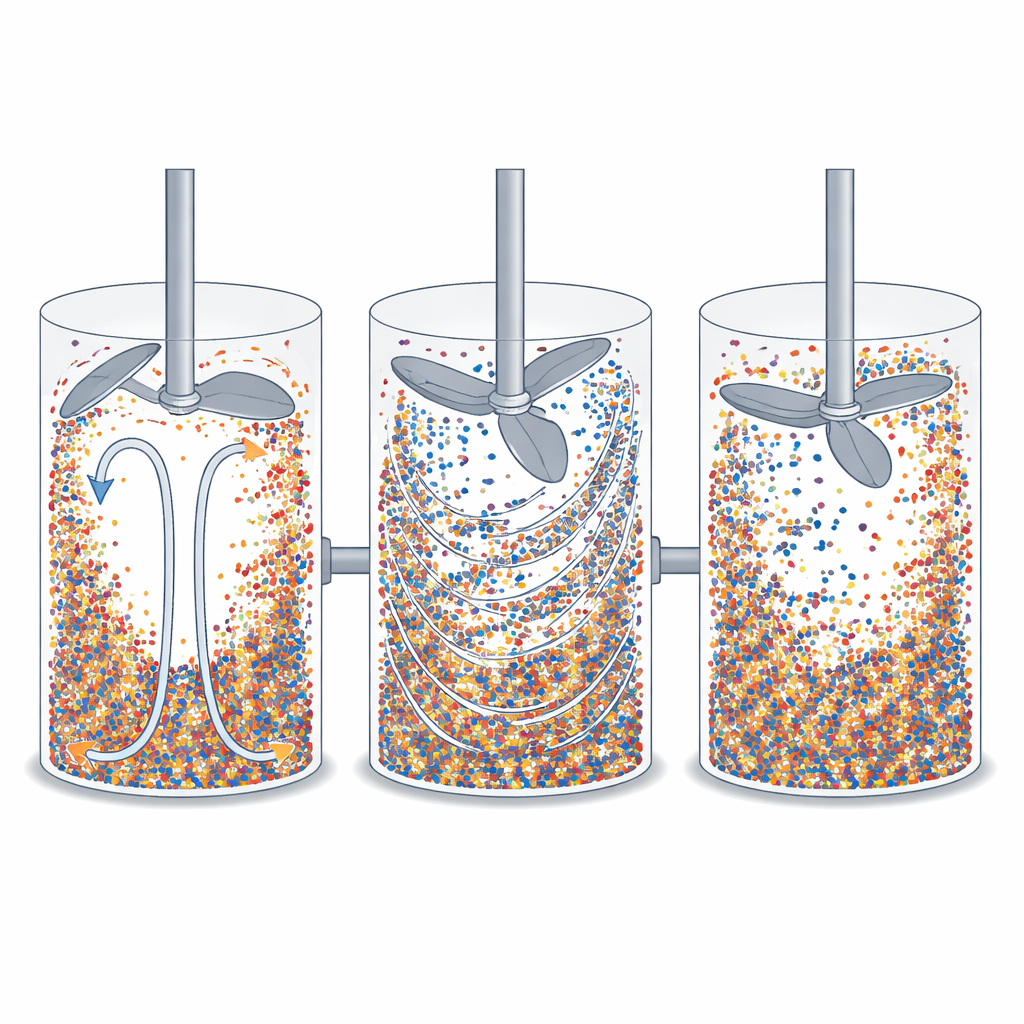
How hard the mixer is driven matters as much as the blade shape. At low to moderate speeds, turning faster makes grains more energetic: collisions intensify, granular temperature and diffusion increase, and particles circulate more rapidly. This helps them blend. But beyond about 100 turns per minute in the studied geometry, centrifugal forces start to dominate. Grains are flung outward, leaving a low-density core and large voids that actually reduce useful collisions and hurt mixing quality. Filling level shows similar trade-offs. With three blades, having the grain height above the blade height (a fill ratio greater than one) improves mixing, even though individual grains move less vigorously overall. Denser beds constrain motion in the middle but maintain good circulation near the walls, which appears to be enough to homogenize the mixture.
Design tips for better industrial mixing
By tying visual experiments to particle-level simulations, the authors offer concrete guidance that plant engineers can apply. For the mixers and particle types examined, they recommend using three-bladed impellers when the vessel is filled above blade height and turning them below 100 revolutions per minute, while two-bladed impellers perform better at lower fill levels. Adjusting blade tilt beyond 90 degrees can speed up the path to a uniform product, and measures like granular temperature and diffusion can serve as early indicators of how well a system will mix before full experiments are run. In simple terms, the work shows that a careful balance of blade shape, speed, and fill can turn what looks like chaotic grain motion into a controllable, efficient process.
Citation: Zhou, Z.H., Zhang, Q., Liu, Y. et al. Influence of impeller configuration and operating parameters on granular mixing: a DEM investigation. Sci Rep 16, 9701 (2026). https://doi.org/10.1038/s41598-026-39060-y
Keywords: granular mixing, industrial mixers, powder processing, impeller design, discrete element method