Clear Sky Science · en
A comprehensive evaluation framework for consumer-grade EEG devices: signal quality, robustness, and usability
Why everyday brain gadgets matter
Headsets that listen to our brain waves have escaped the hospital and entered homes, classrooms, and game consoles. These consumer electroencephalogram (EEG) devices promise meditation coaching, attention tracking, and even mind-controlled toys. But a basic question remains: how trustworthy are the signals they record compared with professional laboratory gear? This study takes a systematic look, putting four popular consumer headsets to the test against a respected research-grade EEG system to see how well they capture brain activity and how easy they are to live with.
A simple three-step checkup for brain headsets
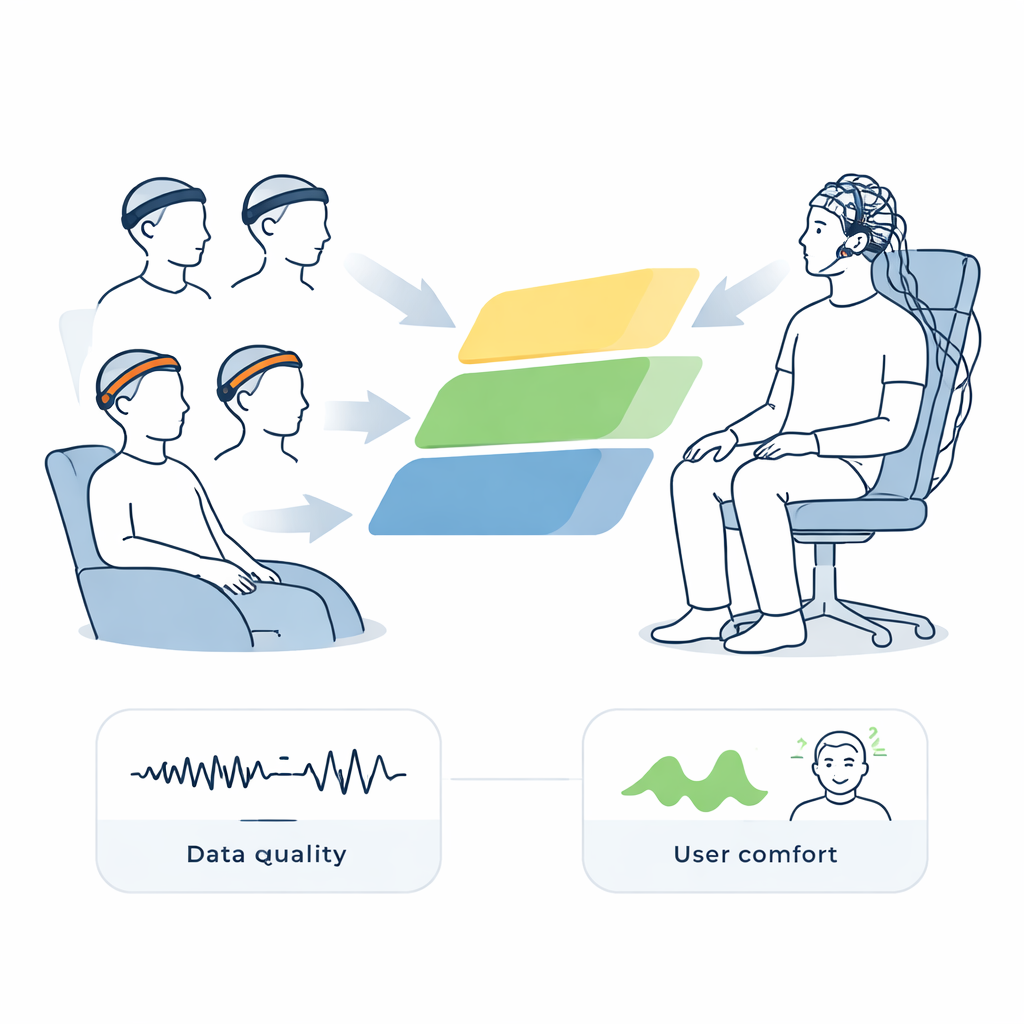
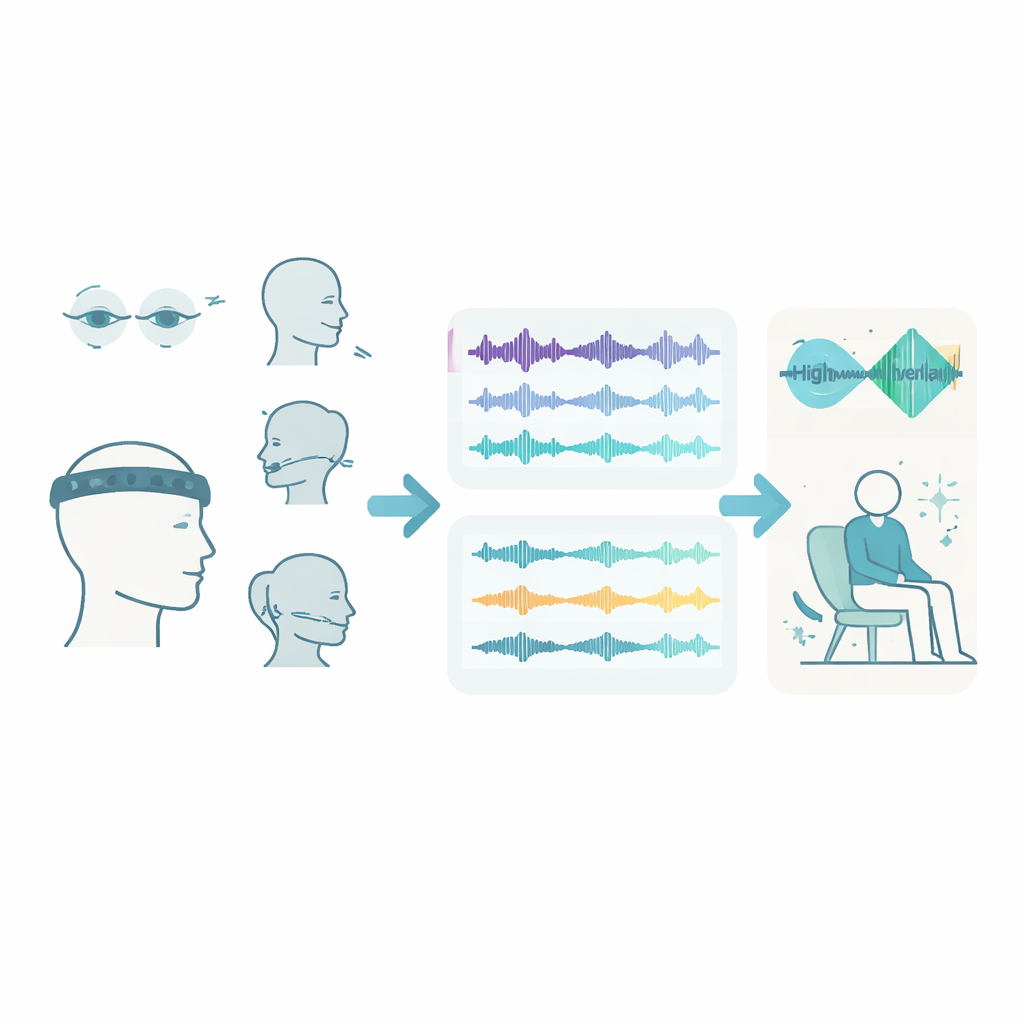
The researchers designed a clear, three-level framework for judging EEG quality that can be applied to any device. First, they asked whether the headset can at least pick up large electrical changes on the scalp, like those caused by eye blinks or clenching the jaw. Second, they checked whether true brain rhythms show up in the signal, focusing on a well-known pattern called the alpha rhythm, which typically grows stronger when we close our eyes and relax. Third, they tested how well each device holds up when the wearer moves, because real life is full of head turns and fidgeting that can bury brain signals in noise. Together, these steps move from basic “is anything there?” to “is it really the brain?” and finally “does it still work in the messy real world?”
Putting five headsets through real-world tasks
To apply this framework, 30 young adult volunteers wore five different dry-electrode headsets in separate sessions: four consumer devices with one to four sensors on the forehead and sides of the head, and one research-grade cap with 21 sensors. In each session, participants completed a set of simple tasks. For the first level, they repeatedly blinked and gently clenched their jaws while their brain waves were recorded. For the second level, they simply rested with eyes open and then with eyes closed, so the team could look for the expected rise in alpha waves and pinpoint each person’s strongest alpha frequency. For the third level, participants slowly turned their heads side to side during a task block, with relaxed rest periods before and after, allowing the researchers to see how much the overall “shape” of the brain signal spectrum changed because of movement.
What the signals reveal about brain activity
The consumer devices performed surprisingly well on the core brain measures. All five headsets reliably registered the large spikes caused by blinks and jaw clenches, showing that they could sense big changes in scalp voltage. More importantly, every device showed the classic boost in alpha power when eyes were closed compared with open, confirming that genuine brain rhythms were being captured. The strongest alpha frequency for each person matched closely between the research cap and the simpler consumer headsets, with only tiny differences of a fraction of a cycle per second. When it came to movement, most devices showed very similar patterns before and after people turned their heads, suggesting good robustness, although one consumer headset proved more sensitive to noise and to differences in head shape.
Comfort and convenience in everyday use
Signal quality is only part of the story; a device that is precise but miserable to wear may never leave the lab. To capture this human side, the team asked participants to rate each headset on comfort, ease of use, design, and willingness to wear it again. Here, the bulky research cap clearly lagged behind. Volunteers reported it as the hardest to put on, the least comfortable, and the most difficult to tolerate for long sessions. By contrast, the streamlined consumer headsets scored well, with one single-sensor band in particular earning the highest marks for comfort and overall preference, even though its limited number of sensors restricts how much detailed information it can provide about different brain regions.
What this means for everyday brain tech
For people curious about brain-sensing gadgets, these findings are encouraging. Within the limits of their simpler designs, consumer EEG headsets can detect key brain rhythms and basic signal changes at a level that broadly resembles a professional research device, while being far more pleasant to wear. The authors stress that careful validation is still essential for each new headset and application, especially for demanding brain–computer interface tasks. But their three-level framework offers a practical roadmap for checking whether a device picks up meaningful brain activity and withstands the bumps of real-world use. In short, with the right testing, lightweight brain headsets can move beyond novelty and become reliable tools for everyday mental health, learning, and interaction.
Citation: Lee, Y., Gwon, D., Kim, K. et al. A comprehensive evaluation framework for consumer-grade EEG devices: signal quality, robustness, and usability. Sci Rep 16, 8408 (2026). https://doi.org/10.1038/s41598-026-39056-8
Keywords: consumer EEG, brain–computer interface, wearable brain sensing, signal quality, usability