Clear Sky Science · en
The Bat Ripple case study shows ecological and economic contributions of grey headed flying foxes in Australia
Why these night flyers matter to us
Most of us think of bats, if at all, as spooky silhouettes against the night sky. But in Australia, large fruit bats called flying foxes quietly keep forests growing and an important slice of the timber industry running. This study introduces the idea of the “Bat Ripple” to show how the nightly movements of these animals spread out across the continent, helping new trees take root and adding hundreds of millions of dollars’ worth of value to the economy each year.
A wave that spreads from bat camps
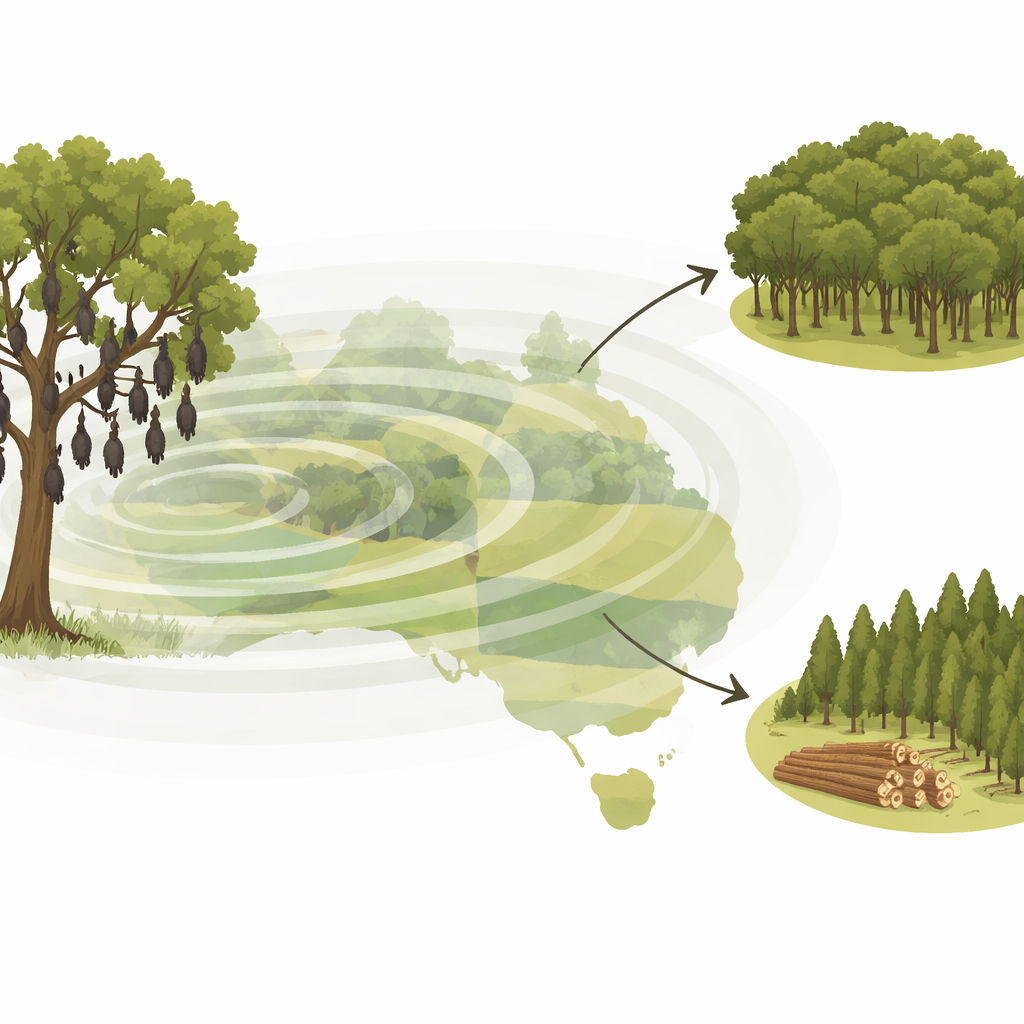
Flying foxes roost together in large daytime camps, then fan out after dark to feed on nectar, pollen, and fruit. Because they can travel tens of kilometres in a single night, their influence is anything but local. By combining a decade of national monitoring data from more than 1,200 known bat camps with information on how far each species typically flies, the authors mapped a vast service area around these roosts. They call this area the Bat Ripple: the zone where bats are likely to pollinate trees and drop seeds as they commute and feed. Across Australia, this ripple covers between 11.6 and 41.4 million hectares—an expanse comparable to a large European country and including native forests, plantations, and land being restored.
Counting the trees bats help to grow
To move from maps to living forests, the researchers focused on one species, the grey-headed flying fox, which lives along eastern Australia and is already considered vulnerable. Using estimates of the total bat population, the number of nights they are active each year, and how often feeding leads to successful seedlings, the team built a computer model of tree recruitment. Even under cautious assumptions, they found that these bats likely help establish around 13.9 million new trees each year within their typical nightly foraging area, and more than 90 million new trees across their widest likely range. In harsher “what if” scenarios, the numbers fall, but still stay in the tens of millions of trees annually, underlining how strongly forests lean on these night-time gardeners.
Putting a dollar value on pollen
The authors then asked what this quiet work might be worth in economic terms. Focusing on eucalypt plantations and native production forests that overlap with bat foraging zones, they estimated how much of timber growth depends on animal pollination, and how strongly flying foxes contribute compared with other creatures. Running thousands of simulations to reflect uncertainty, they concluded that grey-headed flying fox pollination alone likely adds a median of about 611 million Australian dollars to the timber sector each year, with a plausible range between 271 and 955 million. These figures do not attempt to capture all benefits, such as carbon storage or tourism, meaning that the full economic value is almost certainly higher.
Risks of losing the ripple
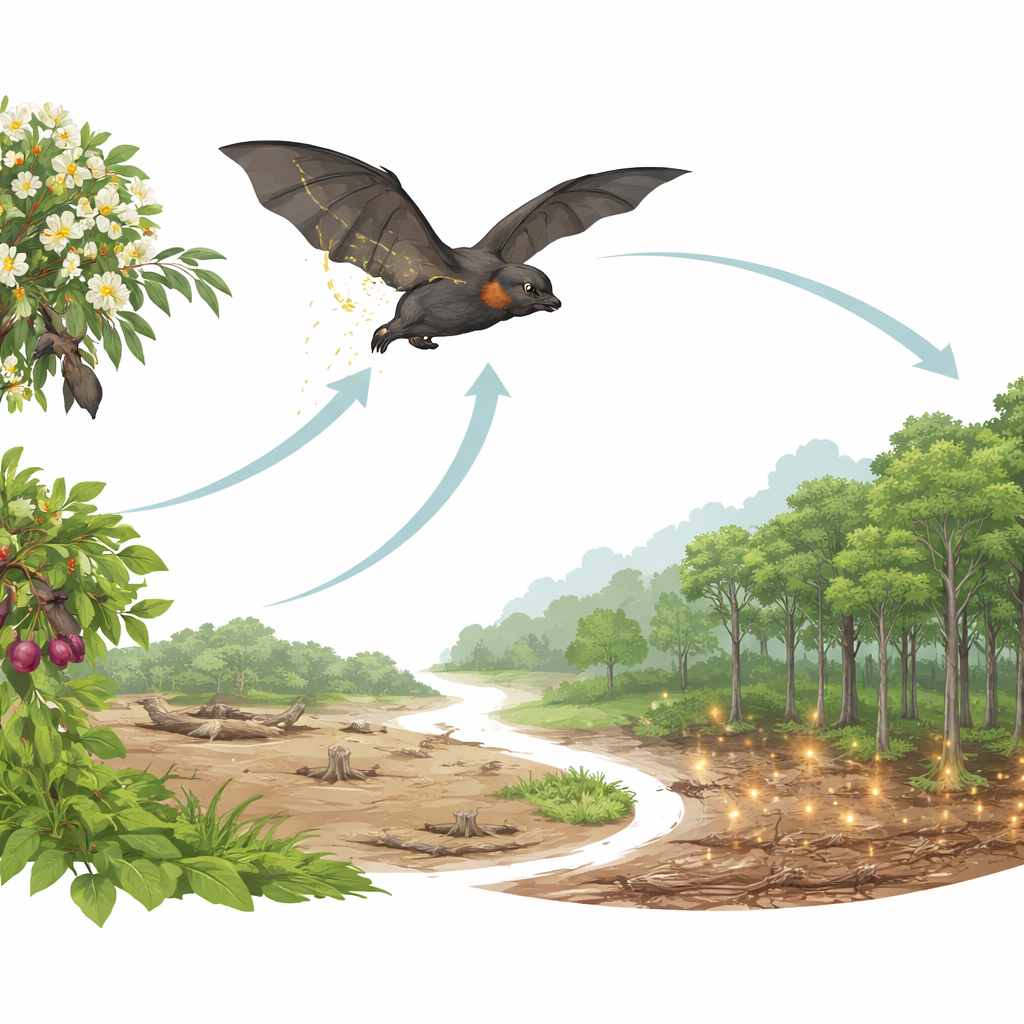
Despite their importance, flying fox populations in Australia face growing threats. Heatwaves linked to climate change have already killed many thousands of bats, and habitat loss continues to squeeze both their feeding grounds and roost sites. The study’s models show that if bat numbers fall, forests may still produce wood for a time, but the quality and reach of pollination decline first. That means fewer seeds carried far from parent trees, weaker gene flow across fragmented landscapes, and slower natural regeneration—especially important as the country seeks to restore forests and lock away more carbon.
What this means for people and forests
In simple terms, the study reveals that flying foxes are not just background wildlife; they are major partners in keeping Australian forests—and the industries that rely on them—healthy and productive. Their nightly flights send out a ripple of seeds and pollen that helps stitch together fragmented habitats, supports future timber harvests, and boosts the land’s capacity to store carbon. Protecting these bats, the authors argue, is less a luxury of conservation and more a form of long-term insurance for both ecosystems and the economy.
Citation: Ortega González, A., Possingham, H., Biggs, D. et al. The Bat Ripple case study shows ecological and economic contributions of grey headed flying foxes in Australia. Sci Rep 16, 8976 (2026). https://doi.org/10.1038/s41598-026-39042-0
Keywords: flying foxes, pollination, forest regeneration, ecosystem services, timber industry