Clear Sky Science · en
Plasma screening in mid-charged ions observed by K-shell line emission
Why tiny shifts in X-ray color matter
When matter is squeezed and heated to extreme conditions—like inside giant planets, fusion experiments, or stellar interiors—its atoms no longer behave as they do in everyday solids. This study shows how scientists can “listen in” on those changes by measuring almost imperceptible shifts in the color of X-ray light emitted by copper. By comparing these shifts to long-standing theories, the work reveals that a key piece of plasma physics—how surrounding charged particles screen, or soften, atomic electric fields—has been systematically underestimated.
The hidden influence of crowded electrons
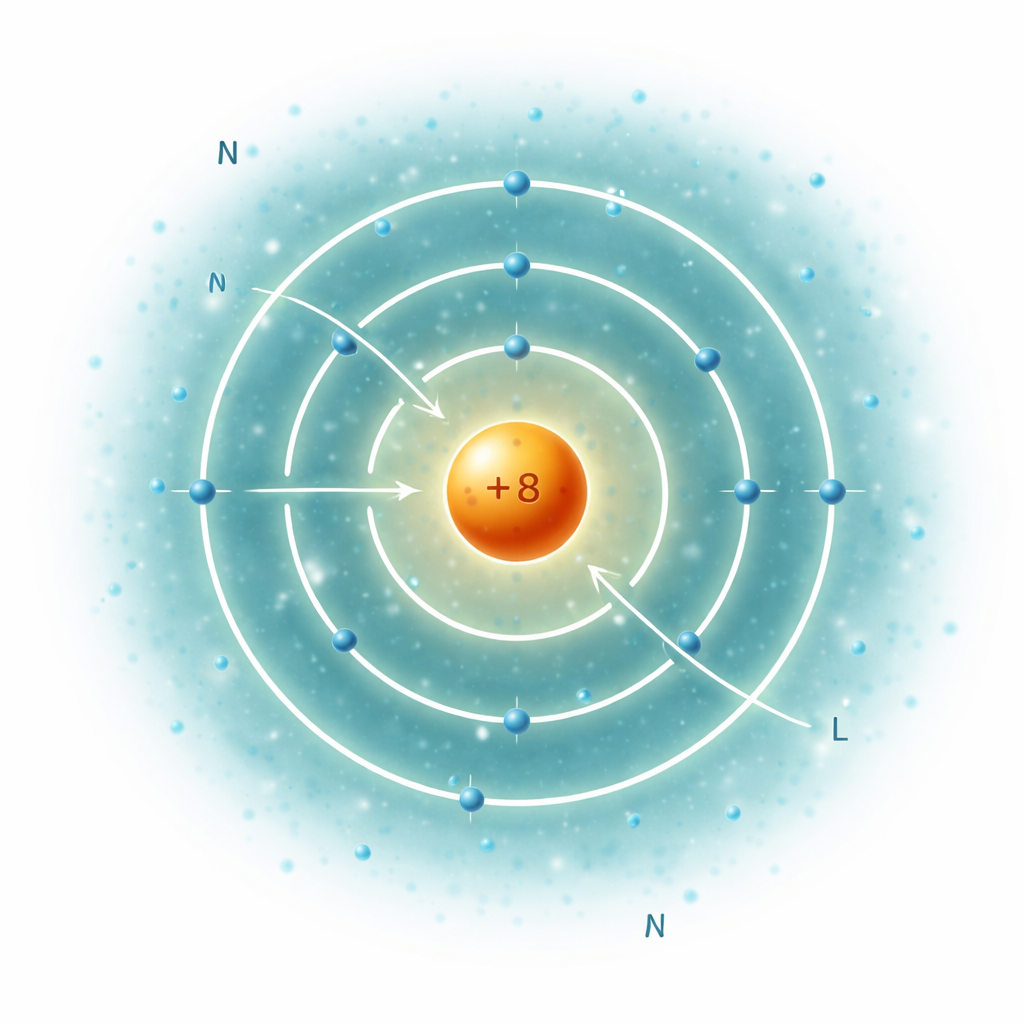
In a normal atom, electrons occupy defined shells around the nucleus, and jumps between these shells produce X-ray lines with very precise energies. In a dense plasma, however, many free electrons crowd around partially stripped ions. Their electric fields partially screen the nuclear charge, subtly changing the energies of the shells and therefore the color of the emitted X-rays. For decades, these “plasma screening” effects and related concepts such as ionization potential depression and continuum lowering have mostly been described by simplified models developed in the 1960s. While newer, more rigorous simulations exist, they are computationally demanding and had not been thoroughly tested for complex, mid‑atomic‑number elements like copper.
Using an X-ray laser as an atomic stethoscope
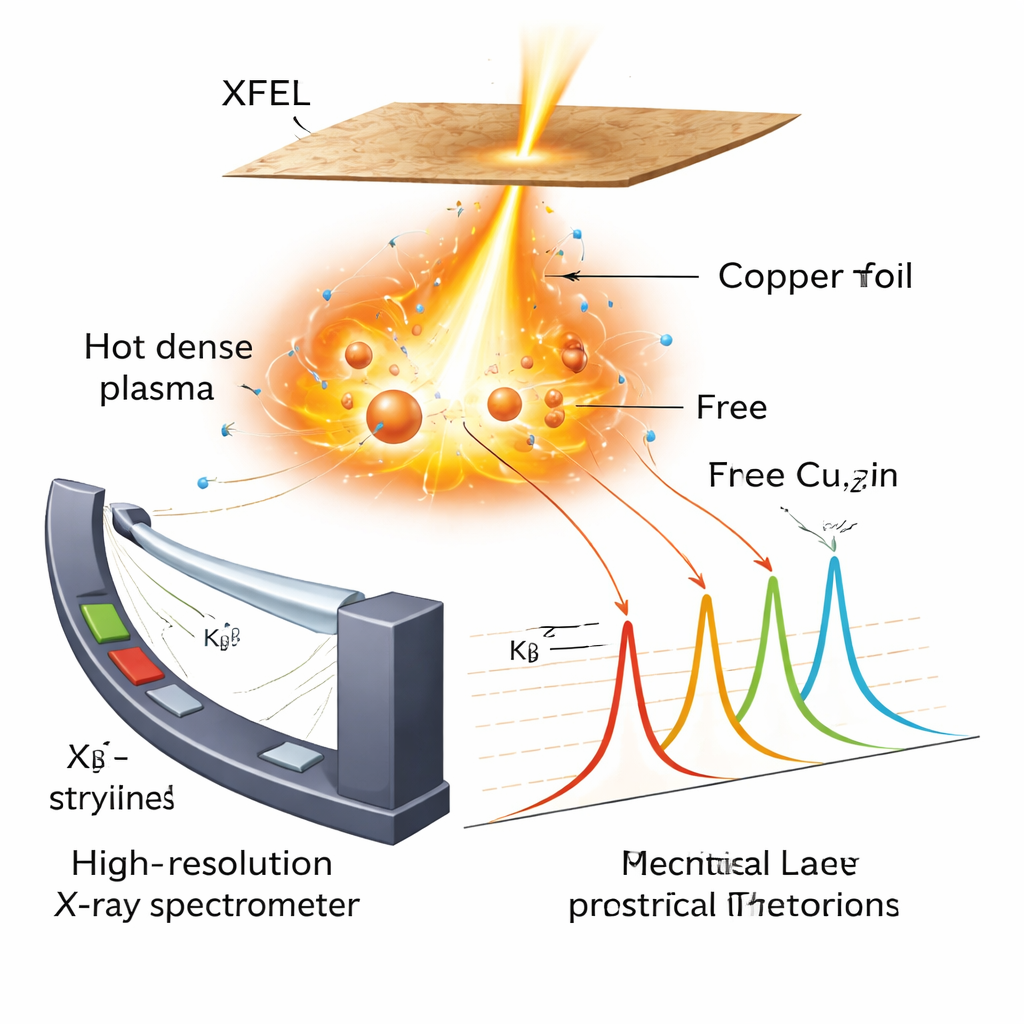
The authors used the European XFEL, an X-ray free electron laser, to fire extremely intense, ultrashort pulses at thin copper foils. These pulses, focused to a spot smaller than a micrometer and tuned above the copper K-shell threshold, heat the target almost instantaneously, creating a hot, dense plasma of copper ions and free electrons. As the ions are excited and ionized, they emit a rich pattern of X-ray lines—most notably the Kα, Kβ, and Kγ lines that originate from electrons falling into the innermost shell. By carefully varying the XFEL photon energy, the team could selectively drive resonant excitation pathways in ions with specific numbers of electrons in their inner shells, effectively tagging which charge states produced which lines.
Decoding a forest of X-ray lines
To interpret this complex emission, the researchers relied on the Flexible Atomic Code, which can calculate millions of possible electronic transitions for copper ions. They first computed line energies for isolated ions in vacuum, then repeated the calculations with a built‑in plasma screening model (the Stewart–Pyatt model) for a range of temperatures and solid‑like densities. By matching measured absorption–emission pairs to the calculated transitions, they could assign each observed line to ions with well-defined occupancies of the K, L, and M shells. The difference between measured and isolated-atom energies directly quantifies the strength of plasma screening. They also examined how the apparent position of the copper K absorption edge and the line shifts changed with plasma heating, using both simulations and X-ray Thomson scattering to estimate the electron temperature.
Old models fall short in extreme plasmas
The measurements reveal that the screening—and related lowering of energy levels—increases with ion charge state, as expected, but is consistently stronger than predicted by the Stewart–Pyatt model at realistic temperatures around 100 eV. The model only matches the data if one assumes much lower temperatures than other diagnostics and simulations indicate, implying that it systematically underestimates screening in this regime. The same conclusion emerges whether the team looks at individual Kα, Kβ, and Kγ lines, their hollow-ion counterparts, or the K-edge position. By tracking how line shifts grow as the XFEL energy density increases, the researchers also extract an empirical relation between Stark shifts and plasma temperature, which broadly agrees in shape—but not in magnitude—with the traditional model.
What this means for understanding extreme matter
For non-specialists, the key message is that the fine structure of X-ray spectra provides a powerful reality check on how we think atoms behave under extreme pressures and temperatures. This work extends earlier tests—mostly done on lighter elements—to more complex, mid‑charged ions and shows that widely used formulas underestimate how strongly a dense plasma environment reshapes atomic energy levels. By offering a detailed, experimentally anchored map of X-ray lines from copper in warm dense matter, the study supplies a benchmark for developing more accurate atomic models. Those improved models will be essential for interpreting data from fusion experiments, planetary interiors, and high‑energy-density physics more generally, where the behavior of electrons around ions controls how matter absorbs, emits, and transports energy.
Citation: Šmíd, M., Humphries, O.S., Baehtz, C. et al. Plasma screening in mid-charged ions observed by K-shell line emission. Sci Rep 16, 5873 (2026). https://doi.org/10.1038/s41598-026-39041-1
Keywords: plasma screening, warm dense matter, x-ray spectroscopy, x-ray free electron laser, ionization potential depression